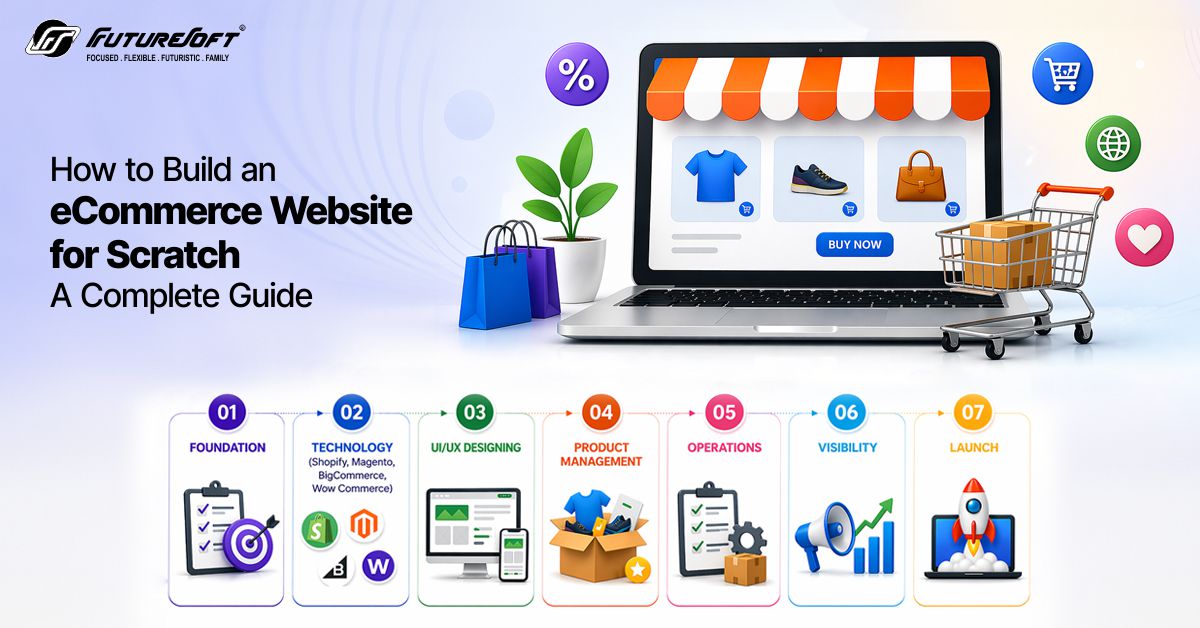
Thinking about starting your own online store, but not sure where to begin? You are not alone. Building an eCommerce website can feel overwhelming with so many tools, technologies, and strategies to choose from.
This guide simplifies the journey. It shows you how to turn your idea into a full-fledged, functional, and high-performing online store that not only looks great but also converts visitors into customers.
We have explained everything, from choosing the right setup to creating engaging shopping experiences and streamlining payments.
Whether you are a beginner or looking to upgrade your current store, this eCommerce development guide will help you confidently step into the world of online store development and build a business that’s ready to grow.
The eCommerce landscape in 2026 has evolved into a sophisticated ecosystem driven by AI-powered eCommerce, composable architectures, and immersive user experiences. If you are searching for an eCommerce development guide that goes beyond basic tutorials, you are in the right place.
Today, building an online store is no longer just about listing products; it’s about creating a living system that adapts, learns, and sells autonomously.
Modern online store development now integrates AI agents, predictive analytics, and hyper-personalized journeys. Businesses are shifting from static storefronts to dynamic ecosystems where human users and AI agents interact seamlessly.
This guide will walk you through how to build an e-commerce website from scratch. It also covers strategy, technology, UX, operations, and future-ready innovations. This roadmap will help you master the eCommerce website development process and understand what is eCommerce website development.
Learn about the best SEO tools to analyze your website performance.
a. Identifying Your Market
In this phase, you need to set the strategic backbone of your entire store. Before you invest in tools or design, you need absolute clarity on who you are selling to, how you will sell, and what makes your brand different.
Many failures in online store development happen not because of poor technology, but because the foundation is weak. A well-defined foundation ensures that every step in your eCommerce website development process is aligned with revenue goals, customer expectations, and scalability.
a. Identify Your Market
Start with understanding demand, not assumptions.
Key actions:
Expert Tip: Don’t forget “everyone.” Narrow positioning improves conversions and reduces marketing costs significantly.
b. Choosing the Right Business Model
Your business model defines how value flows between you and your customers. Selecting the right one is critical for long-term success.
Core eCommerce Business Models
Expert Tip: B2B models require strong backend systems (bulk pricing, custom catalog), while B2C focuses more on UX and branding.
Understand the difference between native and hybrid apps.
c. Selecting Your Shipping and Fulfillment Model
How you deliver products is just as important as what you sell. Your logistics model directly impacts margins, scalability, and customer satisfaction.
Popular eCommerce Fulfilment Models
Expert Tip: If you’re just starting, dropshipping reduces risk. For long-term brand building, D2C or private label offers better control and profitability.
d. Secure Your Digital Real Estate
Your domain and infrastructure are long-term assets.
What to secure:
These steps ensure brand ownership and protect your identity as your eCommerce platform development grows.
e. Brand Identity
Your brand is what customers remember, not just what they buy.
Key elements:
Strong branding directly impacts trust, which is critical in AI-powered eCommerce when users rely on quick decisions.
At this stage, you should have:
This foundation doesn’t just guide your strategy; it determines how effectively you can execute the rest of your eCommerce website design and development journey.
Understand the mobile application development process.
This phase is where your business vision turns into a functional system. The technology you choose will directly impact your store’s performance, scalability, flexibility, and ability to support AI-powered eCommerce.
A poor tech decision can limit growth, while the right one can future-proof your entire operation. In modern online store development, the focus is no longer just on building a website; it’s about creating a composable ecosystem that can evolve with changing customer behavior and emerging technologies.
a. Choosing the Right eCommerce Platform
Selecting the best platform to build eCommerce website is one of the most critical decisions in your journey. Your choice should align with your business model, technical expertise, and growth plans.
Popular eCommerce Platforms
Shopify (Saas-Based):
Magento (Adobe Commerce)
BigCommerce
WooCommerce
Expert Tip: If speed and simplicity matter, go with Shopify. If customization and scalability are your priority, Magento (Adobe Commerce) or a headless setup is a better fit.
b. SaaS vs. Open Source vs. Headless Commerce
Your platform decision also determines your architecture approach. SaaS (Software as a Service)
It offers:
Open Source
Headless Commerce (Recommended)
This is where modern eCommerce platform development aligns with MACH principles:
Expert Tip: Headless architecture is essential for scaling AI-powered eCommerce, allowing personalized experience across web, mobile, apps, and even voice interfaces.
c. Performance-First Hosting
Speed is a ranking factor, a UX factor, and a revenue factor.
Key components of modern hosting:
Slow websites kill conversions. Performance optimization should be a core part of your eCommerce website development process.
d. The Tech Stack of 2026 (Wasm, Serverless, and APIs)
The modern eCommerce stack is modular, scalable, and API-driven. Key Technologies
This setup supports:
Learn how to manage product variants in Magento.
e. Integration That Power Growth
Your eCommerce platform is only as powerful as its integrations.
Essential integrations:
These integrations are crucial for building a strong eCommerce website design and development ecosystem.
f. Future-Proofing Your Infrastructure
Technology evolves fast. Your system should be adaptable.
What to prioritize:
Bringing It All Together
At the end of this phase, you should have:
This phase lays the groundwork for advanced capabilities like AI-powered eCommerce,immersive UX, and seamless integrations. It ensures that your store is ready not just for today, but for future growth.

a. The Mobile-First Paradigm
Over 80% of eCommerce traffic is mobile.
Best practices include:
Mobile-first thinking is critical in eCommerce website design and development.
b. Advanced Information Architecture
Your site structure should guide users effortlessly.
Key principles:
Expert Tip: Use behavioral data to dynamically adjust navigation menus for each user.
c. Immersive Product Experience (AR and 3D Modeling)
In 2026, static images are obsolete.
Must-have features:
These innovations significantly boost conversions and reduce returns.
Discover eCommerce automation and how it helps automate your website.
a. Strategic Product Detail Pages (PDP)
Your PDP is your sales engine.
Optimize with:
b. Benefit-Driven Copywriting
Don’t just describe, sell.
Focus on:
This approach strengthens how to create an eCommerce website that converts.
c. Dynamic Product Listing Pages (PLP)
PLPs should adapt in real time.
Features:
Understand lifecycle email strategy from welcome to win back.
a. Configuring Global and Local Payment Gateways
The eCommerce checkout process in 2026 is radically different.
Key innovations:
Expert Tip: Minimize friction. Every extra step reduces conversions.
b. Logistics and Fulfillment
Efficient logistics define customer satisfaction.
Modern strategies:
c. AI-Assisted Operations (Dynamic Pricing and PIM)
AI-powered eCommerce enables:
This is the future of scalable online store development.
Find out the difference between Magento and Shopify for B2B.
a. Traditional SEO in 2026 (E.E.A.T. and Core Web Vitals)
SEO still matters, but it’s evolved.
Focus areas:
b. GEO (Generative Engine Optimization)
AI search engines now dominate discovery.
To optimize:
Schema Strategy:
This ensures AI engines cite your site in responses.
c. Conversational Commerce (AI Shopping Assistants)
Customers now shop via AI assistants.
Key trends:
This transforms how to create an eCommerce website for modern users.
Discover how to prepare eCommerce marketing strategies for your business.
a. Zero-Trust Security
Security is critical in eCommerce.
Best practices:
b. The Pre-Launch Checklist
Before going live:
This final stage completes the eCommerce website development process and reinforces your understanding of what is eCommerce website development in a practical sense.
c. Analytics and Attribution
Data drives growth.
Essential tools:
Learn how to convert eCommerce analytics into business growth.
Building an eCommerce store in 2026 is about creating an intelligent, adaptive system. This eCommerce development guide has walked you through every stage, from strategy to launch, while emphasizing innovation, scalability, and user experience.
To succeed:
The future belongs to businesses that treat their eCommerce platforms as living ecosystems. By mastering modern eCommerce platform development, optimizing your eCommerce checkout process, and leveraging immersive experiences like virtual try-ons, you position your brand for sustained growth.
Ultimately, the key to success lies in combining strong fundamentals with cutting-edge innovation. Whether you're starting fresh or upgrading an existing store, this guide equips you to lead in the next era of online store development.
Ecommerce website development is the process of creating an online platform where businesses can showcase products, accept orders, process payments, and manage deliveries. It involves frontend design (what users see), backend systems (inventory, orders, payments), and integrations like shipping and analytics.
Modern setups use APIs and AI tools to automate personalization, pricing, and customer interactions, making the store dynamic and scalable.
For beginners, Shopify is often the best platform due to its ease of use, built-in hosting, and minimal technical setup. WooCommerce is another good option if you’re familiar with WordPress and want more control.
If scalability and advanced features are a priority, BigCommerce is a strong alternative. The right choice depends on your budget, technical skills, and long-term goals.
The eCommerce website development process typically takes 2 to 12 weeks. A basic store using platforms like Shopify can be launched in 2–4 weeks, while a custom or headless eCommerce setup may take 2–3 months or more.
The timeline depends on complexity, number of products, design requirements, integrations, and testing phases.
Key features include fast loading speed, mobile responsiveness, intuitive navigation, secure payment options, and a seamless eCommerce checkout process. High-quality product pages, customer reviews, AI-driven recommendations, and strong search functionality also improve conversions. Security, scalability, and analytics tracking are essential for long-term success.
To create a mobile-friendly eCommerce website, use responsive design, optimize images for fast loading, and ensure simple navigation with thumb-friendly buttons.
Implement mobile-first layouts, minimize pop-ups, and enable one-click checkout. Progressive Web Apps (PWAs) and fast hosting further enhance performance, ensuring a smooth shopping experience across all devices.
We would love to be a part of your journey to success. Let's team up today!