
You have a brilliant app idea and have discussed it with family and friends. You are sure it will be perfect for the market as it is filling in the gap and solving a problem. You started researching, and that is where the confusion begins.
What will the process be? Should you go for a mobile app or a website? If a mobile app, then what type? How much will it cost? Can I do it myself, or do I need to hire experts? What seems like a brilliant idea is now stuck in the long list of questions, making it difficult to proceed.
Well, if you are in such a brainstorming and decision-making tornado, let us give you clarity. And this is what this blog is about: to give you clarity about the mobile application development process.
Discover how a phased mobile app development process ensures timely delivery and quality outcomes through planning, design, development, testing, and deployment workflows.
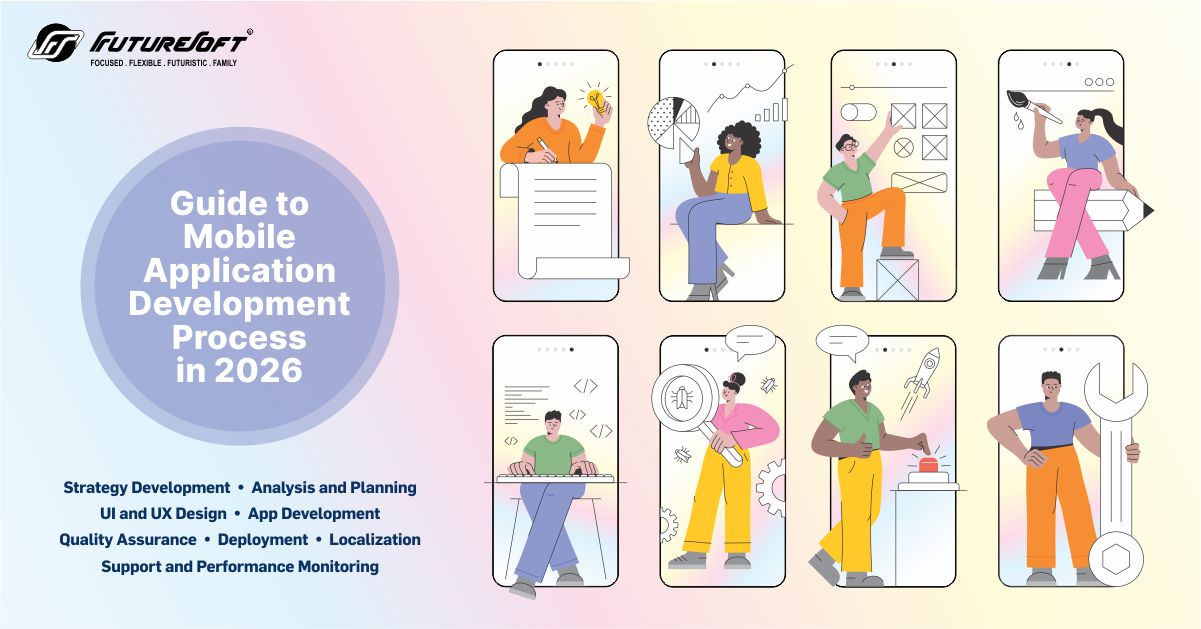
When you begin researching and creating an app, you are not only going to start a project but trigger an entire system that involves a lot of resources and people. According to industry reports, over 70% of digital projects face delays due to poor planning and unclear requirements.
You can see similar issues in eCommerce platforms like Magento, where product variant mismanagement leads to operational friction and lost revenue. The same principle applies to mobile apps.
This blog will help you understand the complete mobile app development process from strategy to support. Additionally, you will get an idea whether you can do it on your own or need to hire a mobile app development company in India.
Mobile application development refers to the end-to-end discipline of product strategy, technical architecture, application design and development, infrastructure setup, security implementation, testing, release management, and lifecycle optimization for mobile devices.
For a business, it’s not about features. It is about:
When you structure them correctly, the app development process becomes a valuable investment that grows rather than increasing your technical debt.
Know the best Shopify development companies in India.
Selecting the right development framework impacts the overall cost, development speed, and exposure risk.
It operates in iterative cycles. It is one of the most transparent and used frameworks. Instead of building everything at once, the mobile app is developed in stages with incremental features that are released every two to four weeks.
Agile emphasizes flexibility and collaboration. It minimizes the risk by breaking the development process into short cycles. This framework allows continuous feedback and adaptation, which lets the team address potential issues early-on in the development process.
Common methodologies used in the Agile framework are:
Advantages of Using Agile Framework
An agile framework supports a rapid application development process and allows you to pivot without rewriting the entire system. However, it needs strong product ownership and disciplined sprint planning.
Risk: Without tight backlog control, scope creep can inflate costs.
Understand how to ensure eCommerce website security.
Waterfall follows a linear structure, which means requirements freeze beforehand from design, development, testing, to deployment to maintenance; everything is fixed and remains unchanged throughout the process. It follows a structured software development life cycle (SDLC).
Advantages of the Waterfall FrameworkThe waterfall framework is most suited for enterprise-grade systems where requirements are fixed.
Risk: Late-stage changes are expensive. This model is less flexible for rapidly evolving businesses, as requirements need to be constant.
This approach is powerful once you cross 10,000-plus active users and need consistent updates.
Find out the best Shopify websites around the world.
| Factor | Agile | Waterfall | DevOps |
| Requirement Flexibility | High | Low | High |
| Time to MVP | Fast | Moderate | Fast |
| Change Cost | Low early | High late | Low |
| Documentation Depth | Medium | High | Medium |
| Best Stage | Early startup | Enterprise | Growth stage |
Your technology choice determines scalability, performance, and funding attractiveness.
These involve using platform-specific programming languages, software development kits (SDKs), and development environments made available by operating system providers. Native app development provides optimal performance and user experience.
It is a popular choice for traditional mobile app development. It uses Xcode, Swift, and Objective-C, while Android development uses Android Studio, Java, and Kotlin. It requires skilled platform-specific developers with extensive knowledge of specific tools.
Technical Strengths:Choose a native app when your core value depends on performance, such as fintech, health tech, gaming, etc.
Learn why the automotive industry is shifting gears to E-commerce
These combine the best of both web technologies and native elements. It is built on standard web technologies like HTML, CSS, and JavaScript. This helps in a faster development process and a near-native experience.
Hybrid apps are easier to maintain, faster speed to market, and a single codebase is deployed for multiple platforms.
Technical Strengths:These are more suitable for internal tools or proof-of-concept products.
These apps allow the deployment of a single codebase across different platforms, simultaneously saving resources and time. It is beneficial for Rapid Mobile App Development (RMAD) and offers many advantages. Cross-platform apps are built using React Native, NativeScript, Flutter, and Xamarin.
Technical Strengths:They are increasingly common in modern mobile application development because it balances cost and scalability.
These web apps are built with web technologies like HTML, CSS, and JavaScript. They offer an installable app-like experience that is fast, reliable, and capable of working offline. They use service workers for caching that allows functionality without a network connection.
Technical Strengths:Study top tools to skyrocket conversion on your D2C brand.
The entire mobile app development process includes the following steps:
It is the first step where you need to define the strategy of the app. Here you need to:
At this stage, many founders confuse feature lists with strategy. The app development process must start with measurable outcomes.


In this step, you decide where you are heading, as you already have your idea in mind and have done research around it. Now, you need to identify all the details you need before moving forward to the next stage.
You need to create:
Poor analysis leads to cost escalation. Good planning reduces rework by up to 30% in typical projects. Discover how to navigate cross-border eCommerce challenges.
For the best experience on your mobile app, you need to pay a lot of attention to the app’s design. If the design is messy or cluttered, the user will immediately leave and uninstall it without a second thought.
That is why it requires a lot of effort to design the UI and UX of the app. It needs to be intuitive, user-friendly, engaging, and offer a smooth experience. Design wireframes first and avoid jumping to visual design.
Application design and development must prioritize frictionless onboarding. Most apps lose 25% of users within the first session due to confusing navigation.


Once the design is complete, move on to the most important stages of your mobile app implementation. In this stage, the code is written, and backend systems are built.
If you use Agile, you will release incremental builds. Many businesses adopt rapid application development techniques here to accelerate MVP release.
After development is completed, it’s time to move to test your app performance. You can ensure your app stability, security, and bug-freeness only with quality assurance and software testing. For the highest quality, testing must cover:
Skipping this stage results in app store rejection or negative reviews.


Once the app is finally ready, it’s time to deploy your app to different app stores (depending on the methodology used). The mobile app deployment strategy is quite simple to follow. You need to submit it to your application to Google’s Play Store or Apple’s App Store, or both, for users to download and use it. You can also go private for distribution.
If you choose App Store or Play Store, you need to fill out several forms, and fulfil several guidelines, and submit your app for review. If you want to go private, then you need to check Apple’s Developer Enterprise Program (for iOS App) and Android’s Alternative Distributions (for Android App) to know how to proceed.
Deployment involves:
Release is not success. It is the beginning of data collection.
Understand how to harness the power of AI for eCommerce.
It means your app should be able to easily support users around the globe. If that’s your plan, then localization is one of the most crucial steps in your app development. If you plan global expansion, adopt language, currency, and cultural design elements.
Localization increases retention in international markets by improving user familiarity.


After the mobile app is finally live and users are gradually downloading and using it, it's time to put your analytical side to work and monitor performance. This stage is also quite critical and can take more time than to create a mobile app itself.
Post launch, track:
This stage defines the long-term viability of your mobile app development process.
If you have a seasoned in-house team of project managers, developers, system architects, BAs, testers, and a digital marketing team, then go for a DIY approach.
Learn how to grow your sales using important eCommerce metrics.
On the other hand, if you need help, then a mobile app development company in India is the most viable option as it reduces the cost by 30-50% compared to Western markets while maintaining quality control and engineering depth.
Before choosing, evaluate:
Understanding the mobile app development process at a structural level gives you leverage. You can question the timelines. You can validate estimates and assess architectural decisions. Whether you decide to build internally or collaborate with a mobile app development company.
This blog gives you an idea of how to approach mobile application development strategically, manage capital wisely, and transform your idea into a scalable digital product with confidence.
Before investing in mobile application development, validate your idea using real market signals. Start by identifying the exact problem your app solves and your target users. Create a simple prototype or landing page explaining your concept and measure signups or interest.
Conduct interviews with at least 15 to 20 potential users to understand their needs and willingness to pay. You can also launch a basic MVP using rapid application development methods to test real usage.
This approach reduces risk and gives clarity before committing to the full mobile app development process.
To estimate the cost of creating an app, break the app development process into stages such as planning, application design and development, backend setup, testing, and deployment. The total cost depends on features, complexity, platform, and integrations.
A simple MVP may cost less, while complex apps with real-time features require more investment. You should also include maintenance, updates, and infrastructure costs.
The most accurate way is to prepare a detailed requirement document and get estimates from a professional mobile app development company in India or an experienced development team.
Agile is the best approach for most startups because it supports flexibility and faster iteration. It allows you to release features in phases and improve based on real user feedback. This reduces upfront investment and improves product market fit.
Waterfall is better for fixed-scope enterprise projects, but it limits flexibility. DevOps is valuable when your mobile application development reaches scale and requires frequent updates and automation.
Agile, combined with rapid application development, helps startups launch faster and reduce risk during the mobile app development process.
Future-proofing starts with selecting scalable technologies and architecture during application design and development. Choose widely supported frameworks like Flutter, React Native, or native technologies that have strong community support.
Use modular architecture so new features can be added without rebuilding the system. Cloud-based infrastructure improves scalability as your user base grows. Also, build clean backend APIs that support expansion into web or other platforms.
This strategy makes your app development process sustainable and supports long-term mobile application development growth.
The cost of hiring a mobile app development company in India depends on the app’s complexity, features, and development approach. A basic app with essential functionality may cost less, while advanced apps with integrations, dashboards, and scalable backend systems cost more.
India is a preferred destination because it offers high-quality mobile application development at competitive rates compared to global markets. Working with an experienced mobile app development company in India also improves development speed, technical quality, and long-term scalability.

The digital landscape has turned smartphones into an integral part of our lives. Restaurants are increasingly recognizing the importance of mobile apps as a powerful tool for business growth and customer engagement

A brilliant app idea is the foundation of any app startup. What can the app provide? Is the app practical? Will it be available? Here are a few of the queries that cross every business owner's mind.
Application development has emerged as a new segment for startups to start with. Amidst a plethora of new ideas, it could be difficult to start one with yours. One began with the food concept, the other with education, and the list is endless.
We would love to be a part of your journey to success. Let's team up today!