
The last decade saw a tremendous rise in the mobile app market. Many businesses went from web to app, but slow apps, bad user experience, and poor performance were some of the major issues that companies face.
Among these companies, many realize that they have invested heavily in the wrong approach, as the major confusion still revolves around native vs hybrid app decisions. So before starting your mobile app development project, ask yourself the following questions:
Should I invest in performance or speed of development? Should I focus on scalability or cost savings? Which one is better, a native app or a hybrid app? Well, this blog will help you with the answers. So, stay tuned.
Learn how selecting between native and hybrid app frameworks impacts user experience and scalability by aligning development workflows with maintenance strategies.
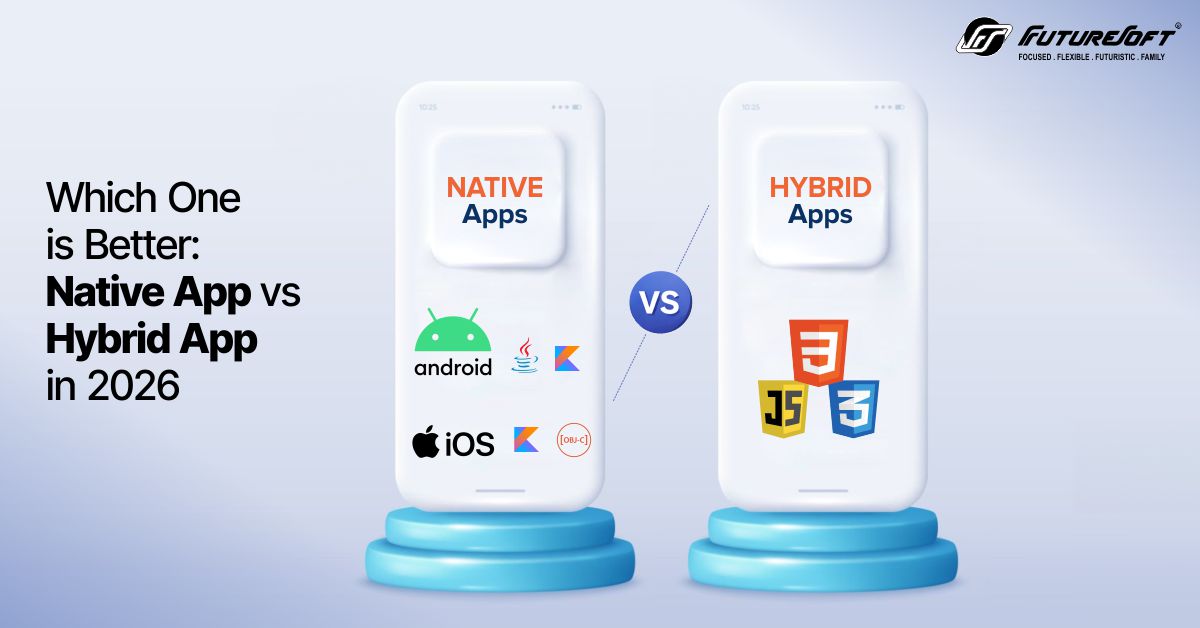
Mobile development has transformed how businesses connect with users, sell products, and build brand loyalty. Startups have grown to global companies, all because they chose the right app architecture from day one.
If you are planning to build an app ecosystem, you are probably searching for an answer to one critical question. Should you build a native app or a hybrid app? This blog will help you with that.
It will completely breakdown both these approaches. You will learn how they work, perform, and which one fits your business model best. Along with that, we will present practical insights that will help you make your decision more quickly.
Learn how to use Shopify analytics to drive business growth.
It refers to an app specifically built for one operating system (Android or iOS). It uses platform-specific programming languages and tools. For Android development, Java or Kotlin is one of the available languages. And for iOS, Swift or Objective-C are the programming languages.
This approach is called native mobile app development because the app is designed to work directly with the operating system.
A native app directly runs on the device. It interacts with the operating system without any abstraction layer. This allows faster execution and deeper integration with device features. Because it is platform-specific, it can fully utilize hardware components such as camera, GPS, Bluetooth, microphone, sensors, and storage.
A native app is written in Swift or Objective-C for iOS and Kotlin or Java for Android. This allows it to align perfectly with platform UI standards and system behavior. Because it follows OS guidelines, navigation gestures, animations, and transitions feel natural to the user.
Know how to strengthen your Magento store security.


Native apps compile into machine-level code. There is no bridge layer between the app and the operating system. This results in faster loading time, smooth scrolling, real-time responsiveness, and better handling of heavy data processing. This is critical for gaming, fintech, AI-powered apps, and streaming platforms.
A native app has full access to device hardware and system APIs. This includes camera controls, GPS and geolocation, Bluetooth and NFC, biometric authentication, push notifications, and sensors such as accelerometers and gyroscopes. Their integration is direct, stable, and optimized.


Security layers are stronger because native apps use platform-level encryption and security libraries. They support secure key storage, encrypted local databases, OS level authentication, and Secure API communication, making it ideal for banking, healthcare, and enterprise applications.
Native apps can store structured data locally using SQLite, Core Data, or Room Database. They can work with the internet, sync data in the background, and manage large local datasets. This is essential for logistics, field operations, and travel apps.
Discover how the automotive industry is shifting gears to eCommerce.


Native development environments such as Android Studio and Xcode offer advanced debugging tools, profiling and performance testing, access to official SDK updates, and extensive third-party libraries. The ecosystem is stable and well-documented.
Native frameworks provide high-precision control over UI rendering. This means smooth micro interactions, platform-specific UI elements, seamless gesture recognition, and complex animation rendering. These features are highly valuable for a premium user experience.

A native app runs faster because it communicates directly with the operating system. This makes it ideal for complex apps like fintech, gaming, or real-time platforms.
Users expect apps to behave naturally on their devices. A native app follows platform guidelines. This improves usability and engagement.
Sensitive apps like banking or healthcare need stronger protection. Native mobile app development provides better encryption and security layers.
You can easily integrate device features like cameras, GPS, biometrics, and sensors.
Find out the top 10 Magento eCommerce websites.
These apps use native app architecture to deliver fast performance and reliable functionality.
Generally, Android Studio is used for Android app development, and Xcode is used for iOS app development.
| Pros | Cons |
| Fast performance | Higher development cost |
| Excellent user experience | Separate codebase for Android and iOS |
| Better scalability | |
| High reliability | Longer development timeline |
| Strong security |
The cost is not fixed; it completely depends on project complexity, time, development phases, and efforts. On average, a basic mobile app development project costs around ₹8 Lakh in India. However, the same project will cost 40-50% more outside India.
A hybrid app is built using web technologies like HTML, CSS, and JavaScript. It runs inside a native container and works seamlessly across multiple platforms. Hybrid mobile app development allows you to build one codebase and deploy it on Android and iOS.
A hybrid app uses a framework that acts as a bridge between web code and device hardware. This allows access to features like cameras and GPS. The app runs inside a web view but behaves like a mobile application.
Study the ultimate guide to eCommerce conversion rate optimization strategies.

A key feature of a hybrid app is a shared codebase. This allows developers to build once, deploy on Android and iOS, and maintain one version. This reduces development effort significantly.
Hybrid apps work across devices using a framework that bridges web code with native APIs. The same logic runs on Android phones, iPhones, and tablets. This is ideal for startups launching quickly.


Since developers reuse code, development time is reduced. It allows rapid prototyping, faster MVP launch, and quick feature rollouts. This is beneficial when time to market is critical.
Hybrid app access device features through plugins or bridges. For example, a camera via plugins, GPS via APIs, and push notifications via framework libraries. While not as deep as natives, it works well for most business apps.


Hybrid apps reduce costs because a single team handles both platforms, maintenance is centralized, and testing effort is reduced. This makes hybrid apps attractive for budget-conscious businesses.
Know how to harness the power of AI for eCommerce.
When you update the codebase, it reflects across platforms. This results in faster bug fixes, unified updates, and simplified version control. Operational management becomes easier.


Hybrid apps use widely known technologies like JavaScript and Dart. This means a larger developer pool, easier hiring, and strong community support. It lowers dependency on platform-specific specialists.
You build once and deploy everywhere. This saves time and resources.
Hybrid mobile app development reduces development costs significantly.
One codebase makes it easier to manage and update it faster.
You can launch on Android and iOS simultaneously.
These apps use hybrid app technologies in various components.
Study the top SEO strategies to boost organic traffic.
For hybrid app development, Flutter and React Native are two of the most famous platforms.
| Pros | Cons |
| Lower development cost | Slightly lower performance |
| Faster launch | Limited deep hardware integration |
| Easier maintenance | Less optimized animations |
| Single Codebase sed pla |
Just like a Native app, the cost is not fixed; it depends on several factors like time, complexity, and effort. Typically, a basic app costs around ₹6 lakh. A mobile app development company in India can build a hybrid app faster and more affordably than Western markets.
This is where businesses make the final decision. We will break down every critical factor.
A native app provides the best user experience. It follows platform-specific design standards. Navigation feels natural and smooth.
A hybrid app offers a good user experience but may not match native performance in complex interfaces.
Native mobile app development requires separate teams for Android and iOS.
A hybrid mobile app, on the other hand, uses one codebase. This reduces complexity.
Typically, a native app takes around 2-3 months for a basic app.
On the other hand, a hybrid app takes around 1.5 to 2 months at least.
Discover visual commerce is the need for eCommerce.
Native apps give you full access to hardware features like cameras, GPS, sensors, etc.
Hybrid apps have limited access to hardware features compared to a native app.
A native app offers the best performance and is preferred for complex apps.
The hybrid app offers good performance but slightly less than native.
Native apps have full access, including sensors, cameras, Bluetooth, WiFi, and background services.
Hybrid apps have access, but they have to get it through plugins. However, there are still some limitations.
Native apps require separate updates for every platform.
In hybrid apps, a single update works across platforms.
Find out the top app ideas for 2026.
| Feature | Native App | Hybrid App |
| Performance | Excellent | Good |
| User Experience | Excellent | Good |
| Development Speed | Slower | Faster |
| Cost | Higher | Lower |
| Codebase | Separate | Single |
| Device Integration | Full | Limited |
| Maintenance | Higher Effort | Easier |
| Scalability | Excellent | Moderate |
| Security | Strong | Good |
| Offline Support | Excellent | Good |
| Best for | Complex apps | MVP and startup apps |
Choose a native app if:
Choose a hybrid app if:
This is why businesses compare hybrid apps vs native apps carefully before deciding.
Understand the future of mobile application development.
Selecting between a native app and a hybrid app completely depends on your business goals, needs, budget, and long-term vision. If performance, scalability, and user experience are your priorities, a native app is the best choice. If cost, speed, and faster launch matter more, a hybrid app is a reliable option.
So, now you understand the difference between the two, so you can make a better decision related to your mobile app development project and choose the right architecture that aligns with your business strategy.
If your roadmap includes complex features, high user traffic, real-time processing, or deep system integration, a native app is stronger for long term scalability. Native mobile app development gives you better performance optimization, security control, and architecture flexibility.
A hybrid app works well for MVPs and early-stage products. However, when traffic grows and feature complexity increases, hybrid frameworks may require performance workarounds.
In the native vs hybrid app debate, long-term enterprise growth usually favors native architecture. That said, the product scope and funding stage should guide your decision.
Yes, in most cases, maintenance is higher for a native app because you manage two separate codebases for Android and iOS. Updates, bug fixes, and feature releases often require dual implementation.
With hybrid mobile app development, you maintain one shared codebase. This reduces testing cycles and deployment effort.
However, if your hybrid app relies heavily on custom native modules, maintenance complexity can increase. In a clean implementation, hybrid app maintenance is generally more cost-efficient than native mobile app development.
. A native app provides the best UI responsiveness and animation smoothness. It uses platform-specific rendering engines and system-level animation APIs.
This results in:
A hybrid app can deliver good UI quality, especially with modern frameworks. But for graphics-heavy apps, gaming, fintech dashboards, or high-interaction platforms, native performance is superior.
If user experience is your competitive advantage, native architecture is stronger in the hybrid app vs native app comparison.
Yes, migration is possible, but it requires partial or complete redevelopment. You cannot directly convert a hybrid app codebase into a fully native app.
Typically, businesses:
Migration costs depend on app complexity and feature set. Planning architecture correctly from the beginning reduces future rework.
For AI-heavy applications such as real-time recommendations, computer vision, predictive analytics, or on-device ML processing, a native app architecture performs better.
Native apps can integrate directly with:
A hybrid app can integrate AI via APIs and cloud processing. This works well for moderate AI usage. However, for intensive AI workloads and edge processing, native architecture offers better control and performance.
If your product roadmap includes AI as a core feature, native development is generally the stronger long-term choice.

The digital landscape has turned smartphones into an integral part of our lives. Restaurants are increasingly recognizing the importance of mobile apps as a powerful tool for business growth and customer engagement
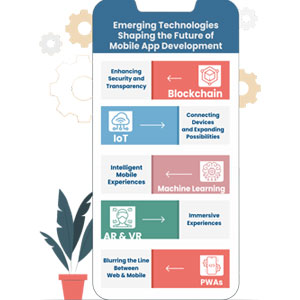
Mobile application development is a dynamic field that constantly evolves with the introduction of new technologies. Staying ahead of the curve and embracing the latest trends is crucial for developers to create innovative and competitive mobile apps.
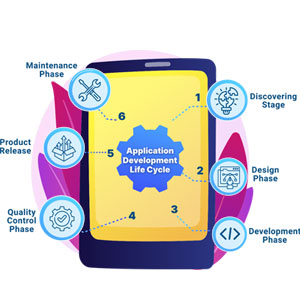
Application development is crucial, and even more imperative when you are operating a business and expecting a pipeline of great projects and revenue. Almost every successful business today is having an application.
We would love to be a part of your journey to success. Let's team up today!