
Do you still spend hours managing orders, emails, inventory, and customer queries on your website? Do you know there is a way that allows you to make these processes more efficient and quicker? You might be struggling with manual work that slows down your business growth and increases your operational costs.
This is where eCommerce automation becomes a growth driver rather than just a technical upgrade. It helps you reduce repetitive work, improve accuracy, and focus on strategy instead of daily firefighting.
If your goal is to scale without hiring large teams or increasing overhead, automation is no longer optional. It is a smart path toward efficiency, faster execution, and better customer experiences.
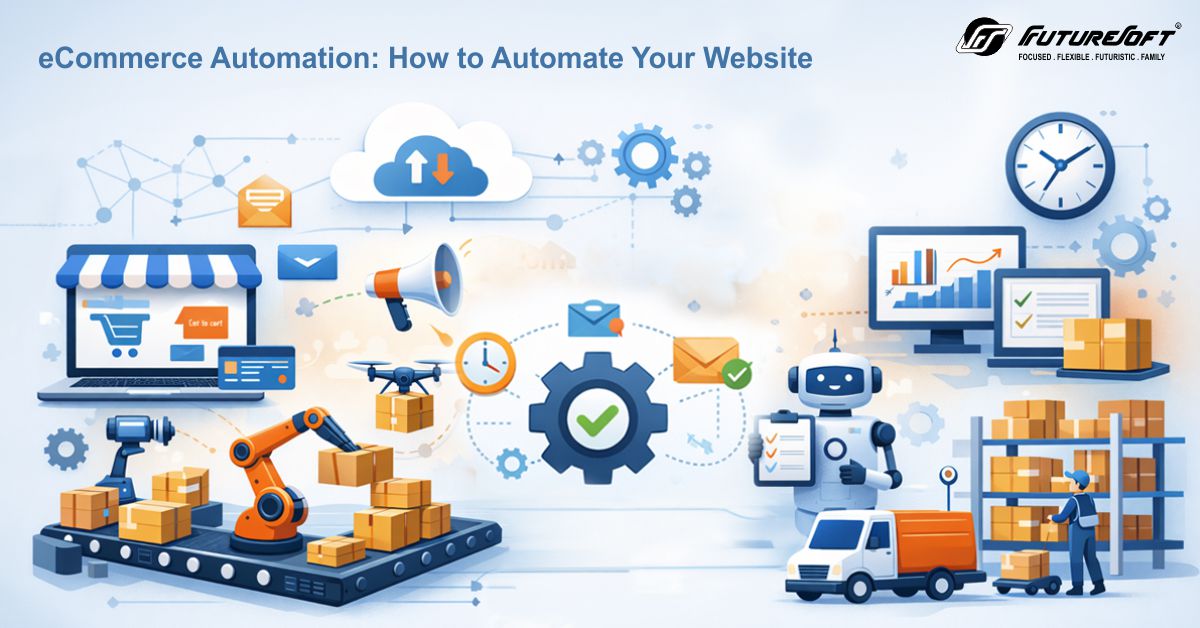
eCommerce automation is rapidly reshaping how online stores operate. When you automate process workflows such as order handling, marketing, and reporting, you reduce manual error and free up time for growth initiatives.
According to Amra and Elma LLC, more than 76% of companies worldwide already use automation tools to improve their business efficiency. Running an online store today is complex. Customers expect fast delivery, personalized communication, and consistent service. Meanwhile, you must manage marketing, logistics, analytics, and security at the same time.
Without business automation, operations can become chaotic. This blog breaks down the full eCommerce automation process, explains why it matters, and shows practical areas where you can implement it immediately. You will also learn how to boost eCommerce processes while keeping costs under control.
Know the top application for quick Shopify checkout.
At its core, automation for eCommerce refers to using software to execute business tasks with minimal human involvement. Instead of manually updating stock, sending emails, or generating reports, systems handle them automatically based on rules and triggers.
A modern eCommerce automation process connects multiple workflows, such as inventory, marketing, customer engagement, and payments, into a unified ecosystem. This reduces operational friction and improves decision speed.
Think of it as building a digital operations engine that runs in the background while you focus on strategy, partnerships, and revenue expansion.
Automation simplifies complex tasks and helps deliver measurable results.
Learn what to consider while selecting a loyalty program.
When implemented correctly, business automation reduces workload and unlocks growth capacity.
The outcome is simple. You spend less time managing tasks and more time expanding revenue channels. That is exactly how to boost eCommerce processes in a competitive market.
Manual workflows drain leadership bandwidth. Automation handles repetitive tasks so you can focus on strategy. Research shows automation saves companies more than six hours per week on routine activities (firework.com).
Imagine reinvesting those hours into product expansion or customer acquisition. That shift alone can change your growth trajectory.


Cost pressure is a constant concern for online retailers. The right process automation tools directly address this challenge.
Lower costs combined with higher productivity create stronger margins.
Find out the top jewelry eCommerce website.
Customer expectations are rising. Automation allows you to deliver faster responses and personalized interactions. About 54% of companies improved customer experience by delivering timely and relevant content through automation (firework.com).
Better experience often translates into repeat purchases and higher lifetime value.


Growth often creates operational strain. Automation absorbs that pressure. AI-driven automation can reduce operational costs by up to 30% while saving more than 20 hours each month, giving businesses room to scale efficiently (arXiv). Instead of reacting to operational bottlenecks, your systems support expansion.
Data-driven decisions outperform guesswork. Automated analytics help you track performance instantly. Since 63% of companies using automation report revenue increases, the connection between insight and growth is evident (pixezy.com).
With clear dashboards, you know what works and what needs adjustment. That clarity is how to boost the eCommerce process sustainably.
Discover the top eyewear eCommerce websites.

Not every workflow needs automation immediately. Focus on high-impact areas first. To make it simple, follow the RICH method. Which goes like:
If a task follows the same steps every time, it is a prime choice. Examples include order confirmations, shipping alerts, and invoice generation. Automation removes human error and improves execution speed.


Processes like campaign optimization, pricing updates, and stock adjustments often require continuous refinement. Automating these workflows keeps them aligned and accurate without continuous supervision. This is a foundational principle of strong business automation.
If an operation requires significant manpower or time, automation can deliver a quick ROI. Companies that use automation report positive ROI within the first year. This is a compelling financial argument.


Complex integrations or data-heavy tasks often slow teams down. Automation platforms manage these workflows with consistency. While evaluating complexity, ask a simple question. Will automation reduce friction and accelerate outcomes? If yes, it belongs to your roadmap.
Find out everything you need to know about virtual try on.
Understanding where to apply automation is critical. Here are certain high-impact areas where you can implement automation and boost your eCommerce website processes effectively.
Stock errors can damage revenue and brand credibility. Automated inventory systems sync stock levels across channels and trigger reorder alerts. Accurate automation models have demonstrated performance accuracy of up to 94% in workload scaling scenarios.
Prominent Automation Tools: TradeGecko, Zoho Inventory, NetSuite
These tools act as powerful process automation tools that reduce stock discrepancies.


Order routing, confirmations, and shipping updates should not rely on manual tracking. Automation speeds fulfillment and reduces delays. Since 50% of businesses saw reduced customer acquisition costs within six months of automation, efficient order workflows contribute directly to profitability.
Prominent Automation Tools: ShipStation, Brightpearl, Orderhive
Security threats are rising with digital commerce growth. Automated monitoring detects suspicious activity faster than manual reviews. Automation improves governance by reducing human oversight gaps and strengthening data management practices.
Prominent Automation Tools: Cloudflare, Sucuri, Palo Alto Networks


Fast Support improves retention. AI chatbots and automated ticketing systems handle common queries instantly. Many teams report improved satisfaction and engagement after adopting automation tools for customer communication.
Prominent Automation Tools: Zendesk, Freshdesk, Intercom
Personalization drives conversions. Automated segmentation uses behavioral data to group customers and deliver relevant messaging. Segmentation powered by automation increases campaign efficiency by 73%.
Prominent Automation Tools: HubSpot, Segment, Salesforce


Marketing is one of the strongest use cases for automation for eCommerce. 80% of users report increased leads, while 77% see higher conversion rates. Automated nurturing can raise sales opportunities by 20% (firework.com).
This is exactly how to boost the eCommerce process without expanding your marketing team.
Prominent Automation Tools: Mailchimp, Marketo, ActiveCampaign
Estimate the total cost of ownership of your eCommerce website.
Manual billing creates delays and reconciliation of errors. Automated systems generate invoices, track payments, and reduce financial friction. Operational savings from automation make budget allocation more efficient and growth-focused.
Prominent Automation Tools: Stripe, Chargebee, QuickBooks


Email remains a high ROI channel when automated correctly. Automated emails generate 320% more revenue than non-automated campaigns. They also achieve 15.2% higher open rates. Few strategies deliver this level of impact with minimal effort.
Manual reporting slows decision-making. Automated dashboards present performance metrics in real time. Since 63% of companies experience revenue growth with automation, data visibility plays a major role in strategic execution.
Prominent Automation Tools: Google Analytics, Tableau, Power BI


Modern stores rely on multiple platforms. Integration automation fetches and synchronizes data across systems, eliminating silos. Centralized automation improves coordination, reduces errors, and supports scalable operations.
Prominent Automation Tools: Zapier, MuleSoft, Make
A connected ecosystem is a defining element of mature eCommerce automation.
Understand the top features to have on your clothing eCommerce website.
The future of digital commerce belongs to businesses that operate with speed, intelligence, and precision. Automation gives you all three. By implementing the right workflows, you reduce manual effort, control costs, and create a foundation for long term growth.
Whether you are optimizing marketing, improving fulfillment, or enhancing customer experience, the right business automation strategy positions your store for sustainable success.
If you want to move faster than competitors, investing in expert eCommerce development services can help you deploy automation with minimal risk and maximum ROI.
Start small, prioritize high-impact workflows, and expand gradually. Once your systems begin working for you, scaling becomes far less complex. That is the real power of automation and the smartest way to boost eCommerce processes today.
The first step is to audit your current workflows and identify repetitive tasks that consume time or cause errors. Focus on areas such as order handling, inventory updates, and customer communication.
Start small with reliable process automation tools, so your team can adapt quickly. A phased eCommerce automation process reduces risk and builds confidence across operations.
When you prioritize high-impact tasks, you build a strong foundation for business automation and learn how to boost eCommerce processes without overwhelming your team
Yes. Automation for eCommerce allows you to send timely messages, recommend relevant products, and recover abandoned carts automatically. These actions reduce friction in the buying journey and encourage repeat purchases.
A well-planned eCommerce automation strategy also improves response speed, which builds trust and loyalty. Many businesses adopt business automation to deliver consistent experiences that influence purchase decisions.
Over time, automated engagement helps you understand customer behavior better and refine campaigns for stronger conversions.
Not necessarily. Many modern platforms offer no-code or low-code interfaces that help you automate process steps with minimal technical knowledge. However, involving experts can help you design a scalable eCommerce automation process and avoid integration issues.
Begin with user-friendly process automation tools, then expand into advanced workflows as your operations grow. Taking this structured approach also clarifies how to boost eCommerce processes while keeping implementation manageable.
Automation is not a one-time setup. Review workflows quarterly or whenever you introduce new products, channels, or campaigns. Regular analysis helps you detect gaps, improve targeting, and increase operational efficiency.
Strong eCommerce automation depends on continuous improvement driven by performance data. As your store scales, refining your business automation strategy helps maintain speed and accuracy while supporting growth objectives.
Yes. Automation centralizes data from marketplaces, social platforms, and your website, so inventory, pricing, and orders stay aligned. This reduces manual updates and prevents stock conflicts.
A connected eCommerce automation process gives you better visibility across channels and improves decision-making. Businesses that invest in automation for eCommerce often expand faster because systems handle operational complexity.
This is a practical example of how to boost eCommerce processes while maintaining control over multi-channel operations.

Business leaders and owners want effective eCommerce marketing strategies to scale their online operations. For the time being, small steps and eCommerce growth tactics might work. However, for long-term success, they need effective strategies that can change their business completely.

In the present times, data is a necessity. Every business, even an eCommerce needs data for understanding users and uncovering hidden insights. eCommerce analytics make informed decisions and accelerate growth.

If you go back a decade, most retailers believed that physical stores were enough to run a profitable business. But customer behavior has changed. With smartphones, fast internet, and digital payments, consumers prefer shopping online instead of standing in queues.
We would love to be a part of your journey to success. Let's team up today!