
When it comes to eCommerce platforms, two platforms stand out from the crowd: Magento and Shopify, especially when it comes to B2B commerce. It breaks down pricing models, customization capabilities, core features, scalability, security, and real-world applicability for businesses planning to launch or migrate to B2B eCommerce.
Through informed analysis and comparisons, this guide helps leaders choose the right solution based on business needs, technical resources, and long-term growth goals. It also highlights how professional eCommerce development services can empower your strategy.
Compare Magento and Shopify through a strategic analysis of features, flexibility, and scalability for sustainable eCommerce growth.
When brands evaluate Magento vs Shopify for their B2B eCommerce strategy, the decision often shapes long-term growth, technology investment, and customer experience. B2B buyers now expect digital experiences that match B2C standards, account hierarchies, personalized catalogs, complex pricing, and bulk ordering.
Recent industry research shows that global eCommerce sales are expected to exceed $6.5 trillion, with B2B representing a substantial share of this opportunity. Yet, many businesses discover that the wrong platform choice can slow growth, constrain innovation, and inflate costs.
In this blog, we cover Magento and Shopify platforms from a B2B perspective, dissect their strengths and limitations, and provide guidance to help brands choose what fits their specific requirements.
Magento, now part of Adobe Commerce, is an open-source eCommerce platform known for flexibility and enterprise strength. It powers approximately 130 to 180 thousand live online stores globally, often used by mid-size to large enterprises with complex workflows.
Magento offers two key editions. First, Magento Open Source, which is free software that businesses host and build upon. Second, Adobe Commerce (formerly Magento Commerce), which adds cloud hosting, premium support, and advanced enterprise features.
Both editions can be extended with modules and custom development, making Magento B2B a strong option for businesses requiring nuanced control.
Learn how to turn eCommerce website analytics into business growth.
Magento provides deep flexibility. Because the platform is open source, developers can modify every part of the system, from checkout flows to product logic, giving businesses full control over the eCommerce experience and integration with internal systems.


Magento offers enterprise-grade security features, including support for secure payment integrations, data protection compliance, and two-factor authentication. With proper maintenance, Magento can match the high-security requirements of B2B enterprises.
Magento supports multiple stores from a single backend instance. Businesses can manage various brands, business units, and regions with localized catalogs and pricing, crucial for global B2B Operations.


Magento supports multiple languages and currencies within one setup, allowing brands to serve international B2B customers with customized localized experiences.
Magento’s native B2B module includes company accounts, quick order forms, shared catalogs, quote management, custom price lists, and customer role permissions; all built into the platform without depending on third-party add-ons.

Magento’s flexibility comes with complexity. Building and managing a Magento B2B store requires experienced developers and careful planning. For companies without technical teams, this can slow down implementation and increase risk.
While Magento open source is free, development, hosting, extensions, and performance optimization require significant investment. Adobe Commerce licensing adds additional cost layers, making the total cost of ownership higher than SaaS alternatives.
Magento stores require continuous updates, performance tuning, server maintenance, and security patching. Without dedicated technical resources, this overhead can become a bottleneck.
Know why Magento development is the go-to solution for an eCommerce platform.
| Pros | Cons |
| Open-source nature (highly customizable) | Requires hosting |
| Impressible content management system | Not-beginner-friendly (requires technical knowledge) |
| Large user community | Requires technical knowledge |
| Optimized for selling globally | |
| Free plan option |
Shopify’s hosted nature means businesses can launch faster without worrying about server setup, security configurations, and maintenance. This is a key advantage for teams with limited technical resources.


Shopify provides a large library of professionally designed themes and intuitive design tools. This allows businesses to quickly create polished storefronts without custom coding.
Shopify’s infrastructure includes built-in hosting, PCI compliance, regular security updates, and SSL setup. Brands benefit from reliable uptime and resilient performance during peak traffic without manual interventions.


Shopify’s app marketplace includes thousands of extensions for marketing, ERP, B2B functionality, and CRM. Businesses can add advanced features through apps rather than custom development.
Know the Best Adobe Commerce SEO practices.
Shopify’s admin interface is streamlined and beginner-friendly. Marketing, customer operations, and inventory can be managed with minimal training.

Shopify’s hosted architecture limits deep platform access. For businesses that need highly unique workflows or checkout logic, Shopify may not provide full control, especially compared with Magento.
Shopify plans involve monthly subscription fees, with advanced B2B features often requiring Shopify Plus. For businesses that want enterprise functionality, subscription costs can be high relative to open-source alternatives.
Many advanced B2B features in Shopify come through third-party apps. While this gives flexibility, it also increases dependency on external providers and potentially raises costs.
For large businesses with complex operational requirements, Shopify’s architecture may require workarounds or multiple apps to simulate Magento-like workflows, which can introduce friction at scale.
Discover the top digital marketing tips for B2B startups.
| Pros | Cons |
| Intuitive drag-and-drop interface | Shopify transaction fees |
| Range of built-in payment processors | Subscription model for using apps |
| No coding is required for basic stores | Limited inventory management options |
| Multichannel selling – Amazon, Instagram | Limited customization options |
| Limited options for selling globally |
Below is a structured comparison chart highlighting key differences between Magento B2B and Shopify B2B:
| Features | Magento B2B | Shopify B2B |
| Open source | Yes | No |
| Hosting included | No (Yes, for Adobe Commerce) | Yes |
| Unlimited bandwidth | No | Yes |
| Multi-store management | Yes | No |
| Customizable themes | Yes | Yes |
| SEO tools | Yes | Yes |
| Mobile optimization | Yes | Yes |
| Third-party integrations | Yes | Yes |
| Built-in payment gateway | No | Yes |
| Inventory management | Yes | Yes |
| Order management | Yes | Yes |
| Discount and promotion tools | Yes | Yes |
| Analytics and reporting | Yes | Yes |
| Multi-currency support | Yes | Yes |
| Multi-languages support | Yes | Yes |
| Custom URL structures | Yes | No |
| B2B Features | Yes | Yes |
| Scalability | Yes | Yes |
| Customer Segmentation | Yes | No |
| Content staging | Yes | No |
| Automated marketing tools | Yes | Yes |
| App Marketplace | Yes | Yes |
| Social Media Integration | Yes | Yes |
| Free SSL certificate | No | Yes |
| PCI-DSS compliant | Yes | Yes |
| Built-in fraud protection | Yes | Yes |
This chart clarifies the difference between Magento and Shopify for B2B in terms of features, operational model, and technical investment.
Find out the traffic generation strategies for Shopify.
Selecting between Magento vs Shopify for B2B depends on where your business stands today and where it plans to be in the future.
If your business demands deep customization, complex pricing models, multi-store architecture, and has technical resources or development partners on hand, Magento B2B is a powerful long-term choice. Its flexibility nearly always surpasses other platforms when it comes to enterprise requirements.
Conversely, if your priority is speed to market, ease of administration, lower operational overhead, and predictable cost, Shopify B2B presents a compelling proposition. Shopify’s hosted environment allows teams to focus more on business strategy and less on infrastructure.
The right choice must align with your capacity to manage technology, your growth, roadmap, and customer experience goals. If you want professional support in implementing either platform, migrating between systems, or extending your B2B eCommerce capabilities, our eCommerce development services can help.
We specialize in both Magento development services and Shopify development services, guiding brands through strategy, performance optimization, and execution.
The main difference between Magento and Shopify for B2B is how much control a business gets over its store. In Magento vs Shopify, Magento B2B offers deeper customization, complex pricing, and account management.
On the other hand, Shopify B2B focuses more on simplicity, faster setup, and built-in hosting. Magento eCommerce fits brands with advanced workflows, while Shopify eCommerce works well for businesses that want quick market entry with fewer technical requirements.
In Magento vs Shopify, Magento B2B is stronger for complex pricing structures. Magento eCommerce supports custom price lists, tiered pricing, shared catalogs, and negotiated quotes natively. Shopify B2B depends more on apps for similar features.
When comparing Shopify vs Magento, Magento gives businesses better control over contract pricing, volume discounts, and customer-specific rates, which is critical for large B2B operations.
The difference between Magento and Shopify for B2B becomes clear in customization. Magento vs Shopify shows that Magento B2B allows full control over workflows, checkout, integrations, and backend logic.
Shopify B2B limits deep customization because it runs on a hosted system. Magento eCommerce is better for businesses that need unique B2B buying journeys, while Shopify eCommerce suits brands that want standard yet efficient setups.
Yes, Shopify B2B can support wholesalers, distributors, and corporate buyers through customer groups, custom pricing, and order minimums. In Shopify vs Magento, Shopify eCommerce relies more on apps for advanced B2B features, while Magento B2B offers many of these functions natively.
Shopify works well for growing B2B brands that need faster deployment with less technical involvement.
In Magento vs Shopify, Shopify eCommerce is easier for non-technical B2B teams. Shopify B2B provides a simple dashboard, built-in hosting, and automated updates. Magento eCommerce requires technical skills for maintenance and customization.
When comparing Shopify vs Magento, Shopify is better for teams that want to focus on sales and operations instead of platform management.
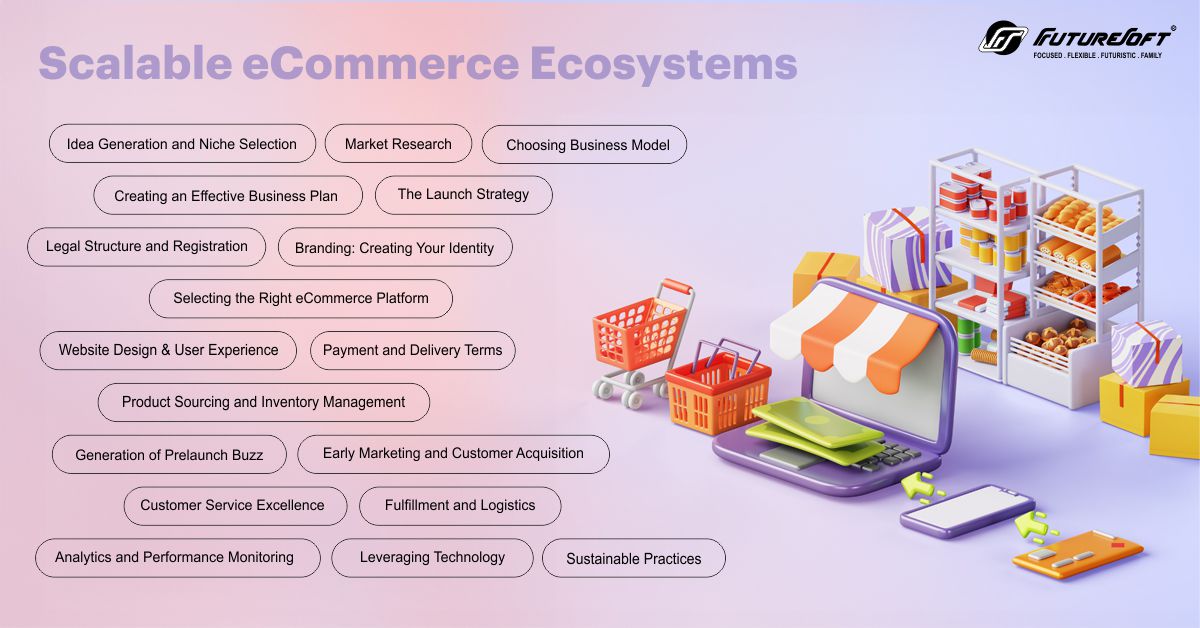
In this competitive eCommerce landscape, building a scalable eCommerce ecosystem isn’t about launching an online store. It’s about creating a business that grows effortlessly with market demands.

An eCommerce website builder is the most needed thing while you are planning to go digital. There are hundreds of options available in the market, but which is the best? Which one fits your requirements most accurately?

The digital revolution has changed how businesses operate globally, especially eCommerce websites. Now they can reach a wider audience to attain higher revenue. Developing an eCommerce website involves numerous factors such as choosing the right platform, selecting the features, integrating essential services, and managing associated costs.
We would love to be a part of your journey to success. Let's team up today!