How to Build Scalable eCommerce Ecosystems

Synopsis:

In this competitive eCommerce landscape, building a scalable eCommerce ecosystem isn’t about launching an online store. It’s about creating a business that grows effortlessly with market demands.

You will know actionable steps to optimize performance and much more in this blog, so you can easily navigate and scale in this digital landscape. Whether you are starting from scratch or revamping an existing setup, this guide will help you understand what it takes to build a resilient and scalable eCommerce platform for long-term success.

Build Scalable eCommerce Ecosystems

Introduction

Before stepping into the digital market, you need to choose a scalable eCommerce platform as it is vital for business growth and long-term success. There are many businesses out there that become digital but still struggle when it comes to scaling or expanding.

Scalability allows your eCommerce business to adapt easily to increased demand, new technologies, and evolving customer expectations. That’s why this blog will provide you with a complete roadmap on how to build scalable eCommerce platform solutions from identifying the problem to delivery, and after that.

You will also learn how to identify profitable niches, research your market, create strong branding, select the right eCommerce platform, and optimize operations for growth. We will also explore marketing, customer experience, analytics, and the latest technologies that drive eCommerce businesses that grow with you, not against you.

Learn more about eCommerce website development.

Step-By-Step Guide for a Scalable eCommerce Platform

Step 1: Idea Generation and Niche Selection

Every successful scalable eCommerce business starts with a strong idea and a well-defined niche. The goal is to identify what people need, where the market is heading, and how your brand can fill the gap profitably.

  • Problem Identification: Identify the real problems customers face. Check out reviews, social media discussions, and industry forums. The best eCommerce idea often solves frustrations people face daily, like product quality, limited variety, or convenience.
  • Trends Analysis: Study current and emerging market trends. Explore reports from Statista, Google Trends, and eCommerce research portals to spot high-growth sectors.
  • Niche Down: Broad markets are crowded and competitive. Instead, select a niche market as it has fewer competitors, higher engagement, and better chances of brand loyalty.
  • Profitability Potential: After deciding niche, analyze its earning potential. Check product margins, average order values, and long-term scalability. A scalable eCommerce platform must support business expansion without technical or operational barriers.

Understand the role of AI in eCommerce and how it improves visual search.

Idea-Generation-Niche-Selection

Market-Research

Step 2: Market Research

Once you have defined your niche, it’s time to validate it through market research. This step helps confirm demand, identify competitors, and understand your audience before building a scalable eCommerce business.

  • Target Audience Research: Your business can only scale when you know who you are selling to. Identify your target audience by studying demographics and buying behaviors. Using tools like Google Analytics, Facebook Audience Insights, and surveys to understand their pain points, preferences, and motivations.
  • Competitor Analysis: Study your competitors, both direct and indirect. Analyze their website experience, pricing, content strategy, and customer engagement. Identify what they do well and where they fall short. This information lets you position your brand uniquely and identify opportunities your competitors miss.
  • Market Validation: Before launching, test the demand for your products. You can create landing pages, run small ad campaigns, or use pre-orders to measure real interest. Market validation reduces risk and provides clarity on long-term growth.

A scalable eCommerce platform thrives on data-backed decisions. Solid market research ensures you build on proven demand rather than assumptions.

Want to scale your eCommerce business?

Step 3: Choosing Business Model

Your business model defines how your eCommerce ecosystem operates, earns, and grows. Choosing the right model is essential for long-term scalability and profitability. Each model comes with its own benefits, challenges, and technological needs. This helps in aligning your resources, goals, and audience.

  • B2B (Business to Business): B2B focuses on selling products or services directly to businesses. It often involves bulk orders, negotiated pricing, and long-term contracts. A scalable eCommerce platform built for B2B.
  • B2C (Business to Customer): The most common business model, which directly sells to customers. It demands strong branding, fast website performance, and personalized user experiences.
  • D2C (Direct-to-Consumer): D2C removes intermediaries, allowing brands to sell directly to customers. It provides higher profit margins and deeper customer insights. A composable commerce platform is ideal for D2C brands.
  • Print on Demand (POD): It is perfect for custom product creators who want to minimize inventory risk. Products are printed and shipped after an order is placed.
  • Dropshipping: Dropshipping lets you sell products without managing inventory. You partner with suppliers who fulfill orders on your behalf. It’s easy to start but competitive.
  • SaaS (Software as a Service): SaaS eCommerce focuses on subscription-based services or tools. This model delivers predictable revenue and strong scalability.
  • Marketplace Selling: In this, you list your products on an existing eCommerce marketplace so they can utilize their platform for your branding and boosting business reach.

A scalable business often combines elements of multiple models to maximize revenue.

Discover the latest Adobe Commerce trends for business growth.

Choosing-Business-Model

Order Tracking

Step 4: Creating an Effective Business Plan

A strong business plan acts as your roadmap for building a scalable eCommerce business. It defines your direction, minimizes risk, and helps you make informed decisions as your company grows.

Your plan doesn’t have to be overly complex; it should be practical, measurable, and adaptable to change. The goal is to align your business vision with realistic execution steps that drive both growth and sustainability.

An effective business plan should include:

  • Executive Summary – A short overview of your business concepts, missions, and goals. It gives stakeholders a quick understanding of what your company does.
  • Market Overview – Insights from your research, including audience needs, market size, and potential demand. This validates your niche and supports strategic decisions.
  • Product and Service Plan – A breakdown of your product lineup, pricing strategy, and value proposition.
  • Operations Plan – Outline how your eCommerce ecosystem will function daily. From the supply chain to customer service.
  • Technology and Platform Plan – Define the role of your chosen scalable eCommerce platform and the tools required for automation.
  • Marketing and Sales Strategy – Map out how you will attract, convert, and retain customers. It includes both organic and paid marketing channels.
  • Financial Forecast – Estimate startup costs, revenue targets, and break-even timelines.
  • Growth and Scalability Plan – Define how your business will expand, through new product lines, regions, or partnerships.

When you have a solid business plan, it keeps your operations structured while maintaining flexibility for the future.

Find out how digital marketing services are transforming your eCommerce.


Step 5: Legal Structure and Registration

Before proceeding to your scalable eCommerce business launch, it’s essential to build a strong legal foundation. The right legal structure protects your assets, defines your tax obligations, and builds credibility with customers and partners.

Choose a Business Structure

Start by choosing a structure that fits your goals. Common options include:

  • Sole Proprietorship
  • Partnership
  • LLC (Limited Liability Company)
  • Corporation

Your business structure impacts taxes, reporting, and scalability. Therefore, you need to consult a financial advisor before finalizing.

Register Your Business Name

Pick a unique, memorable business name and register it with the appropriate government authority. Check domain availability for consistency across your website and social channels.

Obtain Licenses and Permits

Depending on your niche and region, you may ned trade licenses, Exim permits, or data protection compliance and certifications.

Know Tax Obligations

Every country and state has its own tax regulations for eCommerce. Understand sales tax, GST, and income tax requirements.

Website Policies

A scalable eCommerce platform must include essential website policies such as:

  • Privacy Policy
  • Terms and Conditions
  • Return and Refund Policies, etc.

Getting the legal groundwork right reduces future risks and sets your eCommerce ecosystem on a compliant and professional path.

Learn ways to increase the organic traffic of your eCommerce business.

Legal-Structure

Branding-creating-identity

Step 6: Branding: Creating Your Identity

Branding goes beyond a logo; it defines how your audience perceives and connects with your business. For a scalable eCommerce business, strong branding is what builds trust, loyalty, and long-term recognition.

Here’s what differentiates your business from others.

  • Define Your Brand Vision and Mission – Start with clarity. What does your brand stand for? What problem are you solving, and for whom?
  • Create a Memorable Brand Name and Logo – Choose a catchy, easy-to-pronounce, and short name relevant to your niche. And your logo should be clean, versatile, and scalable across digital and print channels.
  • Develop a Unique Brand Voice – Your communication style should resonate with your target audience. Whether you are professional, friendly, or playful, consistency is key. And it should reflect across your ads, website content, social media, and emails.
  • Create a Compelling Value Proposition – Explain what makes your brand different and why customers should choose you. It could be superior quality, better pricing, fast delivery, or excellent support.
  • Build Emotional Connection – Modern consumers connect with stories, not just products. Share your journey, vision, and brand values.

Building a powerful brand identity acts as a multiplier for all your marketing efforts. It not only attracts customers but keeps them engaged.

Understand how virtual try-on solves the top 5 problems of jewelry eCommerce websites.


Step 7: Selecting the Right eCommerce Platform

Selecting the appropriate one of the most important decisions in building a scalable eCommerce business. The platform you select will define how easily your store grows, integrates with new tools, and handles increased traffic and transactions.

A scalable eCommerce platform should support flexibility, performance, and integration without frequent redevelopment. It must adapt to new technologies and customer expectations while maintaining speed and reliability.

Some leading platforms to consider:

  • Shopify – Shopify is ideal for startups and small to mid-size businesses. It offers easy setup, built-in hosting, and a wide range of apps. If you want more, check out other plans such as Shopify Advanced, Shopify Plus, etc.
  • BigCommerce – Known for scalability and performance, BigCommerce is built for larger businesses. It supports multiple payment gateways, APIs, and omnichannel integrations.
  • WooCommerce – WooCommerce is a WordPress plugin that provides flexibility and control. It’s great for businesses that want to manage their store and content in one place.
  • Adobe Commerce (Formerly Magento) - Magento is a powerful choice for enterprises that need advanced features and customization. It’s designed for eCommerce scalability and performance, supporting multi-store setups, global sales, etc.
  • Squarespace – Squarespace combines aesthetics with functionality suitable for creative entrepreneurs and small businesses. It’s excellent for startups focusing on strong visuals and simple selling.

While choosing your platform, focus on your current needs and future vision. A composable eCommerce platform approach, where you integrate best-in-class tools for payments, analytics, etc.

Your platform isn’t just a technical choice; it’s the foundation for growth, performance, and customer experience. When you calculate and plan everything, it will help you make the best decision to choose the right eCommerce platform for your business.


Selecting-Right-eCommerce-Platform

Website-Design-user-exp

Step 8: Website Design and User Experience

A great website design is more than just looks. It offers a smooth navigation and customer journey that helps turn visitors into customers. For a scalable eCommerce business, UX must focus on speed, clarity, and convenience.

  • Mobile-First Design: Over 70% of shoppers browse on mobile devices. Therefore, your website design should be according to mobile view, which is then optimized for the web version, for a smooth and responsive experience.
  • Simple Navigation: Users should find what they are looking for in seconds. Use breadcrumbs, clear menus, logical categories, and a visible search bar. Easier navigation = higher conversion.
  • High-Quality Images and Videos: Visuals influence buying decisions. Use HD images, 360-degree product views, short demo videos, etc. This showcases to customers what they will get on purchase.
  • Great Product Descriptions: Describe benefits, not just features. Keep them concise, keyword-rich, and easy to scan.
  • Clear CTAs (Call to Action): Use actionable words like Shop Now, Add to Cart, Get Started, etc.. And they should stand out visually from the content naturally.
  • Load Speed: A Scalable eCommerce platform must deliver fast load times even during peak traffic. Compress images, use caching, and host your site on reliable servers.
  • Smooth Checkout: Minimize friction in the checkout process. Offer guest checkout, save address options, and provide multiple payment methods.
  • Trust Indicator: Display security badges, verified reviews, and social proof. Customers are more likely to buy from credible and safe websites.
  • Accessibility: make sure your website is usable for everyone, including people with disabilities. Add alt text, readable fonts, and proper color contrast.
  • Scalability: Your website design must support future growth. Build with modular components that allow new features, integration, and technologies.

A well-designed website is a visual treasure; it’s the engine of customer retention, conversion, and performance. Because a better user experience makes it easier to sustain growth across the entire eCommerce ecosystem.

Study the analysis of the top 3 jewelry eCommerce websites.


Step 9: Product Sourcing and Inventory Management

Once your brand identity and platform are ready, the next step is sourcing the right products and managing inventory effectively. This stage directly impacts customer satisfaction, cash flow, and scalability. Product sourcing options:

  • Manufacturing: If you produce your own goods, focus on quality, cost efficiency, and product capacity. Build strong relationships with manufacturers who can scale with your demand.
  • Wholesaling: Buying in bulk reduces cost per unit and increases profit margins. This model suits businesses with storage capacity and consistent demand.
  • Dropshipping/POD: These models minimize inventory risks. You only pay suppliers when customers place orders. It is ideal for startups or brands to test new product ideas.
  • Crafting/Handmade: If you sell handmade or custom items, focus on quality, storytelling, and authenticity. Use limited editions or personalized packaging to improve brand value.
  • Inventory Management System: A scalable eCommerce platform should integrate with an advanced inventory management system. It helps track stock in real time, prevents overstocking, and alerts you before items run out.
  • Order Management System: As your orders grow, automation becomes crucial. An integrated order management system (OMS) simplifies tracking, shipping, and returns. It connects your sales channels and warehouse operations.

Efficient product sourcing and inventory management from the operational backbone of scalability. With the right system in place, your eCommerce ecosystem can handle everything while maintaining customer experiences.


Product-Sourcing-Inventory-Management

Payment-Delivery-Terms

Step 10: Payment and Delivery Terms

Smooth transactions and reliable delivery are the lifelines of any scalable eCommerce business. Customers expect fast, secure, and flexible payment and shipping options. A scalable eCommerce platform must handle multiple payment gateways and shipping methods without downtime or errors.

  • Payment Gateways: Offers multiple payment methods to match customer preferences like credit/debit card, digital wallets, UPI, bank transfers, and buy-now-pay-later options. Integrate trusted gateways for global reach.
  • Security: It should be prioritized. Use SSL certificates, fraud protection tools, and tokenization to safeguard user data.
  • Shipping Strategy: Fast, accurate delivery strengthens loyalty and reduces cart abandonment. Build a shipping strategy based on your target regions, product types, and customer expectations.
    • Multiple Carriers – Partner with reliable carriers to cover different regions.
    • Real-Time Tracking – Integrate tracking tools to keep customers informed.
    • Flexible Shipping Options – Offer express, standard, and free shipping tiers.
    • International Fulfillment – For global scaling, use platforms like ShipBob or Easyship to manage multi-country delivery networks.

Define your delivery terms clearly on the website. Mention handling time, expected delivery windows, and return policies. Clarity reduces disputes and sets realistic expectations.

Strong payment and delivery systems improve both user experience and operational performance. When your checkout and logistics processes scale seamlessly, your entire eCommerce ecosystem becomes more resilient and customer-focused.

Know everything about starting headless eCommerce development.


Step 11: Generation of Prelaunch Buzz

Before your store officially launches, building anticipation is key. A strong prelaunch strategy generates excitement, grows your audience, and positions your brand as desirable even before sales begin. For a scalable eCommerce business, early buzz helps create an instant customer base and valuable data insights.

  • Building a Prelaunch Landing Page: Create a simple landing page that teases your brand story, product highlights, and launch date. Add an email signup form for early access or exclusive discounts.
  • Utilize Social Media Hype: Use social platforms to spark curiosity. Share behind-the-scenes videos, product previews, and polls to engage your audience.
  • Collaborate with Influencers: Partner with micro- or mid-tier influencers who align with your niche. Their followers trust their opinions, which can quickly raise awareness before launch day.
  • Email Marketing Campaigns: Start nurturing leads from your prelaunch signups. Send personalized updates, sneak peeks, and special offers to maintain excitement and strengthen your early community.
  • Press and PR Outreach: Pitch your brand story to online publications and blogs related to your niche. A well-timed media feature can bring credibility and traffic during launch week.

Prelaunch buzz isn’t just about hype; it’s strategic preparation. It helps test messaging, build anticipation, and gather early customer insights. With the right execution, it creates momentum that fuels your scalable eCommerce platform.

Find out why you need a cross-device compatible virtual try-on for omnichannel success.

Generation-Prelaunch-Buzz

Launch-Strategy

Step 12: The Launch Strategy

Your launch day marks the official beginning of your scalable eCommerce business. A strong launch creates visibility, drives sales, and sets up the tone for customer trust. The key is a successful launch is a combination of marketing, operations, and technology to deliver a smooth and exciting audience experience.

  • Soft Launch or Beta Test: Before going public, consider a limited beta launch. Invite a small group of users to test your website, products, and checkout process. Their feedback helps identify bugs, improve UX, and confirm eCommerce scalability and performance.
  • Optimize Traffic Readiness: A scalable eCommerce platform must handle sudden spikes in visitors. Test your hosting, database, and integrations in advance. Optimize images, use CDNs, and allow caching to keep load times fast even during peak hours.
  • Launch-Day Campaigns: Run high-impact marketing campaigns across channels. Combine paid ads, social posts, influencer mentions, and email announcements for maximum visibility.
  • Engage in Real-Time: Monitor social media and website analytics during the launch. Respond instantly to customer questions and feedback.
  • Post-Launch Follow-Up: Once the initial buzz fades, follow up with thank-you emails, surveys, and product recommendations. Gather feedback and track what worked best during launch week.

A well-executed launch doesn’t just generate sales; it builds brand credibility and momentum for sustainable growth. With the right preparation, your composable commerce platform and marketing engine can scale effortlessly as traffic and orders multiply.

Discover how much Shopify website development services cost.


Step 13: Early Marketing and Customer Acquisition

When your eCommerce platform is live, your immediate goal is to attract and convert your first set of customers. The early marketing phase lays the foundation for brand visibility, repeat engagement, and predictable scalability.

  • Leverage Multi-Channel Marketing: Don’t rely on a single channel. A scalable eCommerce strategy uses an integrated approach that combines SEO, paid ads, social media, and email marketing.
    • SEO ensures consistent organic traffic.
    • Paid ads on Google and Meta generate immediate leads.
    • Social Platforms like Instagram and TikTok boost engagement through storytelling.
    • Email nurtures long-term customer relationships.
  • Retargeting Campaigns: Most first-time visitors won’t buy immediately. Use retargeting ads to bring them back with personalized offers or limited-time deals.
  • Content Marketing for Authority: Start publishing educational blogs, how-to guides, and video tutorials. Content not only drives SEO traffic but also positions your brand as a trusted authority in your niche.
  • Social Proof and Reviews: Encourage early customers to leave reviews or share unboxing videos. User-generated content builds authenticity and inspires new buyers.
  • Referral and Loyalty Programs: Reward early adopters for bringing new customers. Referral discounts or loyalty points turn your first users into active promoters who help you scale your customer base organically.

Early marketing isn’t just about generating sales; it’s about establishing trust and brand recall. By aligning marketing automation, personalization, and analytics, your scalable eCommerce platform can steadily expand its customer network.


Early-Marketing

Customer-Service-Excellence

Step 14: Customer Service Excellence

Customer service is more than solving problems; it’s the emotional connection that builds lifetime value. A scalable eCommerce platform must deliver support that’s fast, reliable, and proactive as order volumes grow.

  • Omnichannel Support: Offer assistance through live chat, email, social media, and phone. Customers expect seamless interactions wherever they engage. Use helpdesk tools to centralize communication and speed up response.
  • Chatbots and AI Support: Integrate AI-driven chatbots for 24/7 instant replies to FAQ and order queries. As your business scales, automation reduces support load without compromising experience.
  • Personalization Through Data: Analyze customer behavior to offer context-aware solutions. Personalized replies, recommendations, or follow-ups make users feel valued.
  • Clear Return and Refund Policies: Transparency is trust. Display simple, well-structured return and refund policies to minimize confusion and build buyer confidence.
  • Post-Purchase Engagement: Follow up after purchase with thank-you messages, feedback forms, and care tips. It converts buyers into loyal customers and helps identify improvement areas.
  • Measure Support KPIs: Track metrics like average response time, resolution rate, and customer satisfaction scores (CSAT). These insights help maintain quality.

Customers’ service excellence isn’t just an operational process; it’s the heartbeat of a scalable eCommerce business. When support aligns with empathy and efficiency.

Want a composable and sustainable eCommerce?

Step 15: Fulfillment and Logistics

Fulfillment and logistics from the operational backbone of any scalable eCommerce business. They determine how efficiently your brand can deliver products, manage costs, and maintain customer satisfaction as order volumes increase.

  • Centralized Inventory Management: As you scale, managing multiple warehouses or suppliers becomes complex. Use a cloud-based inventory management system to sync stock levels and more.
  • Smart Warehousing Solutions: Adopt a smart warehouse management system to automate picking, packing, and labeling. Using barcode or RFID systems to minimize manual errors and improve turnaround times.
  • Flexible Fulfillment Models: Choose a model that matches your growth stage:
    • In-house fulfillment for full control and branding.
    • Third-party logistics (3PL) providers for scalability and global reach.
    • Dropshipping for minimal inventory risk.
  • Optimized Shipping Strategy: Offer multiple delivery options such as standard, express, and same-day delivery. Integrate APIs from courier services to automate label generation and tracking.
  • Packaging: Custom brand packaging to improve brand recall and create an unboxing experience that customers share online.
  • Real-Time Tracking and Notifications: Customers expect live updates. Integrate tracking systems that notify users at every delivery stage. This minimizes support queries and improves overall satisfaction.
  • Return Management System: Set up an efficient logistics easy return portal to process requests smoothly. Automating this process through Composable commerce improves efficiency and boosts customer confidence.

Efficient logistics empowers your scalable eCommerce platform to deliver consistently, even during peaks.


Fulfillment-Logistics

Analytics-Performance-Monitoring

Step 16: Analytics and Performance Monitoring

Data is the foundation of eCommerce scalability and performance. Every click, purchase, and abandoned cart holds insights into what’s working and what needs improvement. A scalable eCommerce business must rely on analytics to make informed, data-driven decisions.

  • Set Clear KPIs: Define metrics that align with your business goals. Track key indicators such as:
    • Conversion rate
    • Average Order Value (AOV)
    • Customer Acquisition (CAC)
    • Cart Abandonment Rate
    These metrics offer a clear snapshot of performance at every funnel stage.
  • Leverage Analytics Tools: Use tools like Google Analytics 4, Hotjar, etc., to understand user journeys, behavior, and engagement. Integrate the dashboard to consolidate real-time data.
  • A/B Testing: Experiment with different layouts, product placement, and CTAs to identify what works best for your business.
  • Predictive Insights: Adopt AI-driven analytics to forecast demand, predict churn, and personalize recommendations.
  • Monitor Marketing ROI: Connect analytics with your ad platforms to measure ROI across Google, Meta, and influencer campaigns.
  • Customer Feedback Integration: Combine quantitative data with qualitative insights from reviews, surveys, and social media mentions.
  • Real-Time Performance Tracking: In a composable commerce platform, real-time monitoring permits you to track system performance, page load speed, uptime, etc.

With strong analytics and performance tracking, you gain a 360-degree view of your business. It’s how you move from guesswork to precision, fueling consistent growth and long-term scalability.

Find out the top checkout tools to increase conversion of your eCommerce website.


Step 17: Leveraging Technology

Technology is the driver behind every scalable eCommerce business. As operations grow, automation, integration, and innovation help maintain speed, performance, and customer satisfaction.

The right tech stack not only supports current operations but also adapts to future demands.

  • Cloud Infrastructure: Cloud hosting like AWS, Google Cloud, or Azure to give flexibility to your website to handle traffic surges without downtime.
  • Composable Commerce Platform: A Composable commerce platform lets you assemble best-of-breed solutions such as CMS, PIM, CRM, and payment gateways into one system. It offers flexibility to adapt, replace, or upgrade components without affecting the rest. This is essential for long-term eCommerce scalability and performance.
  • API-First Approach: Adopt an API-driven structure to connect various applications from logistics to marketing automation tools.
  • Artificial Intelligence and Machine Learning: AI helps personalize product recommendations, predict customer behavior, and optimize pricing strategies. While the machine learning models analyze patterns across millions of data points to improve operations and marketing.
  • Automation Tools: Automate order confirmation, abandoned cart emails, and stock updates. They reduce human errors and save time.
  • Data Management and Security: Implement a centralized data layer to store, analyze, and safeguard information. Get cybersecurity solutions and follow GDPR, etc.
  • Advanced Integrations: Integrate marketing tools, analytics platforms, and ERP systems for unified operations.

Technology isn’t just a support system; it’s the foundation of agility. When leveraged effectively to empower your scalable eCommerce Platform.

Learn about top cosmetics eCommerce websites.

Leveraging-Technology

Sustainable-Practices

Step 18: Sustainable Practices

Sustainability is no longer optional; it’s an essential practice for building a scalable eCommerce business that earns long-term trust and customer loyalty. Adapting sustainability into your operations strengthens brand reputation, reduces costs, and attracts eco-conscious buyers.

  • Eco-friendly Packaging: Switch to recyclable, compostable, or reusable packaging materials. Not only does this reduce your carbon footprint, but it also appeals to customers who prefer responsible brands.
  • Ethical Sourcing and Suppliers: Work with suppliers who prioritize fair labor, ethical manufacturing, and responsible sourcing. Transparency across the supply chain helps you ensure authenticity and compliance.
  • Energy-Efficient Operations: Optimize your warehouse, offices, and data centers to use renewable energy. Many hosting offers carbon-neutral servers that align perfectly with a scalable eCommerce platform vision.
  • Waste Reduction: Minimizes excess inventory through demand forecasting and data-driven production planning. Unsold stock can be recycled or donated instead of being discarded.
  • Sustainable Delivery Options: Offer carbon-neutral or consolidated delivery options to reduce emissions. Encourage customers to choose green delivery at checkout, offering incentives like discounts or loyalty points.
  • Promote Circular Economy Practices: Encourage buy-back or trade-in programs that extend product life cycles. This approach reduces waste and promotes customer retention.
  • Communication and Education: Share your sustainability journey openly through your website and social media. Transparency builds credibility and connects your value with your customer’s beliefs.

By incorporating sustainable practices into your business model, your scalable eCommerce platform becomes future-ready. It balances profit, people, and the planet. Responsible practice attracts modern consumers, boosts brand image, and strengthens your position in the value-driven marketplace.

Discover a top headless Magento (Adobe Commerce) website to take inspiration from.

Futureproofing Your Scalable eCommerce Business

The eCommerce landscape is evolving faster than ever. To stay competitive, your business must adopt innovations that increase flexibility, performance, and customer engagement. Below are the most impactful trends shaping the future of scalable eCommerce business models.

1. Hyper-Personalization

Customers now expect individualized shopping experiences. AI-driven personalization uses behavioral and contextual data to recommend products, predict preferences, and even customize pricing. This improves conversions and customer satisfaction while maintaining eCommerce scalability and performance.

2. Continued Expansion of Social and Live Commerce

Social media platforms are transforming into eCommerce ecosystems. Features like Instagram Shops, TikTok Shopping, and live-stream selling are redefining how brands interact with audiences. Incorporating these into your scalable eCommerce platform opens new, high-engagement sales channels.

3. Voice Commerce

Voice assistants like Alexa and Google Assistant are changing how users shop. Voice-activated commands simplify reorders and quick purchases. This makes shopping more accessible. Optimizing your site for voice search is now a must.

4. Data Privacy and Security

As data becomes central to eCommerce operations, privacy compliance is vital. Implement strong encryption, transparent policies, and consent-based marketing. A composable commerce platform with a secure API helps protect customer data while allowing integration. Learn what is a product visualizer and why it is important.

5. Sustainability as Standard

Sustainability will shift from a selling point to a business necessity. Brands that adopt eco-friendly logistics, ethical sourcing, and carbon-neutral operations will lead the market and gain consumer trust.

6. AI Evolution

I will reform automation and strategy. From demand forecasting to sentiment analysis, it will power decision-making across marketing, logistics, and customer experience. Integrating AI into your scalable eCommerce platform helps you react faster and predict better.

7. Omnichannel Fluidity

Customers expect consistency across all touchpoints, like web, mobile, social, and physical stores. A unified omnichannel system allows customers to start shopping on one device and finish on another without friction.

8. Headless Commerce

Headless architecture separates the frontend from the backend, giving you creative freedom and faster scalability. It supports seamless integration and quicker deployments; ideal for brands planning continuous innovation.

9. AI Agents

AI agents will handle customer inquiries, recommend products, and even manage inventory autonomously. This trend will redefine support and operations efficiency across global markets. Study the key features to have on your clothing eCommerce website.

10. Automation

From personalized email flows to predictive inventory restocking, automation will continue to reduce human workload and improve accuracy. Automated systems help businesses grow without proportionally increasing costs.

11. Augmented Reality (AR)

AR allows customers to visualize products in real-world environments. Whether it’s furniture placement or virtual try-ons, AR reduces return rates and builds buying confidence, an essential feature for scalable growth.

Ready to Build Scalable Solutions?

Ready to take your eCommerce to New Heights !

Our Expertise

  • Front-end and Back-end Development
  • Adobe Commerce Development
  • Shopify Development
  • BigCommerce Development
  • WooCommerce Development
  • Third-Party Integration
  • Custom Development
  • Theme Development

Wrap Up

Building a scalable eCommerce platform is no longer just an advantage; it’s a necessity for modern business success. Every step, from ideation and research to fulfillment and analytics, plays a crucial role in shaping a robust ecosystem that grows with your customers’ needs.

A well-designed composable commerce platform gives businesses the agility to adapt, expand, and evolve as new technologies and trends emerge. Whether it’s automation, AI, or omnichannel experiences, scalability ensures your brand remains efficient, competitive, and future-ready.

As digital commerce continues to transform, only those who invest in scalability, sustainability, and customer experience will lead the market. Now is the time to strengthen your foundation and build a scalable eCommerce business that thrives long into the future.

If you are ready to elevate your brand with a scalable eCommerce platform, ping us today. We can transform your vision into a high-performing digital ecosystem.

Some common challenges while scaling an eCommerce platform are managing high traffic loads, maintaining site speed, inventory and order management, ensuring data security, integrating new technologies, balancing marketing costs, and sustaining customer satisfaction.

Overcoming these requires a scalable eCommerce platform built with flexibility, automation, and performance in mind.

Scaling in eCommerce means expanding your online business to handle increased traffic, sales, and operations without compromising performance or customer experience. It involves optimizing infrastructure, automating workflows, improving logistics, and improving marketing strategies to support long-term growth efficiently.

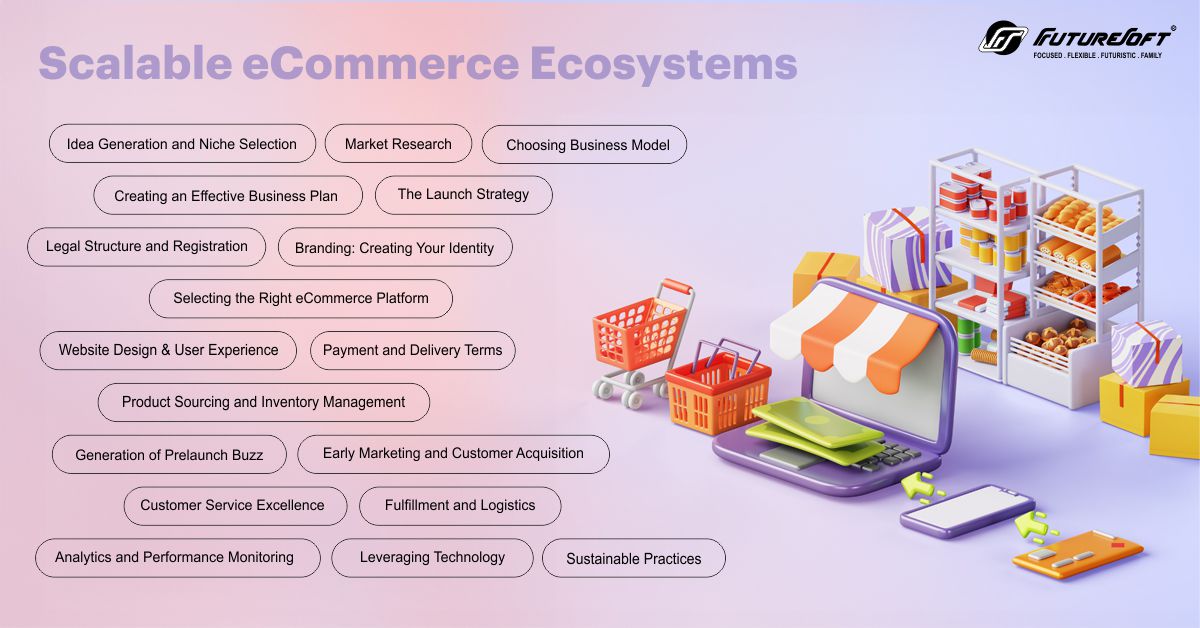
The step-by-step guide to building a scalable eComemrce solution is:

  • Idea Generation and Niche Selection
  • Market Research
  • Choosing Business Model
  • Creating an effective business plan
  • Legal structure and registration
  • Branding: creating brand identity
  • Selecting the Right eCommerce Platform
  • Website design and user experience
  • Product sourcing and inventory management
  • Payment and delivery time
  • Generation of prelaunch buzz
  • The launch strategy
  • Early marketing and customer acquisition
  • Customer service excellence
  • Fulfillment and logistics
  • Analytics and performance monitoring
  • Leveraging technology
  • Sustainable practices

These are the steps that help you build a scalable eCommerce platform for your business.

You can future-proof your eCommerce business by focusing on the following points:

  • Hyper-personalization
  • Continued expansion of social and live commerce
  • Voice commerce
  • Data privacy and security
  • Sustainability as standard
  • AI Evolution
  • Omnichannel Fluidity
  • Headless Commerce
  • AI Agents
  • Automation
  • Augmented Reality

These are ways to futureproof your eCommerce business for long-term sustainability and growth.
Related Blog

Why an eCommerce Website is a Must for a Retail Business

Why an eCommerce Website is a Must for a Retail Business

If you go back a decade, most retailers believed that physical stores were enough to run a profitable business. But customer behavior has changed. With smartphones, fast internet, and digital payments, consumers prefer shopping online instead of standing in queues.
Increase Organic Traffic for Your eCommerce Website

How to Increase Organic Traffic for Your eCommerce Website

Ranking on top positions and relevant keywords in the eCommerce domain is not that easy, especially when you are competing against top websites like Amazon, Etsy, Walmart, Alibaba, etc.
eCommerce Website Development Services Cost

How Much Does an eCommerce Website Development Services Cost?

The digital revolution has changed how businesses operate globally, especially eCommerce websites. Now they can reach a wider audience to attain higher revenue. Developing an eCommerce website involves numerous factors such as choosing the right platform, selecting the features, integrating essential services, and managing associated costs.

Have a project for us?

We would love to be a part of your journey to success. Let's team up today!