
Have you ever paused mid-planning and asked yourself which path will actually move your business forward faster and smarter? That question usually comes up when founders and product leaders reach the crossroads of PWA or a mobile app.
You want reach, speed, performance, and revenue, but budgets and timelines are real constraints. Over the years, we have seen businesses struggle not because of bad ideas, but because of the wrong platform choice.
This blog speaks directly to that pain. It helps you evaluate both options clearly so you can invest in app development with confidence and long-term vision.
Compare PWA vs mobile apps to discover which technology offers better performance, accessibility, development efficiency, and user experience for modern digital products.
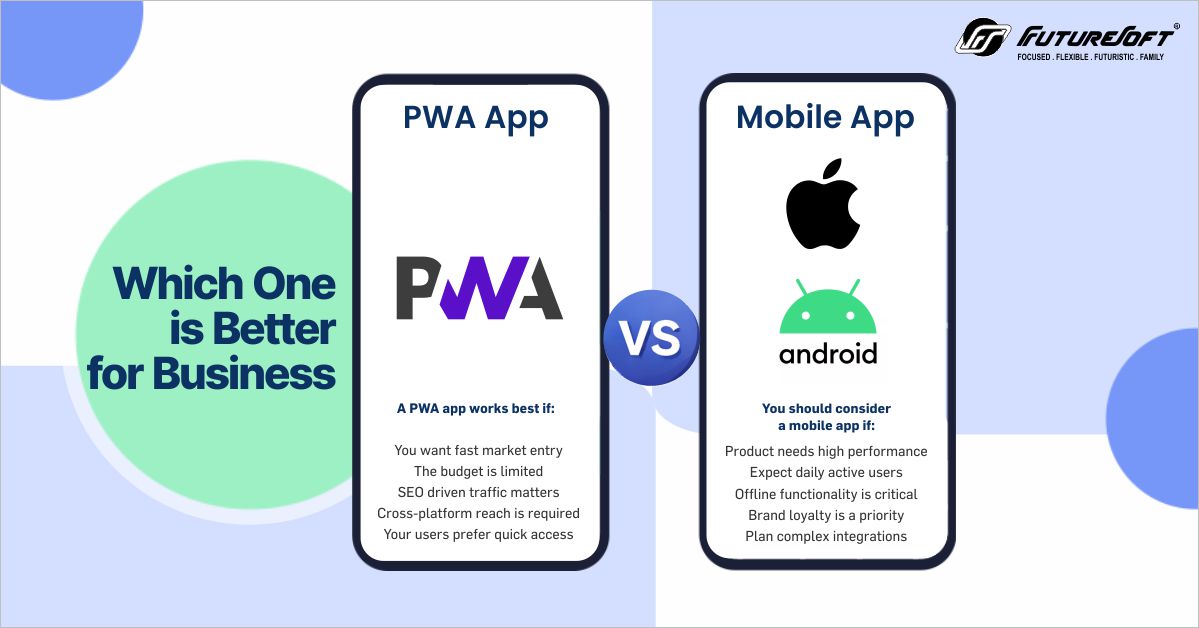
When clients approach me, the first conversation often starts with the words mobile app, PWA app and a lot of confusion. According to Statista, mobile apps are expected to generate over 935 billion dollars in revenue globally by 2025, while Google reports that progressive web app experiences can increase conversion rates by up to 36%.
These numbers show opportunity, but also complexity. You are not just choosing technology. You are choosing how users discover you, engage with you, and stay loyal to your brand. This blog sets the stage by breaking down both options from real business experience, not theory.
Know the difference between Headless Commerce on Magento or Shopify.
A mobile app is a software application built specifically for mobile operating systems like Android or iOS. These are often referred to as a native app because they are designed to work closely with device hardware and system features.
From a business perspective, a mobile app offers several clear advantages.
Companies that invest in a mobile app usually have a clear long-term roadmap. They want depth of engagement, not just reach. This approach suits products where daily or frequent interaction matters.
A progressive web app is built using technologies, but behaves like an app when accessed through a browser. A PWA app works across devices and does not require traditional installation from an app store.
Benefits of a PWA app
From what I have seen, a progressive mobile app is often chosen by businesses that want speed, flexibility, and wider reach. It is especially useful when users discover your product through search or social channels.
Understand which one is better for B2B Magento or Shopify.
Over the years, this comparison has been the most decisive part of client discussions. This is where business goals meet technical reality. Below, I go deeper into each factor, so you can judge impact, not just features.
Installation decides web app perspective; accessibility is its biggest strength. Users can access the app instantly through a browser link. There is no forced commitment. This reduces drop-offs, especially for first-time users arriving from ads or search results.
In many consumer-facing businesses, I have seen this lower acquisition friction dramatically. From a mobile app perspective, installation is a deliberate step. User visit app store, reviews details, and installs.
While this adds friction, it also filters serious users. Businesses with strong brand pull benefit from this commitment-driven behavior.


Performance directly impacts retention and perceived quality.
A progressive web app delivers good speed using caching and modern browser APIs. For content-heavy platforms, this works well. However, performance still depends on browser optimization and device limitations.
A mobile app delivers consistently higher performance. Because it runs closer to the operating system, animations, transitions, and background processes feel smoother. For performance-critical products like fintech or media streaming, this difference is noticeable.
Find the top Shopify themes for Sport Brands.
Offline usage is often underestimated until users ask for it.
A progressive web app supports partial offline access. Cached pages and limited data access work well for reading or browsing scenarios.
A mobile, on the other hand, supports full offline workflows. Users can create, edit, and sync data later. In enterprise and productivity use cases, this capability becomes essential.


This factor affects long-term cost and scalability.
With a progressive web app, one codebase serves all platforms. Updates are instant, and maintenance cycles are shorter. For startups testing product market fit, this flexibility is valuable.
With a mobile app, development often involves separate teams or frameworks for every platform. Maintenance requires version control and store compliance. While costlier, it delivers long-term stability for mature products.
User experience defines how intuitive your product feels.
A progressive web app delivers a consistent interface across devices. However, it still feels browser-driven in certain interactions.
A mobile app provides a deeply immersive experience. Gestures, animations, and hardware-level interactions feel natural. For brand-led products, this experience strengthens emotional connection.
Learn how to prepare eCommerce marketing strategies for your business.

Discoverability affects how users find you organically.
A progressive web app is indexed by search engines. This supports SEO driven acquisition and makes content discoverable globally.
A mobile app relies on app store search and marketing campaigns. Discovery improves with reviews and ratings, but organic reach is more limited.


Push notifications remind users about your app and re-engage them on the app.
A progressive web app supports push notifications on most modern devices. These work well for reminders and updates.
A mobile app offers advanced notification controls. Rich media, action buttons, and deeper personalization improve engagement over time.
Security improves your trust and ensures that users are aware of compliance with privacy and other policies.
A progressive web app uses HTTPS and follows web security standards. This is sufficient for many use cases.
A mobile app benefits from platform-level encryption, biometric authentication, and secure storage. For sensitive data, this adds another layer of confidence.

Monetization strategy influences platform choice.
A progressive web app supports direct payments and subscriptions. This avoids platform fees and gives more control over revenue.
A mobile app integrates with app store billing systems. While fees apply, users often trust these systems more, which can increase conversion rates.
Discover how to create a conversion-driven email campaign.
A platform's compatibility defines your brand reach.
A progressive web app works across devices and operating systems. This simplifies expansion into new markets.
A mobile app requires separate builds and testing. While resource-intensive, it allows platform-specific optimization.


Deployment speed matters in fast-moving markets.
A progressive web app updates instantly. Users always see the latest version without action.
A mobile app requires store approval and user updates. This slows iteration but improves quality control.
Brand visibility influences recall.
A progressive web app lives on the home screen but competes with browser behavior.
A mobile app has a permanent presence on the device. Over time, this builds stronger habitual usage.


App stores act as credibility signals.
A progressive web app bypasses app stores completely.
A mobile app benefits from reviews, ratings, and rankings, which influence trust and downloads.
Scalability means how easily you can upscale or downscale features or modules in your app.
A progressive web app scales like a web platform. Infrastructure upgrades are simpler.
Mobile app scales well but needs planned architecture and release cycles.
Find out the top email marketing campaigns for a better open rate.


Support ecosystems reduce risk.
A progressive web app benefits from a large web developer community and evolving standards.
A mobile app has mature SDKs, extensive documentation, and platform-backed support, which helps with complex builds.
| Factor | Progressive Web App | Mobile App |
| Installation | Optional | Mandatory |
| Performance | Moderate to High | Very High |
| Offline Use | Limited | Advanced |
| Discoverability | Search engines | App stores |
| Development Cost | Lower | Higher |
| Updates | Instant | Store dependent |
| Platform Reach | Universal | Platform specific |
| Monetization | Web payments | In-app purchases |
You should consider a mobile app if:
This is often the answer when clients ask me how to choose the mobile app for long-term engagement.
Learn how to leverage generative AI for eCommerce content creation.
A PWA app works best if:
Many early-stage founders ask me how to choose the mobile app alternative, and this is where progressive solutions shine.
After a decade of advising businesses, my honest answer is that there is no universal winner. The right choice depends on your audience, goals, and growth plan. Understanding how to choose the mobile app or a progressive solution helps you avoid costly mistakes.
This guide gives you clarity so you can speak confidently with partners offering mobile app development pwa app development services. The better informed you are, the stronger your product foundation will be.
The core difference lies in reach versus depth. A progressive web app helps you acquire users faster through search visibility and easy access. A mobile app focuses on deeper engagement, retention, and long-term loyalty.
If your growth depends on quick discovery and lower entry barriers, a PWA app works well. If repeat usage and brand stickiness matter more, a native app supports sustainable business growth.
For most startups, a progressive web app is the better starting point. It reduces initial app development costs, shortens launch timelines, and works across devices. This helps validate ideas quickly.
A native app becomes relevant once user behavior is proven and deeper engagement is required. Knowing how to choose the mobile app approach early helps avoid unnecessary technical debt.
A progressive web app generally has lower maintenance costs due to a single codebase and instant updates. Fixes and improvements roll out immediately. A mobile app requires ongoing updates for different platforms, store compliance, and testing.
This increases long-term maintenance effort. Businesses planning frequent feature updates often find progressive mobile app maintenance more cost-efficient in the early stages.
Yes, a mobile app usually delivers better performance. Native apps access device hardware directly, which improves speed, responsiveness, and offline capabilities. A progressive web app performs well for most use cases but depends on browser limitations.
If performance is critical to user experience, choosing a native app becomes important when evaluating how to choose the mobile app for your product.
Both platforms support monetization, but in different ways. A mobile app benefits from in-app purchases and trusted store billing, which can increase conversions. A PWA app allows direct payments without platform fees, giving more revenue control.
The right choice depends on your business model, audience trust, and long-term monetization strategy tied to app development goals.

Digital growth in the present time is more crucial than ever. Magento or Adobe Commerce is one of the most popular eCommerce platforms that offer a wide array of features and options for owners to scale. However, even though there are a lot of features and applications, many stores still struggle to drive consistent traffic.
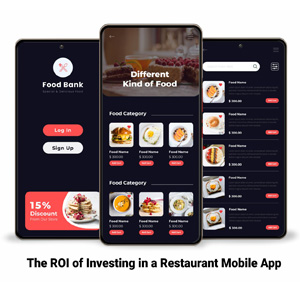
The digital landscape has turned smartphones into an integral part of our lives. Restaurants are increasingly recognizing the importance of mobile apps as a powerful tool for business growth and customer engagement
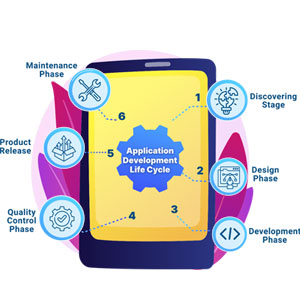
Application development is crucial, and even more imperative when you are operating a business and expecting a pipeline of great projects and revenue. Almost every successful business today is having an application.
We would love to be a part of your journey to success. Let's team up today!