
Have you ever thought that your current eCommerce platform slows innovation, hurts customer experience, or limits your digital presence and omnichannel growth? Many businesses face these exact pain points with traditional monolithic platforms that bind the frontend presentation layer to backend commerce logic.
This blog explores the solution, Headless Commerce on Magento and Shopify. Along with that, it will explore some more important topics related to Headless Magento and Headless Shopify. So, if you are evaluating next-generation commerce platforms that boost agility, performance, and customer engagement, read on.
Gain insights into headless commerce on Magento vs Shopify by evaluating technical architecture, flexibility, benefits, and pricing implications.
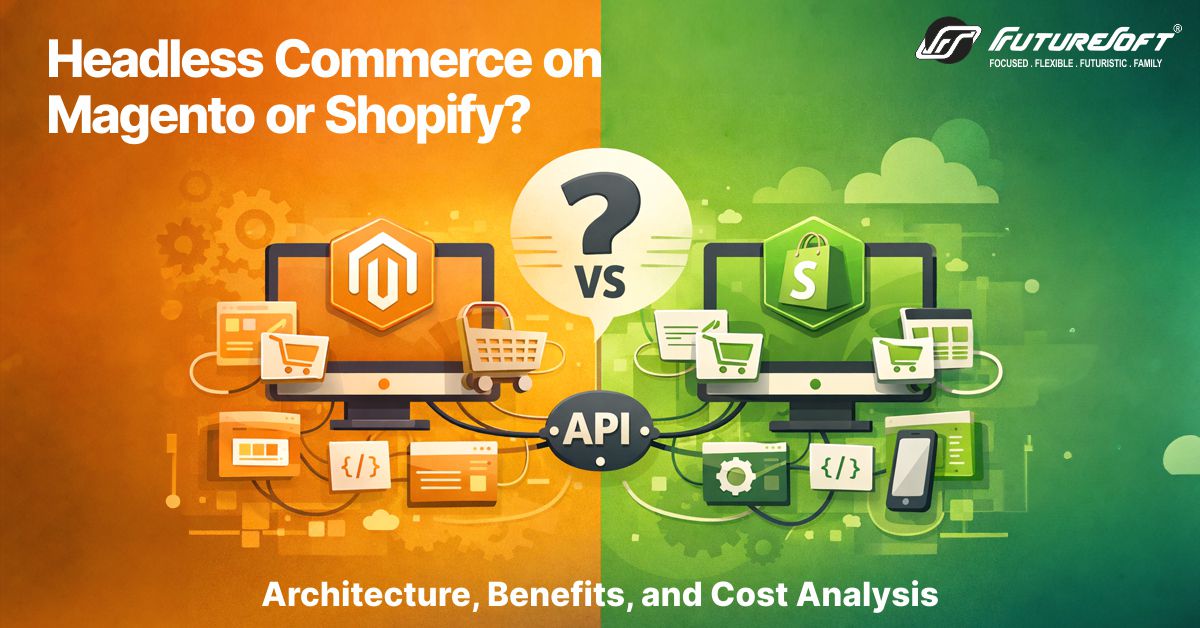
Headless commerce on Magento and Shopify is no longer a buzzword, but an advanced eCommerce reality. It has quickly become a strategic priority for brands looking to accelerate digital innovation while improving site performance and customer experience.
According to Shopify research, slow page speeds cause more than 40% of customers to abandon a website if it doesn’t load in under three seconds, and 64% expect mobile pages to load in under 4 seconds.
Traditional monolithic platforms tie the user interface to backend logic. This creates limits on performance, design flexibility, and scalability, particularly as brands expand into new channels or markets. This blog will cover:
Whether you are planning a migration, redesign, or entirely new commerce implementation, this guide will help you chart the right path.
Find out the detailed analysis of the top 3 jewelry eCommerce websites.
Headless Commerce Shopify has become a preferred option for brands that want speed, operational simplicity, and faster innovation cycles without managing heavy backend infrastructure. Shopify’s headless model is especially attractive to companies prioritizing rapid expansion, global reach, and predictable operating costs.
Shopify’s cloud-native infrastructure supports automatic scaling during traffic spikes such as product launches, seasonal sales, or flash campaigns. In a headless setup, frontend scalability is fully decoupled from backend commerce operations.
This allows businesses to independently scale user experience layers without disrupting checkout, inventory, or order processing. If your brand is experiencing rapid growth or international demand, this scalability reduces operational risk and infrastructure planning overhead.


At the core of Headless Shopify is an API-first philosophy. Shopify exposes storefront APIs and GraphQL APIs that allow developers to pull only the data required for each experience. This results in faster page rendering, lower payload sizes, and more responsive customer interactions.
From a business perspective, this architecture supports faster experimentation with new frontend experiences, campaigns, and personalization logic without touching backend systems.
Find out the checkout tool to increase conversion of your eCommerce website.
One of Shopify’s strongest advantages in headless deployments is its mature app ecosystem. Even when running a custom frontend, businesses can still leverage apps for payments, shipping, subscriptions, analytics, and marketing automation.
This significantly lowers long-term development costs and reduces dependency on large engineering teams, which is a key reason Headless Commerce Shopify is favored by mid-market and enterprise brands alike.

While Shopify excels in speed and simplicity, Headless Magento remains the platform of choice for enterprises with complex catalogs, pricing models, and multi-brand operations. Magento’s flexibility makes it particularly suitable for B2B, hybrid B2B-B2C, and highly customized commerce environments.

Magento’s decoupled architecture allows businesses to separate frontend experience delivery from backend commerce logic while returning complete control over data models, workflows, and integrations.
Discover the top headless Magento website.
This level of architectural freedom supports advanced use cases such as custom pricing rules, segmented catalogs, and region-specific business logic, which are difficult to implement on restrictive platforms.
In Headless Commerce on Magento, a single backend supports multiple frontends, including websites, mobile apps, POS systems, and partner portals. Customer profiles, order history, loyalty programs, and pricing rules remain centralized.
This creates consistent experiences across channels while allowing each frontend to serve a distinct audience or market.


Magento headless implementations allow organizations to design frontend experiences without template or framework limitations. This is particularly valuable for brands that compete on experience differentiation rather than price alone.
Custom design systems, advanced search experiences, and immersive product discovery flows can be built without backend constraints.
Headless Magento aligns well with microservices strategies. Businesses can incrementally replace or improve parts of the system, such as search, personalization, or checkout, using independent services.
This reduces long-term technical debt and supports gradual modernization rather than risky full-platform rewrites.
Know the best third-party logistics partners for jewelry in India.

A headless architecture separates experience delivery from commerce logic. This approach improves performance, flexibility, and scalability while reducing dependencies between frontend and backend teams. Both Magento and Shopify implement this concept differently, which impacts cost, complexity, and long-term governance.
Magento Headless ArchitectureMagento’s headless model is designed for organizations that want granular control over every layer of their commerce stack.
The frontend is typically built using modern JavaScript frameworks, while Magento’s backend handles core commerce functions such as catalog management, pricing, promotions, customer accounts, and order processing. This separation allows frontend teams to deploy changes independently, improving release velocity and reducing regression risk.


Magento exposes REST and GraphQL APIs that allow frontends to request commerce data dynamically. This API-driven communication supports real-time updates, faster interactions, and improved performance metrics.
For SEO and performance-sensitive businesses, this architectural pattern provides measurable gains in page load speed and engagement.
Know how to select a virtual try-on solution for your jewelry and watch website.

A middleware layer optimizes data flow between frontend and backend systems. It aggregates API responses, applies business logic, and improves frontend performance by reducing redundant calls. For large enterprises, this layer becomes essential for managing complexity at a scale.
Deploying front-end assets closer to users through edge networks significantly improves global performance. Intelligent caching strategies reduce backend load while maintaining real-time accuracy for pricing and inventory.


Magento headless setups often act as a foundation for microservices adoption. Over time, businesses can decouple functions like search, recommendations, and analytics into independent services without disrupting core commerce operations.
Shopify’s headless architecture focuses on simplicity, speed, and developer productivity.

The frontend is built using modern frameworks that communicate directly with Shopify APIs. This allows teams to deliver highly optimized user experiences while maintaining a clean separation from backend commerce logic.
Learn the key features to have on your clothing eCommerce website.
Shopify’s API provides access to products, carts, customers, and checkouts. The API layer is designed to be developer-friendly, which reduces implementation time and accelerates frontend experimentation.

Shopify continues to manage payments, security, compliance, and order processing. This significantly lowers operational overhead and reduces the need for in-house infrastructure management.
Hydrogen in Shopify’s React-based framework is designed specifically for headless storefronts. It provides prebuilt components and performance optimizations that reduce development effort while maintaining flexibility.
Oxygen offers global edge hosting optimized for Hydrogen storefronts. This hosting layer improves reliability and reduces latency across regions.
A headless CMS enables marketing and content teams to manage editorial content independently from developers. This separation improves content velocity and campaign execution without affecting commerce logic.
Discover how to calculate the total cost of ownership of your eCommerce website.
From a financial perspective, Shopify headless pricing and Magento headless pricing differ significantly in structure. Shopify typically involves lower upfront costs and predictable monthly expenses, which appeal to businesses seeking faster ROI and controlled budgets. Magento requires a higher initial investment due to custom development and infrastructure needs, but offers greater flexibility for complex use cases and long-term scalability.
Learn everything about the warehouse management system.
Cost considerations should include frontend development, middleware, hosting, integrations, maintenance, and internal team requirements. Choosing the right platform depends on business complexity, growth plans, and internal technical maturity.
Headless Commerce Cost Breakdown
| Cost Components | Headless Shopify | Headless Magento |
| Platform & Licensing | Shopify Plus: ~$2,000+/mo | Magento Open Source: Free / Enterprise: $22,000-$125,000/yr |
| Frontend Development | $10,000-$100,000+ | $50,000-$150,000+ |
| API & Middleware | $5,000-$20,000 | $20,000-$80,000 |
| Hosting & Edge | $100-$2,000/mo | $500-$2,500+/mo |
| Integrations | $3,000-$15,000 | $10,000-$50,000 |
| Ongoing Maintenance | $1,500-$5,000/mo | 10-20% of dev cost annually |
Headless commerce platforms are redefining digital commerce. For businesses that prioritize rapid delivery and predictable pricing with strong ecosystem support, Headless Commerce Shopify is a compelling choice.
For enterprises with complex use cases that need deep customization and control, Headless Commerce on Magento offers unmatched flexibility and power. Regardless of your choice, adopting a headless architecture positions your business for future innovation, improved performance, and superior customer experiences.
If you are evaluating Magento development services and Shopify development services, this analysis should help you prepare a realistic budget, define your priorities, and engage with the right partners to execute your vision.
Headless Commerce separates the frontend experience from backend commerce logic. In Headless Commerce on Magento and Headless Commerce Shopify, APIs deliver product, cart, and checkout data to any interface.
This removes the limits of monolithic systems that slow updates and restrict design. A modern headless Commerce platform improves speed, SEO, and omnichannel delivery while reducing release risk. Brands adopt Headless Magento or Headless Shopify to gain agility, higher conversions, and future-ready growth.
. For B2B and complex catalogs, Headless Commerce on Magento is usually stronger. Headless Magento supports tiered pricing, custom catalogs, contract terms, and multi-account buyers. Its headless architecture fits deep workflows and ERP links.
Headless Commerce Shopify works well for simpler B2B models with faster rollout needs. Companies with advanced pricing and segmentation usually select a Magento-based headless Commerce platform for long-term control and scale.
Hydrogen and Oxygen in Headless Shopify offer a fast path to build and host React storefronts with global delivery. Magento PWA with microservices in Headless Commerce on Magento gives deeper control over data, logic, and integrations.
Shopify favors speed and ease of use. Magento favors customization and system depth. Both fit a modern headless Commerce platform, but Magento supports more complex business rules while Shopify supports quicker execution.
Costs include frontend development, API and middleware, hosting, integrations, and ongoing support. Shopify headless pricing includes subscription and Hydrogen Oxygen hosting. Magento headless pricing includes development, hosting, and possibly enterprise licensing.
Headless Commerce on either Magento or Shopify also requires CMS, analytics, and personalization tools. A headless Commerce platform costs less to scale on Shopify but offers more depth on Magento for complex builds.
. Yes, existing stores on Magento and Shopify can migrate to Headless Commerce without changing backend data. Headless Commerce on Magento uses APIs to connect new frontends to current catalogs and orders.
Headless Commerce Shopify does the same with Storefront APIs and Hydrogen. This lets brands adopt a modern headless architecture while keeping existing systems, which lowers risk and speeds up transformation.

Headless commerce is a revolutionizing technology that’s changing the eCommerce landscape. It provides businesses with unparalleled flexibility, speed, and scalability. This technology decouples the front-end and back-end to create a seamless omnichannel experience according to evolving consumer needs.

The digital revolution has changed how businesses operate globally, especially eCommerce websites. Now they can reach a wider audience to attain higher revenue. Developing an eCommerce website involves numerous factors such as choosing the right platform, selecting the features, integrating essential services, and managing associated costs.

Shopify website development there are a lot of costs involved apart from buying Shopify subscription plans such as themes, plugins, domains, and hiring professionals. We will discuss how these factors impact the total development cost.
We would love to be a part of your journey to success. Let's team up today!