
You created a perfect email marketing campaign and sent it to users with the hope of receiving the best results and above-average conversions. However, the results came out differently and were way less than expected.
That’s not just your problem, but a majority of email marketers overestimate their email marketing campaigns. To get desired results, you need to dive deeper and understand how to connect, engage, and convert through impactful and personalized email strategies.
That’s why you need some tips that can guide you to focus specifically on your target audience. You need to learn to use smart email campaign best practices to increase conversion.
Following email campaign best practices is no longer optional because it’s essential for brands that want measurable conversions. We all receive around 100-120 marketing emails per day, according to the data provided by Statista.
However, to turn those sends into meaningful sales or engagement, you need to address the audience's intent, personalization, and structure to convert. This blog will let you know everything you need to know to create a conversion-driven email marketing campaign that stands out.
Additionally, we will tell you how to define clear goals, build trust with your audience, add value through your messages, and use automation to maximize your email marketing conversion rates. You will also learn what makes your campaigns relatable, persuasive, and memorable.
Understand how AI tools are supercharging your social media marketing services.
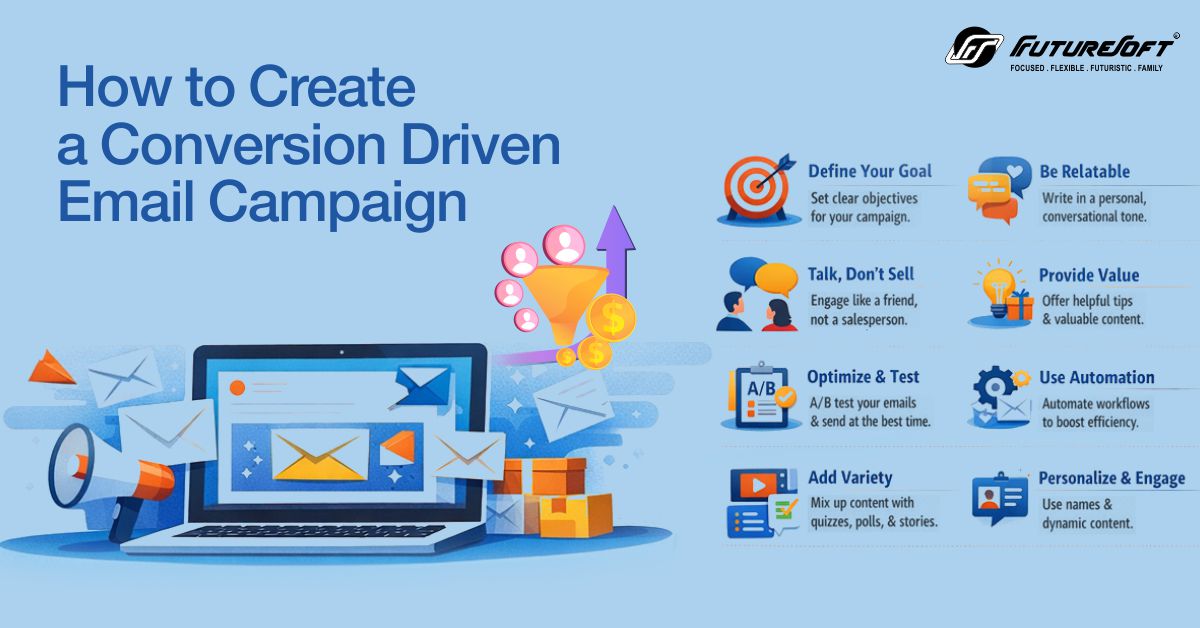
A successful email campaign is more than just sending messages; it’s about connecting with your audience in a way that sparks interest and drives action. Here are some of the proven steps and email campaign best practices that can help you improve engagement and boost conversion rate in email marketing results.
Every great email campaign starts with clarity. Before hitting send, ask yourself: What would I do? What do I want the recipient to do? Is the message convincing enough for a click? Do you want them to sign up for a webinar, purchase a product, or read a blog?
As per HubSpot, 73% of marketers say setting clear objectives improves overall campaign effectiveness. Without a set goal, your content will lack focus.
For example, if your goal is to increase product trials, your email content, CTA, and visuals should all direct users toward that single action. This goal-driven approach helps in better email campaign management and tracking success through metrics like click-through and conversion rates.


Relatability builds connections. Your audience should feel that the email was written just for them. Avoid robotic language or generic phrases like “Dear Customer.” Instead, you need to use conversational tones and be personal that mirror real communication.
A relatable email feels authentic. For example, see how Spotify sends you personalized “Year Wrapped” summaries that make you smile. This human touch not only improves engagement along with raising your email marketing conversion rates because people connect with brands that understand their emotions and preferences.
Don’t sell, converse. People are tired of being constantly marketed to. Instead of writing a promotional pitch, try creating a meaningful dialogue.
For example, an email that starts with, “We noticed you loved our last webinar; how about joining the next one?” Sounds more inviting than a direct sales pitch. This approach transforms your email from an advertisement into a relationship builder, which directly boosts conversion rate in email marketing outcomes.


Value-driven emails outperform promotional ones every single time. Whether it’s a free guide, insider tip, or industry update that offers value establishes trust.
According to Statista, 49% of consumers prefer to receive brand updates through email when the content is informative and useful. This is where email marketing best practices come in: focus on educating, not selling.
A company offering digital marketing services can send a monthly insights newsletter highlighting the latest trends. That adds value and subtly promotes expertise.
Optimization is the heartbeat of conversion. If your emails don’t reach your target audience at the right time or on the right device, even the best content will fail. Optimize your subject lines, visuals, and send times.
For instance, emails sent on Tuesday mornings often see 20% higher open rates compared to weekends. Use A/B testing to find what works best. Good email campaign management also involves cleaning your email list regularly.
This helps maintain high deliverability and improves email marketing conversion rates by avoiding inactive subscribers.


Every email must have a purpose beyond promotion. Think of what benefit the reader gets from opening it. For example, if you are sharing a new product, don’t just talk about features; highlight the problems it solves. Purpose-driven communication builds trust and keeps your audience engaged longer.
Brands that communicate purpose effectively experience 30% higher engagement rates, according to Campaign Monitor. That’s why this principle stands as one of the best practices for B2B email marketing too.
Find out the latest Adobe Commerce trends you must know.
Monotony kills engagement. If every email looks or sounds the same, subscribers tune it out. Introduce variety through newsletters, polls, customer stories, or video snippets. You can even use interactive elements like “Click to Reveal” offers or mini-quizzes.
These not only help in making your email more engaging but also increase time spent on the message, a key to conversion rate in email marketing.
For example, Airbnb sends beautifully designed experience stories mixed with travel tips to keep their communication exciting and refreshing.


Great emails linger in the reader’s mind. It could be a powerful message, a clever visual, or even humor that sticks. Use storytelling as your weapon. Stories are remembered 22 times more than facts, as per cognitive studies.
A short, emotional narrative that aligns with your brand identity helps recipients associate positive feelings with your name. When people remember your brand, they are more likely to convert later, improving email marketing conversion rates significantly.
Know about the 15 best eCommerce websites for electronics.
Automation makes your campaign smarter. Whether it’s a welcome series, re-engagement emails, or cart recovery reminders, automated flows drive conversions effortlessly.
For instance, triggered emails (like abandoned cart reminders) generate 70% higher open rates compared to standard broadcasts. With smart automation, businesses can also scale up email campaign management and save hours while maintaining personalization.
Platforms like Mailchimp and HubSpot allow segmented automation to ensure every subscriber gets content relevant to their stage in the buyer journey.


Personalization isn’t just about using someone’s first name. It also includes using a recognizable “From” address. People are 30% more likely to open an email that comes from a person rather than a brand name, according to Experian. Instead of “info@company.com” try “raj@company.com.”
This small shift humanizes your campaign and strengthens trust, an essential component of email marketing best practices. Over time, it fosters consistent engagement and higher open rates.
Engagement is the heart of every conversion. Your email design, tone, and message should captivate readers. Start with irresistible subject lines, followed by concise, value-driven content. Use visual elements like GIFs or infographics where appropriate.
Interactive CTAs like “Grab My Spot” or “Get the Secret” often perform better than dull “Learn More” buttons. According to HubSpot, engaging CTAs can increase clicks by 202%. That’s the difference between an opened email and a converted one, key to conversion rate email marketing success.
Discover 15 Shopify jewelry stores that showcase their creativity.


The email preview text is your hidden opportunity. It appears right next to the subject line and can boost open rates dramatically. Use this space to expand curiosity or hint at what’s inside the email. For example:
These subtle hooks often drive higher engagement. Smart marketers always treat previews as mini-CTAs, part of email campaign best practices that elevate performance.
Appealing emails resonate emotionally and visually. The design, tone, and offer should align with your audience type. If your subscribers are B2B professionals, keep it sleek, informative, and insightful.
If they are lifestyle shoppers, make it vibrant and aspirational. In both cases, your copy must connect with pain points and aspirations. This strategy, when paired with best practices for B2B email marketing, ensures relevance and conversions. Appealing emails make users pause, read, and act.


Your sending reputation matters. Spam filters and email providers track your sender behavior. High bounce rates or spam complaints can ruin your domain’s credibility. Use verified sending domains and warm them up gradually.
Tools like SendGrid and Mailgun provide excellent insights into the deliverability of health. Clean email lists and ethical sending habits are central to email campaign management. Good sender reputation equals more inbox visibility, which directly improves email marketing conversion rates and ROI.
Creating conversion-driven campaigns isn’t just about design or timing; it’s about delivering meaningful experiences that inspire action. From defining your goal to mastering personalization and automation, every small step contributes to higher email marketing conversion rates and brand credibility.
For businesses and professionals aiming to transform their outreach, following email marketing best practices is the smartest investment. With a consistent strategy, authentic content, and the right execution, you can convert subscribers into loyal customers.
If you are ready to take your campaigns to the next level, connect with us today. Our expert email marketing services and digital marketing services help brands like yours achieve measurable growth through strategic email communication that converts.
The best practices for email marketing include defining clear goals, segmenting your audience, writing engaging subject lines, and personalizing each email. Use automation, A/B testing, and mobile-optimized designs to improve reach.
Always track key metrics such as open rates and conversions. Providing value, maintaining a consistent schedule, and following ethical sending rules are essential for strong email campaign management and improved conversion rate email marketing results.
A conversion happens when a recipient takes a desired action after reading your email. It could be purchasing a product, signing up for a service, or downloading a resource. Measuring conversions helps marketers assess email marketing conversion rates and identify what motivates audience engagement.
High conversions reflect the success of your campaign strategy and adherence to email marketing best practices.
Effective email campaign management involves planning, scheduling, monitoring, and optimizing every campaign. Use professional tools like HubSpot or Mailchimp to automate workflows, segment audiences, and track results.
Regularly clean your contact list, personalize your communication, and evaluate performance metrics such as click-through and conversion rates. Strong management ensures better deliverability and boosts the conversion rate of email marketing outcomes.
Subject lines are the first thing your audience sees. A strong, curiosity-driven subject line increases open rates by up to 35%. Avoid spammy words and focus on clarity, value, and relevance.
They play a vital role in email campaign best practices because they determine whether your email gets opened or ignored.
The ideal frequency depends on your audience and goals, but consistency matters more than volume. Most businesses find success sending one to two emails per week. Test frequency through analytics to avoid fatigue and unsubscribes while keeping engagement high.
Have you ever wondered how large-scale websites like Airbnb, Canva, or G2 rank high on search engines despite having thousands or even millions of pages? The secret lies in a scalable approach known as Pragmatic SEO.

A lot has changed in SEO in the past few years. All this is powered by digital transformation and AI (Artificial Intelligence). The rules for online visibility are being rewritten. Traditional searches and SEO rely on clicks and traffic which is being disrupted by the rise of zero click searches.

In 2025, online shoppers are more demanding than ever. Competition is fierce, algorithms keep evolving, and buyers expect fast, engaging, and personalized experiences before they even consider clicking “Add to Cart”.
We would love to be a part of your journey to success. Let's team up today!