
Thinking about starting your own online store, but not sure where to begin? You are not alone. Building an eCommerce website can feel overwhelming with so many tools, technologies, and strategies to choose from.
This guide simplifies the journey. It shows you how to turn your idea into a full-fledged, functional, and high-performing online store that not only looks great but also converts visitors into customers.
We have explained everything, from choosing the right setup to creating engaging shopping experiences and streamlining payments.
Whether you are a beginner or looking to upgrade your current store, this eCommerce development guide will help you confidently step into the world of online store development and build a business that’s ready to grow.
Discover the complete process of building an eCommerce website with SEO, mobile optimization, and conversion strategies.
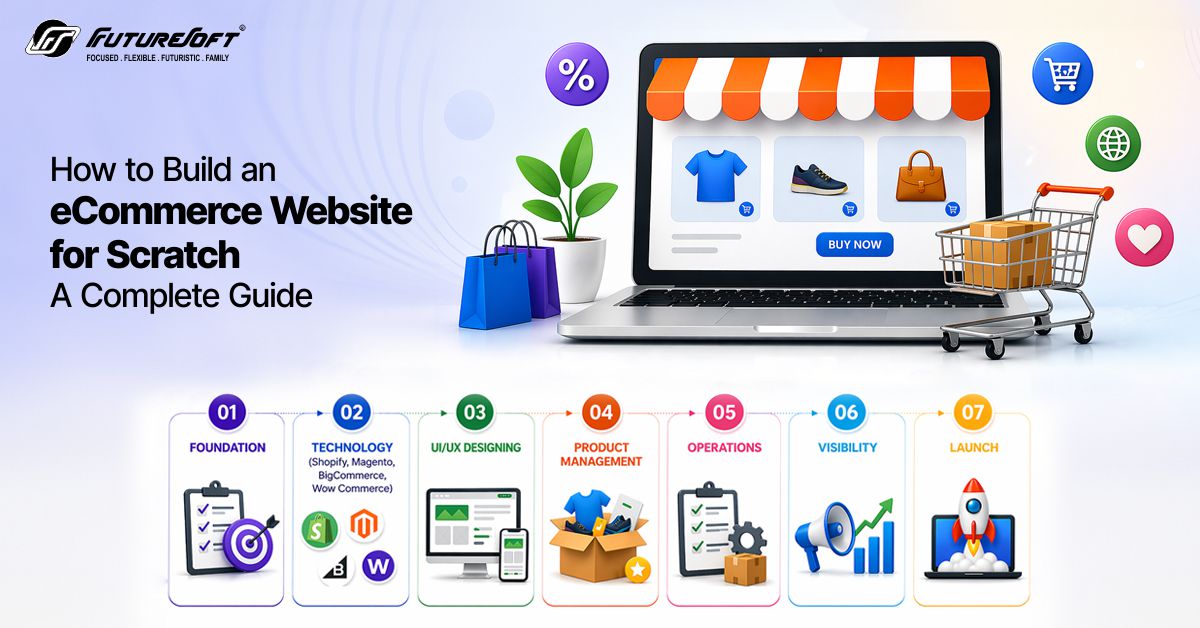
The eCommerce landscape in 2026 has evolved into a sophisticated ecosystem driven by AI-powered eCommerce, composable architectures, and immersive user experiences. If you are searching for an eCommerce development guide that goes beyond basic tutorials, you are in the right place.
Today, building an online store is no longer just about listing products; it’s about creating a living system that adapts, learns, and sells autonomously.
Modern online store development now integrates AI agents, predictive analytics, and hyper-personalized journeys. Businesses are shifting from static storefronts to dynamic ecosystems where human users and AI agents interact seamlessly.
This guide will walk you through how to build an e-commerce website from scratch. It also covers strategy, technology, UX, operations, and future-ready innovations. This roadmap will help you master the eCommerce website development process and understand what is eCommerce website development.
Learn about the best SEO tools to analyze your website performance.
eCommerce website development refers to the complete process of creating an online platform where you can sell your products or services digitally. It involves designing the user interface, building the backend infrastructure, integrating payment systems, and optimizing the site for performance and conversions.
In simple terms, it’s the foundation of any successful online business.
An effective eCommerce website development process goes beyond just building a website; it focuses on creating a seamless shopping experience for users while ensuring scalability and automation for business owners.
| Stage | Purpose |
|---|---|
| Planning | Define goals, audience, and business model |
| Design | Create UI/UX for better engagement |
| Development | Build frontend and backend systems |
| Integration | Add payments, shipping, and tools |
| Testing | Fix bugs and optimize performance |
| Launch & Optimization | Go live and improve continuously |
Learn about the top tools to skyrocket conversions for D2C brands.
Understanding the eCommerce website development cost in India is one of the first steps before starting your online business. The total cost depends on multiple factors such as platform selection, features, design complexity, integrations, and scalability requirements.
If you are wondering how much doe it costs for an eCommerce website, the answer isn’t fixed; it can range from basic level store development to enterprise-grade solutions. The cost of developing an e-commerce website varies based on your business goals and the level of customization required.
| Project Type | Shopify | WooCommerce | Magento |
|---|---|---|---|
| Basic Store | 1 lakh | 2.5 to 3 lakhs | 4.5 - 5.5 lakhs |
| Mid-Level Store | 1.5 - 2 lakhs | 4.5 - 5 lakhs | 7.5 - 9 lakhs |
| Enterprise Store | 6 lakhs | 7 - 9 lakhs | 10 lakhs + |
Start lean and scale gradually. Instead of investing heavily upfront, validate your idea with a basic store and upgrade as your business grows. This approach optimizes your cost of developing an e-commerce website while reducing risk.
Choosing the best platform to build ecommerce website is one of the most critical decisions in your journey. Your platform determines how your store performs, scales, and adapts to future trends like AI-powered ecommerce and headless commerce.
A smart decision in eCommerce platform development ensures flexibility, faster growth, and better user experience, while a poor choice can limit your business in the long run.
Before selecting a platform, evaluate these essentials:
Always choose a platform not just for your current needs, but for where your business will be in the next 2–3 years.
Discover the top headless Magento websites that are scaling because of the architecture.
Shopify is a user-friendly, SaaS-based eCommerce platform that allows businesses to quickly launch and manage online stores without technical expertise. It offers built-in hosting, security, and a wide app ecosystem. This makes it ideal for beginners and growing brands.
Best for:
Advantages:
Limitations:
Magento, also known as Adobe Commerce, is a powerful, enterprise-level eCommerce platform designed for large-scale businesses. It offers extensive customization, advanced features, and scalability, making it suitable for complex catalogs, B2B operations, and high-growth ecommerce environments.
Best for:
Advantages:
Limitations:
WooCommerce is an open-source ecommerce plugin for WordPress that provides flexibility and control over your online store. It is ideal for content-driven websites, offering strong customization options and SEO capabilities, though it requires plugins and technical management for advanced features.
Best for:
Advantages:
Limitations:
Learn about the best third-party logistics partner for jewelry in India.
| Feature | Shopify | WooCommerce | Magento (Adobe Commerce) |
|---|---|---|---|
| Ease of Use | Very Easy | Moderate | Complex |
| Customization | Limited | High | Very High |
| Scalability | Good | Good | Excellent |
| Cost | Subscription-based | Low to Medium | High |
| Hosting | Included | Self-hosted | Self/Cloud-hosted |
| Best For | Beginners & SMEs | Content-driven stores | Enterprise & B2B |
Since the platform you choose can impact your store's growth and performance, it's worth reviewing the differences between Shopify vs WooCommerce vs Magento before making a decision.
1.1. Identifying Your Market
In this phase, you need to set the strategic backbone of your entire store. Before you invest in tools or design, you need absolute clarity on who you are selling to, how you will sell, and what makes your brand different.

Many failures in online store development happen not because of poor technology, but because the foundation is weak. A well-defined foundation ensures that every step in your eCommerce website development process is aligned with revenue goals, customer expectations, and scalability.
Start with understanding demand, not assumptions.
Key actions:
Expert Tip: Don’t forget “everyone.” Narrow positioning improves conversions and reduces marketing costs significantly.
1.2. Choosing the Right Business Model
Your business model defines how value flows between you and your customers. Selecting the right one is critical for long-term success.
Core eCommerce Business Models
Expert Tip: B2B models require strong backend systems (bulk pricing, custom catalog), while B2C focuses more on UX and branding.
Understand the difference between native and hybrid apps.
1.3. Selecting Your Shipping and Fulfillment Model
How you deliver products is just as important as what you sell. Your logistics model directly impacts margins, scalability, and customer satisfaction.
Popular eCommerce Fulfilment Models
Expert Tip: If you’re just starting, dropshipping reduces risk. For long-term brand building, D2C or private label offers better control and profitability.
1.4. Secure Your Digital Real Estate
Your domain and infrastructure are long-term assets.
What to secure:
These steps ensure brand ownership and protect your identity as your eCommerce platform development grows.
1.5. Brand Identity
Your brand is what customers remember, not just what they buy.
Key elements:
Strong branding directly impacts trust, which is critical in AI-powered eCommerce when users rely on quick decisions.
At this stage, you should have:
This foundation doesn’t just guide your strategy; it determines how effectively you can execute the rest of your eCommerce website design and development journey.
Understand the mobile application development process.

This phase is where your business vision turns into a functional system. The technology you choose will directly impact your store’s performance, scalability, flexibility, and ability to support AI-powered eCommerce.
A poor tech decision can limit growth, while the right one can future-proof your entire operation. In modern online store development, the focus is no longer just on building a website; it’s about creating a composable ecosystem that can evolve with changing customer behavior and emerging technologies.
2.1. Choosing the Right eCommerce Platform
Selecting the best platform to build eCommerce website is one of the most critical decisions in your journey. Your choice should align with your business model, technical expertise, and growth plans.
Popular eCommerce Platforms
2.1.1.Shopify (Saas-Based):
2.1.2. Magento (Adobe Commerce)
2.1.3. BigCommerce
2.1.4WooCommerce
Expert Tip: If speed and simplicity matter, go with Shopify. If customization and scalability are your priority, Magento (Adobe Commerce) or a headless setup is a better fit.
2.2. SaaS vs. Open Source vs. Headless Commerce
Your platform decision also determines your architecture approach.
2.2.1. SaaS (Software as a Service)
It offers:
2.2.2. Open Source
2.2.3. Headless Commerce (Recommended)
This is where modern eCommerce platform development aligns with MACH principles:
Expert Tip: Headless architecture is essential for scaling AI-powered eCommerce, allowing personalized experience across web, mobile, apps, and even voice interfaces.
2.2.3 Performance-First Hosting
Speed is a ranking factor, a UX factor, and a revenue factor.
Key components of modern hosting:
Slow websites kill conversions. Performance optimization should be a core part of your eCommerce website development process.
2.3 The Tech Stack of 2026 (Wasm, Serverless, and APIs)
The modern eCommerce stack is modular, scalable, and API-driven. Key Technologies
This setup supports:
Learn how to manage product variants in Magento.
2.4. Integration That Power Growth
Your eCommerce platform is only as powerful as its integrations.
Essential integrations:
These integrations are crucial for building a strong eCommerce website design and development ecosystem.
2.5. Future-Proofing Your Infrastructure
Technology evolves fast. Your system should be adaptable.
What to prioritize:
Bringing It All Together
At the end of this phase, you should have:
This phase lays the groundwork for advanced capabilities like AI-powered eCommerce,immersive UX, and seamless integrations. It ensures that your store is ready not just for today, but for future growth.
3.1. The Mobile-First Paradigm
Over 80% of eCommerce traffic is mobile.
Best practices include:

Mobile-first thinking is critical in eCommerce website design and development.
3.2. Advanced Information Architecture
Your site structure should guide users effortlessly.
Key principles:
Expert Tip: Use behavioral data to dynamically adjust navigation menus for each user.
3.3. Immersive Product Experience (AR and 3D Modeling)
In 2026, static images are obsolete.
Must-have features:
These innovations significantly boost conversions and reduce returns.
Discover eCommerce automation and how it helps automate your website.

4.1. Strategic Product Detail Pages (PDP)
Your PDP is your sales engine.
Optimize with:
4.2. Benefit-Driven Copywriting
Don’t just describe, sell.
Focus on:
This approach strengthens how to create an eCommerce website that converts.
4.3. Dynamic Product Listing Pages (PLP)
PLPs should adapt in real time.
Features:
Understand lifecycle email strategy from welcome to win back.
5.1. Configuring Global and Local Payment Gateways
The eCommerce checkout process in 2026 is radically different.
Key innovations:
Expert Tip: Minimize friction. Every extra step reduces conversions.

5.2. Logistics and Fulfillment
Efficient logistics define customer satisfaction.
Modern strategies:
5.3. AI-Assisted Operations (Dynamic Pricing and PIM)
AI-powered eCommerce enables:
This is the future of scalable online store development.
Find out the difference between Magento and Shopify for B2B.

6.1. Traditional SEO in 2026 (E.E.A.T. and Core Web Vitals)
SEO still matters, but it’s evolved.
Focus areas:
6.2. GEO (Generative Engine Optimization)
AI search engines now dominate discovery.
To optimize:
Schema Strategy:
This ensures AI engines cite your site in responses.
6.3. Conversational Commerce (AI Shopping Assistants)
Customers now shop via AI assistants.
Key trends:
This transforms how to create an eCommerce website for modern users.
Discover how to prepare eCommerce marketing strategies for your business.
7.1. Zero-Trust Security
Security is critical in eCommerce.
Best practices:

7.2. The Pre-Launch Checklist
Before going live:
This final stage completes the eCommerce website development process and reinforces your understanding of what is eCommerce website development in a practical sense.
7.3. Analytics and Attribution
Data drives growth.
Essential tools:
Learn how to convert eCommerce analytics into business growth.
Effective eCommerce website design and development is not just about aesthetics; it’s about creating a seamless, high-converting experience that guides users from discovery to purchase with minimal friction.
In today’s competitive landscape, strong design directly influences trust, engagement, and revenue. Below are the key best practices to ensure your store is optimized for performance and eCommerce conversion optimization:
With most users shopping on mobile devices, your website must be designed for smaller screens first.
A slow or poorly optimized mobile experience can significantly reduce conversions.
Speed is critical for both SEO and user experience.
Even a 1-second delay can impact your eCommerce conversion optimization metrics.
Users should find what they need within seconds.
A well-structured layout improves usability and reduces bounce rates.
Know the essential features to have on your food and beverage eCommerce website.
Your product pages must build confidence and clarity.
Strong visuals play a major role in eCommerce website design and development success.
A complicated checkout process leads to cart abandonment.
A frictionless checkout is essential for better eCommerce conversion optimization.
Customers need reassurance before making a purchase.
Trust elements directly impact purchase decisions.
Modern ecommerce relies on personalization.
This enhances engagement and boosts conversions.
Your design should reflect a strong brand identity.
Consistency builds recognition and trust.
Learn the 101 of warehouse management system.
AI-powered eCommerce is no longer optional. It’s a competitive necessity. It enables online stores to analyze user behavior, predict intent, and deliver highly relevant experiences in real time.
Instead of static storefronts, businesses now operate intelligent systems that adapt to each customer, improving engagement, efficiency, and revenue.
One of the most impactful applications of AI is eCommerce personalization. AI analyzes browsing patterns, purchase history, and preferences to display tailored product recommendations, personalized offers, and dynamic content.
This not only improves user satisfaction but also significantly increases average order value and repeat purchases.
Traditional search is being replaced by intelligent search systems that understand natural language and intent. Features like predictive search, voice search, and visual search help users find products faster. This reduces friction and enhances the overall shopping journey.
AI helps businesses adjust pricing in real time based on demand, competition, and user behavior. It also predicts inventory needs, reducing overstocking or stockouts. These capabilities make operations more efficient and data-driven.
Realize 15 best Shopify jewelry store.
Chatbots and virtual assistants provide instant responses to customer queries, handle order tracking, and even assist in product selection. This ensures 24/7 support while reducing operational costs and improving customer satisfaction.
AI systems monitor transactions in real time to identify suspicious activities and prevent fraud. This builds trust and ensures a secure shopping environment for users.
Modern AI-powered eCommerce integrates technologies like augmented reality and virtual try-ons, allowing users to visualize products before purchasing. This is especially effective for industries like fashion, jewelry, and eyewear, where experience plays a crucial role.
Once your online store is live, the focus shifts to improving customer engagement and increasing conversions. Many businesses now use AI-powered eCommerce solutions to personalize user journeys, analyze customer behavior, and streamline support processes.
A complicated or slow ecommerce checkout process is one of the biggest reasons customers leave without completing a purchase. Even when users show strong buying intent, friction at checkout can instantly increase your cart abandonment rate.
Optimizing this final step is critical for maximizing conversions and revenue.
Customers expect a quick and effortless checkout. Long forms, multiple steps, or forced account creation create unnecessary friction. A smoother ecommerce checkout process keeps users focused and reduces drop-offs.
Security concerns are a major reason for abandoned carts. If users don’t feel safe, they won’t proceed. Trust signals directly lower the cart abandonment rate.
Time is critical. The longer the checkout takes, the higher the chances of losing the customer. Modern AI-powered eCommerce systems even enable agentic payments, where AI assistants can complete purchases instantly.
After launching your ecommerce website, focus on optimizing the checkout experience to reduce shopping cart abandonment and turn more visitors into paying customers.
Limited payment methods can cause hesitation. Providing multiple options improves accessibility and reduces friction in the ecommerce checkout process.
Unexpected shipping fees or taxes at checkout often lead to abandonment. Transparency helps maintain trust and lowers the cart abandonment rate.
With most users shopping on mobile devices, a poorly optimized checkout leads to frustration.
To rank your ecommerce website on Google, you need a solid SEO foundation. Start with keyword research to understand what your target audience is searching for. Optimize product titles, descriptions, and category pages with relevant keywords while maintaining natural readability.
Ensure your website structure is clean, with proper URLs, internal linking, and sitemap submission. Google prioritizes websites that are easy to crawl and provide clear value to users.
Content plays a major role in rankings. Your website should demonstrate Experience, Expertise, Authority, and Trust (E-E-A-T). Create detailed product descriptions, buying guides, and blogs that answer user queries.
Add customer reviews and FAQs to build credibility. High-quality content not only improves rankings but also keeps users engaged, reducing bounce rates, and improving overall performance.
Google rewards fast, secure, and mobile-friendly websites. Optimize your site speed by compressing images, using caching, and leveraging CDNs. Ensure your site is fully responsive across devices.
Core Web Vitals: loading speed, interactivity, and visual stability are critical ranking factors. A technically optimized site improves user experience and increases your chances of ranking higher.
A well-structured website helps both users and search engines. Use clear navigation, logical categories, and smart filters so users can find products easily. A seamless browsing experience encourages users to stay longer on your site, which signals quality to Google.
Additionally, optimizing the ecommerce checkout process ensures users complete their journey smoothly, indirectly supporting SEO through better engagement metrics.
While SEO brings traffic, conversions validate your website’s effectiveness. A high cart abandonment rate can negatively impact user behavior signals like session duration and return visits.
Simplify checkout with fewer steps, offer multiple payment options, and ensure transparency in pricing. When users complete purchases efficiently, it strengthens your site’s overall performance metrics, which can positively influence rankings.
Use Schema.org markup to help search engines understand your content better. Add product schema, review ratings, and FAQs to increase your chances of appearing in rich results.
With the rise of AI-driven search, structuring your data clearly also helps your site get featured in AI-generated answers, improving visibility beyond traditional rankings.
Know the top applications for quick Shopify checkout.
Comprehend how to start a Shopify Dropshipping store.
When planning your online store, one of the biggest decisions is whether to build it yourself or partner with professionals. Both approaches have their advantages, but the right choice depends on your budget, technical expertise, and long-term goals.
Building your store yourself can seem cost-effective, especially for startups. Platforms like Shopify or WooCommerce make it easier to launch without deep technical knowledge.
If you're just testing an idea, DIY can work, but scaling becomes difficult without professional expertise.
Know the points you should consider while choosing a loyalty program for your website.
Working with an eCommerce website development company India gives you access to experienced developers, designers, and strategists who understand the complete ecosystem of online selling.
When you hire eCommerce developer teams or agencies, you also gain access to advanced eCommerce development services such as AI integrations, custom features, and security enhancements.
If your goal is long-term growth, investing in professionals ensures better ROI compared to fixing issues later.
| Criteria | DIY Approach | Hiring an Agency |
|---|---|---|
| Cost | Lower upfront | Higher investment |
| Time | Slower | Faster |
| Quality | Basic | Professional |
| Scalability | Limited | High |
| SEO Optimization | Often missing | Built-in |
| Support | Self-managed | Dedicated support |
A professional eCommerce website development company in India not only builds your store but also ensures it performs well in search, delivers a strong user experience, and supports long-term growth.
Learn about the top AI-based chatbot for your eCommerce website.
Building an eCommerce store in 2026 is about creating an intelligent, adaptive system. This eCommerce development guide has walked you through every stage, from strategy to launch, while emphasizing innovation, scalability, and user experience.
To succeed:
The future belongs to businesses that treat their eCommerce platforms as living ecosystems. By mastering modern eCommerce platform development, optimizing your eCommerce checkout process, and leveraging immersive experiences like virtual try-ons, you position your brand for sustained growth.
Ultimately, the key to success lies in combining strong fundamentals with cutting-edge innovation. Whether you're starting fresh or upgrading an existing store, this guide equips you to lead in the next era of online store development.
Ecommerce website development is the process of creating an online platform where businesses can showcase products, accept orders, process payments, and manage deliveries. It involves frontend design (what users see), backend systems (inventory, orders, payments), and integrations like shipping and analytics.
Modern setups use APIs and AI tools to automate personalization, pricing, and customer interactions, making the store dynamic and scalable.
For beginners, Shopify is often the best platform due to its ease of use, built-in hosting, and minimal technical setup. WooCommerce is another good option if you’re familiar with WordPress and want more control.
If scalability and advanced features are a priority, BigCommerce is a strong alternative. The right choice depends on your budget, technical skills, and long-term goals.
The eCommerce website development process typically takes 2 to 12 weeks. A basic store using platforms like Shopify can be launched in 2–4 weeks, while a custom or headless eCommerce setup may take 2–3 months or more.
The timeline depends on complexity, number of products, design requirements, integrations, and testing phases.
Key features include fast loading speed, mobile responsiveness, intuitive navigation, secure payment options, and a seamless eCommerce checkout process. High-quality product pages, customer reviews, AI-driven recommendations, and strong search functionality also improve conversions. Security, scalability, and analytics tracking are essential for long-term success.
To create a mobile-friendly eCommerce website, use responsive design, optimize images for fast loading, and ensure simple navigation with thumb-friendly buttons.
Implement mobile-first layouts, minimize pop-ups, and enable one-click checkout. Progressive Web Apps (PWAs) and fast hosting further enhance performance, ensuring a smooth shopping experience across all devices.
We would love to be a part of your journey to success. Let's team up today!
 ChatGPT
 Perplexity
 Claude
 Google AI Mode
 Grok
Grok