
Choosing the right eCommerce platform is one of the most important decisions you will make for your online business. The platform you select impacts your growth, operating costs, customer experience, and long-term scalability.
While Shopify offers simplicity and speed, Magento (Adobe Commerce) delivers enterprise-level flexibility and power. WooCommerce sits in the middle as a cost-effective solution with strong customization potential.
This guide explores the strengths, limitations, costs, scalability, and ideal use cases of all three platforms. Whether you are a startup, a fast-growing D2C brand, or a large enterprise, this comparison will help you identify the platform that aligns with your business goals and digital commerce roadmap.
A comprehensive comparison of Shopify, WooCommerce, and Magento, helping businesses select the right platform based on goals and requirements.
India's digital commerce market continues to grow at an unprecedented pace. Rising internet penetration, affordable smartphones, UPI adoption, and increasing consumer trust in online shopping have transformed how businesses sell products and services.
For business owners, founders, and executives, building an online store is no longer just a technology decision. It is a strategic growth decision. The platform you choose affects everything from customer acquisition and operational efficiency to future expansion into global markets.
Whether you are calculating the cost to build D2C website in India or evaluating the best eCommerce platform for small business in India, selecting the right foundation can determine how quickly you scale and how effectively you compete.
When evaluating modern eCommerce solutions, three names consistently dominate discussions: Shopify, Magento (Adobe Commerce), and WooCommerce. Each platform serves different business requirements, budgets, and growth ambitions.
Understanding where each excels is the first step toward making a confident investment decision.
Shopify has become one of the most popular eCommerce platforms among Indian D2C brands because it removes much of the technical complexity associated with running an online store.
As a fully hosted Software-as-a-Service (SaaS) platform, Shopify manages hosting, security, software updates, and infrastructure. This allows you to focus on growing your business instead of managing servers and technical maintenance.
Another major advantage is Shopify's growing AI ecosystem. Through Shopify Magic, AI-powered product recommendations, automated content generation, customer service integrations, and predictive analytics, businesses can improve customer experiences and increase operational efficiency without extensive technical expertise.
Many successful Indian brands in fashion, beauty, wellness, and lifestyle categories rely on Shopify because it provides a fast route to market while supporting modern AI-driven commerce initiatives.
Know the 7 key steps to building a stunning cosmetics eCommerce website.
3.1.1. Some Shopify Insights
Indian businesses increasingly favor Shopify due to its compatibility with local commerce requirements.
Popular payment providers such as Razorpay, PayU, Cashfree, and UPI integrations are readily available. Logistics integrations through Shiprocket, Delhivery, and Blue Dart simplify order fulfillment and shipping management.
For founders looking to launch quickly, Shopify often enables store deployment within days rather than months. This is especially valuable when entering competitive categories where speed matters.
Businesses evaluating the cost to build D2C website in India frequently discover that Shopify offers a lower initial investment compared to custom-built solutions.
Know the top Shopify websites around the world.
3.1.2. Successful Implementation
Shopify works exceptionally well for:
3.1.3. Pros of Shopify
3.1.4. Cons of Shopify
Magento, now known as Adobe Commerce for its enterprise offering, is designed for organizations requiring extensive customization, sophisticated business logic, and large-scale operations.
Unlike Shopify, Magento provides complete control over the platform architecture. Businesses can customize virtually every aspect of the customer experience, backend operations, and integrations.
One of Magento's strongest advantages is its compatibility with advanced AI implementations. Enterprises can integrate AI-powered personalization engines, predictive inventory management, customer segmentation tools, dynamic pricing models, and machine learning solutions directly into their commerce ecosystem.
This flexibility makes Magento particularly attractive for organizations pursuing sophisticated digital transformation strategies. This combination of customization, scalability, and AI readiness makes Magento a preferred choice for enterprises with complex requirements.
Find the top eCommerce sites on Magento.
3.2.1. Some Magento (Adobe Commerce) Insights
Running Magento in India typically requires a dedicated technology strategy.
Most organizations host Magento on cloud infrastructure such as AWS, Azure, and Google Cloud Platform. Development teams often include Magento-certified developers, DevOps specialists, QA engineers, and project managers.
Magento excels in environments where businesses manage multiple brands, regional catalogs, B2B pricing structures, distributor networks, or extensive inventory systems.
Large retail chains and manufacturers often select Magento because it supports advanced workflows that standard SaaS platforms may struggle to accommodate.
When evaluating Magento vs Shopify, the primary difference often comes down to flexibility versus simplicity.
3.2.2. Successful Implementation
Magento is particularly effective for:
3.2.3 Pros of Magento (Adobe Commerce)
Learn how you can harness the power of AI for eCommerce.
3.2.4. Cons of Magento (Adobe Commerce)
WooCommerce is an open-source WordPress plugin that transforms a standard website into a fully functional online store.
Because WordPress powers a large percentage of websites globally, WooCommerce has become a popular option among Indian startups, small businesses, and content-driven brands.
Its open-source architecture also makes it highly compatible with AI-powered plugins and third-party tools. Businesses can integrate AI chatbots, personalized recommendation engines, automated content generation tools, intelligent search functionality, and marketing automation platforms without significant licensing costs.
Its flexibility, AI adaptability, and relatively low software costs make WooCommerce attractive for organizations that want greater control while gradually adopting AI-powered commerce capabilities.
3.3.1. Some WooCommerce Insights
WooCommerce has significant adoption across India's MSME ecosystem.
Cities such as Bangalore, Pune, Hyderabad, Delhi NCR, and Ahmedabad have large developer communities familiar with WordPress and WooCommerce development.
Businesses often choose WooCommerce when they already operate content-rich websites and want to add commerce functionality without rebuilding their entire digital presence.
For organizations searching for the best eCommerce platform for small business in India, WooCommerce frequently appears as a viable option because of its affordability and flexibility.
Study everything about starting a Headless commerce website.
3.3.2. Successful Implementation
WooCommerce is ideal for:
3.3.3. Pros of WooCommerce
Learn everything custom eCommerce development.
3.3.4. Cons of WooCommerce
| Criteria | Shopify | Magento (Adobe Commerce) | WooCommerce |
| Upfront Costs | Low | High | Low to Medium |
| Ease of Use | Excellent | Complex | Moderate |
| Payment Gateway Integration | Excellent | Excellent | Excellent |
| Scalability | High | Very High | Moderate to High |
| Maintenance Effort | Very Low | High | Medium to High |
| SEO Capabilities | Strong | Excellent | Excellent |
| Hosting Management | Included | Self-Managed | Self-Managed |
| Time to Launch | Fast | Slow | Moderate |
| Customization | Moderate | Exceptional | High |
| Technical Expertise Required | Low | High | Medium |
The right platform for your business depends on factors such as scalability, customization needs, and technical expertise. These considerations often become clearer when you understand the broader process of how to build an eCommerce website and the role a platform plays within it.
There is no universal winner. The right choice depends on your business model, budget, growth plans, and internal capabilities.
Businesses comparing Shopify vs WooCommerce often select Shopify when speed and simplicity outweigh customization needs.
Discover the cost of Shopify website development services.
Organizations evaluating Magento vs WooCommerce frequently choose Magento when business complexity exceeds what plugins can comfortably support.
For many growing businesses evaluating the best eCommerce platform in India, WooCommerce represents an attractive middle ground between affordability and flexibility.
If your goal is launching within two weeks, Shopify is often the strongest option.
If your business relies on complex inventory rules, distributor pricing, or enterprise workflows, Magento deserves serious consideration. If budget control and content-driven growth are top priorities, WooCommerce can deliver excellent results.
Find out the cost of eCommerce website development services.
Ultimately, platform selection should align with your business strategy rather than short-term cost considerations. The platform that supports your growth five years from now is often the smartest investment today.
The debate around Shopify vs Magento vs WooCommerce is not about finding a universally superior platform. It is about finding the right platform for your specific business requirements.
Shopify excels in simplicity and speed. Magento dominates enterprise customization and scalability. WooCommerce offers flexibility and affordability for growing businesses.
As Indian digital commerce becomes increasingly competitive, your platform choice should support both current goals and future expansion. Invest in the platform that aligns with your vision, operational capabilities, and growth ambitions. That decision can become one of the strongest foundations of your digital success.
Magento typically requires higher investments due to hosting, development, maintenance, and infrastructure expenses. WooCommerce has lower initial costs but still requires hosting, plugins, security management, and ongoing maintenance.
Magento offers the highest level of scalability and customization. WooCommerce provides strong flexibility but may require additional optimization as traffic grows. Shopify offers scalability with less customization freedom.
The best eCommerce platform for small business in India depends on your requirements. Shopify works well for quick launches, while WooCommerce is attractive for businesses seeking lower upfront costs and greater control.
They are extremely important. Platforms that support UPI, Razorpay, PayU, Cashfree, and other local payment providers improve customer convenience and reduce checkout friction.
For many D2C brands, Shopify offers faster deployment, easier management, and lower technical overhead. Magento becomes more attractive when businesses require advanced customization and enterprise-level capabilities.
When it comes to eCommerce platforms, two platforms stand out from the crowd: Magento and Shopify, especially when it comes to B2B commerce. It breaks down pricing models, customization capabilities, core features, scalability, security, and real-world applicability for businesses planning to launch or migrate to B2B eCommerce.
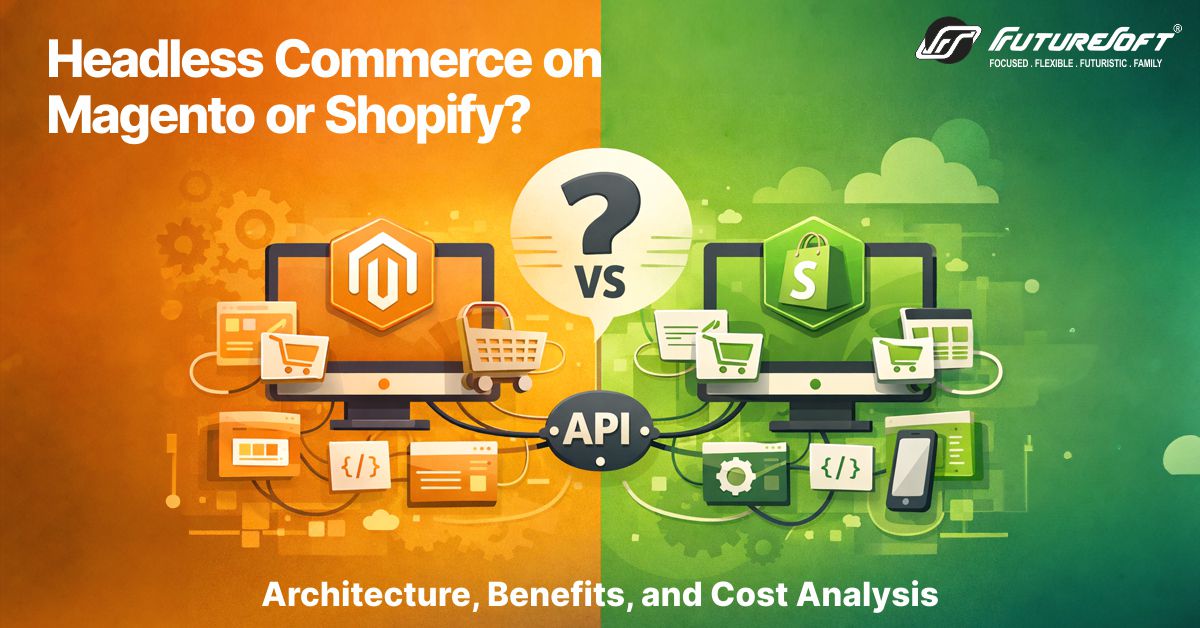
Have you ever thought that your current eCommerce platform slows innovation, hurts customer experience, or limits your digital presence and omnichannel growth? Many businesses face these exact pain points with traditional monolithic platforms that bind the frontend presentation layer to backend commerce logic.

An eCommerce website builder is the most needed thing while you are planning to go digital. There are hundreds of options available in the market, but which is the best? Which one fits your requirements most accurately?
We would love to be a part of your journey to success. Let's team up today!