
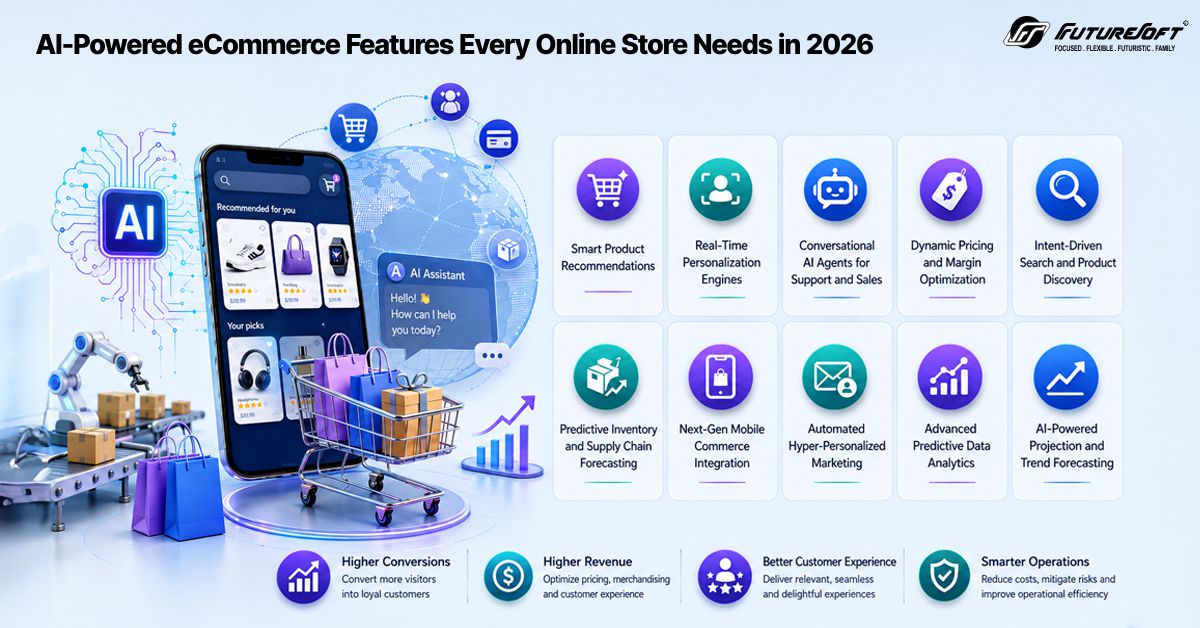
In 2026, AI has become the intelligence layer that powers every successful digital commerce operation. From personalized shopping journeys and autonomous customer support to predictive inventory planning and dynamic pricing, AI helps businesses make faster decisions while creating better customer experiences.
If you want to grow your online store, improve profitability, and compete with digital-first brands, investing in an intelligent commerce ecosystem is a business priority rather than a technology upgrade.
This guide explores the most impactful AI-powered features every online store should adopt, explains how they contribute to revenue growth, and provides practical insights for Indian business owners, D2C founders, and enterprise leaders planning their next phase of digital transformation.
Learn about checkout tools to increase conversion of your eCommerce store.
As customer expectations evolve, AI is helping eCommerce businesses deliver faster, smarter, and more personalized shopping experiences.
India's digital commerce market continues to expand at an unprecedented pace. Millions of shoppers are purchasing products through smartphones, social platforms, marketplaces, and brand websites every single day. This rapid growth creates enormous opportunities, but it also increases competition and customer expectations.
Your customers expect instant answers, highly relevant product suggestions, frictionless checkout experiences, and fast delivery updates. Traditional automation is no longer enough to satisfy these expectations.
An advanced AI eCommerce platform acts as the decision-making engine behind your online business. It continuously studies customer behavior, purchase intent, inventory movement, and regional demand patterns to improve every interaction without constant manual intervention.
Businesses that embrace intelligent automation today are positioning themselves for stronger profitability, faster growth, and greater resilience in an increasingly competitive marketplace.
Know about the top Magento jewelry website.
Modern online stores cannot rely on static workflows and manual optimization. Every interaction generates valuable data that can improve customer experience and business performance. The following AI-powered capabilities represent the essential technology stack that helps you increase revenue, reduce operational complexity, and build long-term customer loyalty in 2026.
Traditional recommendation engines relied on simple purchase history or generic "customers also bought" sections. Modern AI recommendation systems work very differently.
Instead of displaying identical suggestions to every visitor, they evaluate browsing patterns, previous purchases, regional preferences, device behavior, price sensitivity, and even real-time shopping intent before generating recommendations.
A customer browsing ethnic wear in Delhi during the festive season may receive completely different suggestions from someone shopping for similar products in Bengaluru. This level of intelligence creates a shopping experience that feels highly relevant without requiring manual merchandising updates.
Many executives researching what is AI in eCommerce discover that recommendation engines are often the fastest way to increase Average Order Value. By presenting complementary products at the right moment, AI encourages customers to add more items to their cart while improving overall satisfaction.
For Indian retailers handling thousands of SKUs across multiple categories, intelligent recommendations transform product discovery into a continuous revenue generation engine rather than a simple navigation feature.
Before implementing advanced capabilities such as AI-powered recommendations, visual search, or intelligent automation, businesses should focus on building a scalable and user-friendly eCommerce platform that can support future growth and innovation.


Every visitor arrives at your website with a different objective. Some are researching products, some are comparing prices, and others are ready to purchase immediately.
Modern generative AI eCommerce technology builds a unique experience for each visitor in real time. Homepage banners, promotional offers, search results, category pages, and product descriptions can adapt dynamically based on browsing history, location, previous interactions, and current intent.
Instead of managing dozens of manually created landing pages, AI continuously generates variations that maximize engagement and conversions. For example, a first-time visitor searching for premium electronics may receive educational content and product comparisons. A returning customer who abandoned a cart yesterday may immediately see a personalized discount and recently viewed products.
This approach also benefits marketing teams by reducing repetitive content creation while improving campaign performance across every channel.
Customer support has evolved far beyond answering basic questions. The latest AI agents function as autonomous digital employees capable of handling complete customer journeys.
Instead of simply responding with predefined answers, these systems verify orders, initiate returns, track courier movements, recommend products, process exchanges, and guide customers through checkout using natural conversations.
This represents a major advancement in AI in B2B eCommerce, where distributors and procurement teams often require assistance with bulk orders, custom pricing requests, invoice retrieval, and account-specific purchasing workflows.
The latest conversational agents can access multiple business systems simultaneously, reducing delays that traditionally requires several support representatives.
If you are exploring how to use AI in eCommerce, autonomous support agents provide one of the highest returns on investment. They operate continuously, respond instantly, and improve with every customer interaction.
They also support multiple Indian languages, making digital shopping more accessible across diverse regional markets.
Find out top headless Magento website take inspiration from.


Pricing has become one of the most powerful competitive advantages in digital commerce. Fixed pricing models often fail to respond to changing customer demand, competitor activity, and inventory movement. AI changes this approach by continuously evaluating multiple data points and recommending the most profitable selling price.
Instead of waiting for weekly reports, intelligent pricing engines monitor competitor prices across marketplaces, brand websites, and retail platforms in real time. They also account for seasonal buying patterns, regional purchasing behavior, promotional campaigns, and stock availability.
During festive periods such as Diwali, Navratri, or the year-end sale season, AI can identify products with rising demand and adjust pricing while maintaining healthy margins. When inventory levels increase beyond planned thresholds, the system can introduce strategic discounts before products become slow-moving assets.
For businesses managing thousands of SKUs, manual pricing decisions often lead to missed revenue opportunities. AI replaces guesswork with continuous optimization based on live market signals.
Companies evaluating the cost of AI integration in e-commerce in India often discover that dynamic pricing delivers measurable returns within a short period through improved margins, higher conversion rates, and better inventory utilization.
The result is a pricing strategy that balances customer expectations with long-term business profitability instead of competing only on discounts.
Discover best third-party logistics partner in India.
Customers no longer search using perfect keywords. They describe what they need in natural language, upload images, or use voice commands while shopping from their mobile devices.
AI-powered search understands the intent behind every query rather than matching individual words. A customer searching for "comfortable office chair for long work hours under ₹10000" receives highly relevant recommendations even if those exact words never appear in the product title.
Visual search introduces another layer of convenience. A shopper can upload a photograph of a dress, sofa, or lighting fixture and instantly discover similar products within your catalog.
Voice search continues to gain popularity among mobile-first consumers, making conversational product discovery a valuable competitive advantage.
The benefits of AI in eCommerce become particularly visible through intelligent search experiences because customers spend less time browsing and more time purchasing. Faster product discovery also reduces bounce rates while increasing customer satisfaction.
For businesses selling large catalogs across multiple categories, intent-driven search transforms navigation into an intuitive shopping assistant that continuously improves as more customers interact with the platform.
Study how to calculate the total cost of ownership of your business.


Inventory decisions directly influence profitability. Overstocking blocks working capital, while stock shortages result in lost sales and dissatisfied customers.
AI forecasting systems analyze historical sales, regional buying patterns, supplier performance, weather conditions, holidays, and marketing campaigns to estimate future demand with impressive accuracy.
Instead of maintaining identical inventory across every warehouse, businesses can distribute products according to expected regional demand. A fashion retailer may stock higher quantities of winter apparel in North India while increasing lightweight collections in southern markets. This intelligence becomes even more valuable for brands expanding into Tier 2 and Tier 3 cities, where purchasing behavior often differs significantly from metropolitan markets.
Retail leaders researching the best AI tools for Indian retail brands increasingly prioritize predictive inventory management because it improves cash flow while reducing warehousing costs and emergency replenishment expenses.
AI also identifies products likely to become slow-moving inventory, allowing merchandising teams to launch timely promotions before profit margins decline.
The outcome is a more responsive supply chain that aligns inventory investment with actual customer demand rather than assumptions.
Things you must know about warehouse management system.

Mobile devices now drive the majority of online shopping activity across India. Customers expect fast-loading pages, frictionless navigation, and instant checkout regardless of their internet speed or device capabilities.
AI improves mobile commerce by predicting customer actions before they happen. Frequently viewed products load faster, search suggestions become more relevant, and checkout forms automatically prioritize the information most likely to be required.
Smart checkout assistants reduce abandonment by identifying hesitation signals and offering contextual support at critical moments. Instead of leaving the website, customers receive instant answers that help them complete their purchase.
AI also works seamlessly with UPI payments, digital wallets, and local payment preferences, creating a smooth purchasing experience from product discovery to order confirmation.
Businesses evaluating the cost of AI integration in e-commerce in India should consider mobile optimization a strategic investment rather than a technology upgrade. Even small improvements in mobile conversion rates can generate substantial revenue growth when applied across thousands of daily visitors.
As mobile commerce continues to dominate digital retail, intelligent optimization becomes a fundamental requirement for sustainable business growth.
Understand and find everything about virtual try-on.
Modern consumers receive hundreds of promotional messages every week. Generic campaigns struggle to capture attention, making intelligent marketing automation an essential business capability.
AI studies browsing behavior, purchase history, engagement patterns, and preferred communication channels to determine the perfect message, delivery time, and product recommendation for every individual customer.
Instead of scheduling one campaign for an entire audience, the system sends WhatsApp notifications, emails, and promotional updates precisely when each customer is most likely to engage.
A shopper who regularly purchases skincare products every six weeks may receive replenishment reminders at the ideal moment, while another customer interested in electronics receives product comparison content before making a buying decision.
This level of personalization increases open rates, click-through rates, and repeat purchases while reducing marketing waste.
For organizations investing in artificial intelligence in eCommerce, automated marketing represents a continuous revenue engine that operates around the clock. It builds stronger customer relationships through relevant communication instead of excessive promotional messaging.
The result is higher customer retention, better campaign performance, and a marketing strategy driven by behavioral intelligence rather than fixed schedules.
Learn everything about order management system.


Most businesses collect enormous amounts of data but struggle to convert it into meaningful business decisions. AI changes that by identifying patterns that would otherwise remain hidden within thousands of transactions and customer interactions.
Instead of reviewing historical reports, predictive analytics estimates future customer behavior. It calculates customer lifetime value (LTV), identifies high-value segments, predicts repeat purchase probability, and flags customers who are likely to stop buying before the decline becomes visible.
This intelligence allows your marketing and sales teams to take action early. A customer showing reduced engagement can automatically receive relevant offers, educational content, or loyalty incentives that encourage another purchase.
Executive teams also benefit from unified dashboards that combine marketing, sales, inventory, and customer service data into one decision-making framework. Rather than comparing disconnected reports, leaders gain a comprehensive view of business performance and growth opportunities.
Predictive analytics also improves budget allocation by identifying channels that consistently generate profitable customers instead of focusing only on traffic or impressions.
When AI converts raw data into actionable insights, every department can make faster and more confident decisions that contribute directly to long-term business growth.
Find out how to start headless eCommerce development.
Planning for the future has traditionally relied on historical sales reports and executive experience. While both remain valuable, they often fail to capture rapidly changing consumer preferences and market conditions.
AI-powered forecasting models evaluate purchasing behavior, search trends, economic indicators, regional demand, competitor activity, and social media conversations to predict future opportunities months in advance.
Instead of reacting to trends after they become popular, your business can prepare inventory, marketing campaigns, and product launches before demand reaches its peak.
A fashion retailer may identify increasing interest in sustainable clothing well before competitors. An electronics brand may recognize growing demand for AI-enabled smart home products and adjust procurement strategies accordingly.
This proactive approach reduces risk while improving investment decisions across merchandising, operations, and marketing.
Organizations that use predictive trend modeling build more resilient business strategies because decisions are supported by continuously updated intelligence rather than assumptions. The result is greater confidence when expanding product categories, entering new markets, or planning seasonal campaigns.
Study how to reduce shopping cart abandonment on your D2C website.

Deploying intelligent commerce capabilities is about much more than automation. Every AI-powered feature contributes to stronger profitability, better customer experiences, and faster business decisions.
When these capabilities work together, they create a digital commerce ecosystem that grows smarter with every customer interaction.

Customers expect immediate assistance regardless of the time or day. AI-powered support agents provide instant responses to order queries, delivery updates, returns, exchanges, and product recommendations without waiting for human intervention.
This reduces operational costs while allowing support teams to focus on complex customer situations that require personal attention. The result is faster resolution times, higher customer satisfaction scores, and consistent service throughout the year, including high-volume festive sales periods.
Every shopper appreciates a buying experience that reflects their interests and preferences. AI makes this possible across millions of simultaneous website sessions without increasing marketing or merchandising resources.
Product recommendations, promotional banners, search results, and content continuously adapt based on customer behavior. This creates the experience of having a dedicated shopping consultant for every visitor while allowing your business to scale rapidly without sacrificing customer engagement.
Know how to increase organic traffic for your eCommerce website.


AI continuously evaluates visitor behavior, cart activity, campaign performance, and purchasing signals to identify opportunities for increasing conversions.
Instead of waiting for weekly reports, pricing strategies, recommendations, promotional offers, and checkout experiences improve in real time. This helps you increase conversion rates, improve average order value, and reduce customer acquisition costs while making every marketing investment more productive.
Rapid business growth often introduces operational complexity. AI automates repetitive tasks such as inventory planning, customer communication, order processing, and demand forecasting, allowing teams to focus on strategic initiatives.
During major shopping events, intelligent systems continue operating at scale without compromising speed or accuracy. This allows your business to handle increasing transaction volumes while maintaining consistent service quality and operational performance.


Executive decisions become more effective when they are supported by reliable intelligence rather than assumptions. AI combines customer behavior, marketing performance, inventory movement, and sales trends into clear business insights.
Leaders can quickly identify profitable customer segments, high-performing campaigns, and emerging market opportunities. This clarity improves planning, budget allocation, and long-term business strategy while reducing uncertainty across departments.
Things you should know about custom website development.
Customer confidence plays a critical role in digital commerce success. AI continuously monitors transactions, login behavior, payment activity, and unusual account patterns to identify potential fraud before financial damage occurs.
Intelligent security systems can block suspicious activity, verify risky transactions, and protect customer accounts without creating unnecessary friction for genuine shoppers. This strengthens brand reputation, reduces fraud-related losses, and creates a safer shopping environment that encourages repeat purchases and long-term loyalty.

Adopting AI does not require rebuilding your entire eCommerce ecosystem in one phase. The most successful businesses begin with a focused objective, validate results, and gradually expand intelligent capabilities across their operations.
Start by identifying a business challenge with measurable impact. You may want to reduce cart abandonment, improve customer support, increase Average Order Value, or optimize inventory planning. A clear proof of concept allows your leadership team to evaluate business value before making larger investments.
The next priority is data quality. AI performs best when product information, customer records, inventory data, and marketing analytics are accurate and consistently maintained. Investing in clean data pipelines creates a strong foundation for every future AI initiative.
Integration planning is equally important. Your AI solutions should work smoothly with your ERP, CRM, payment gateways, logistics partners, marketing automation tools, and customer support platforms. Connected systems create a unified view of your business and eliminate information silos.
Learn how to secure your eCommerce website with encryption.
Choose technology that can grow with your business instead of solving only today's challenges. Modular architectures allow you to add recommendation engines, conversational assistants, predictive analytics, and pricing intelligence as your requirements evolve.
Finally, work with an experienced implementation partner that understands Indian digital commerce, compliance requirements, local payment ecosystems, multilingual experiences, and enterprise integrations.
A strategic partner helps you move from experimentation to measurable business outcomes while reducing deployment risks and accelerating return on investment.
AI is no longer a future concept reserved for global enterprises. It is becoming the operating system of modern digital commerce and a critical driver of sustainable growth.
Whether you manage a growing D2C brand or a large enterprise marketplace, intelligent recommendations, predictive analytics, conversational commerce, and automated marketing can improve customer experiences while supporting stronger business performance.
The businesses that invest in AI today will be better positioned to adapt to changing customer expectations, market conditions, and competitive pressures tomorrow. The opportunity is not simply to automate existing processes. It is to build an online store that learns, evolves, and grows with every interaction.
Artificial intelligence enables B2B businesses to automate customer support, personalize product catalogs, forecast demand, optimize pricing, and provide intelligent purchasing assistance. These capabilities reduce manual effort while improving operational efficiency and customer satisfaction.
The best solutions depend on your business goals. Companies typically invest in AI-powered recommendation engines, conversational sales agents, predictive analytics platforms, intelligent search solutions, dynamic pricing systems, and inventory forecasting tools that integrate with existing commerce platforms.
AI in eCommerce refers to the use of intelligent algorithms and machine learning models that analyze customer behavior, automate business processes, personalize shopping experiences, predict demand, and improve decision making across online retail operations.
Start with high-impact use cases such as personalized product recommendations, AI-powered customer support, intelligent search, dynamic pricing, and automated marketing campaigns. Implementing these capabilities incrementally allows businesses to measure performance improvements and scale successful initiatives.
Indian digital commerce continues to grow rapidly, creating higher customer expectations and stronger competition. AI helps businesses improve conversions, optimize inventory, reduce operational costs, strengthen fraud prevention, and deliver personalized shopping experiences that drive long-term customer loyalty.
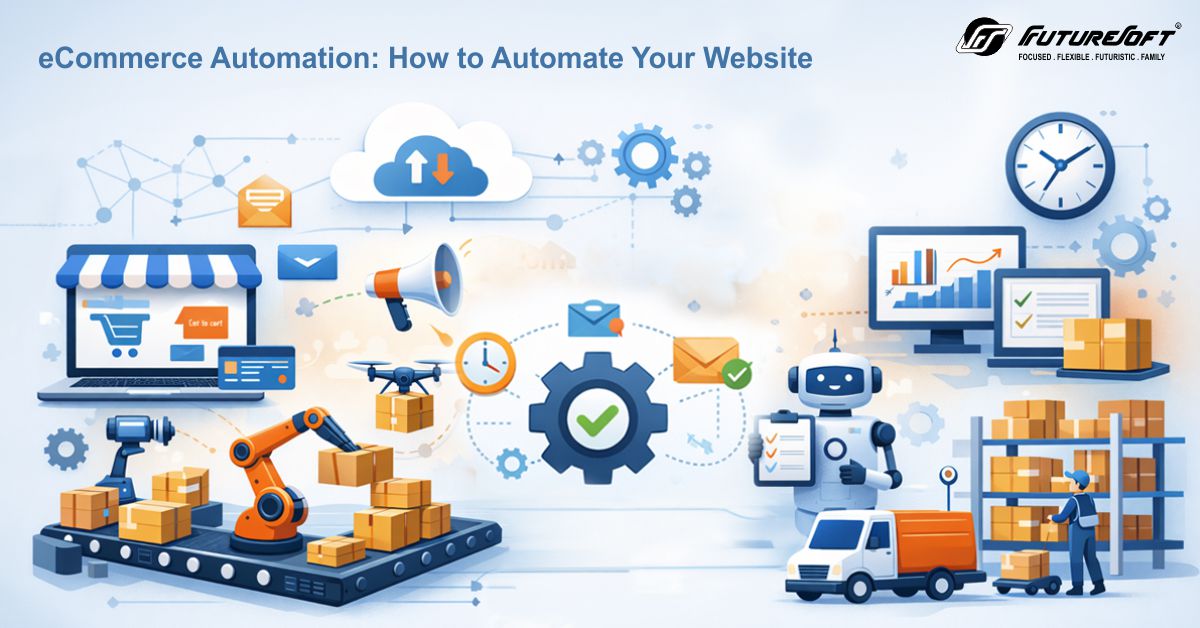
Do you still spend hours managing orders, emails, inventory, and customer queries on your website? Do you know there is a way that allows you to make these processes more efficient and quicker? You might be struggling with manual work that slows down your business growth and increases your operational costs.

In 2025, artificial intelligence is revolutionizing the future of search engine optimization (SEO) by making strategies smarter, faster, and more efficient. This blog explores how AI is reshaping SEO services through predictive analytics, AI-powered keyword research, voice and visual search optimization, technical audits, and hyperlocal targeting.

Digital transformation has changed the entire online space, and social media is no different from digital transformation. In 2025, it is being redefined to be faster, smarter, and more intelligent than ever before. Artificial Intelligence (AI) has evolved from being just a buzzword to a strategic marketing tool.
We would love to be a part of your journey to success. Let's team up today!