Structuring of software code
It refers to segregation of code into various microservices & micro frontends. Further, it involves identification of correct design patterns such as Service Oriented Architecture, Event Driven/MVC Architecture.


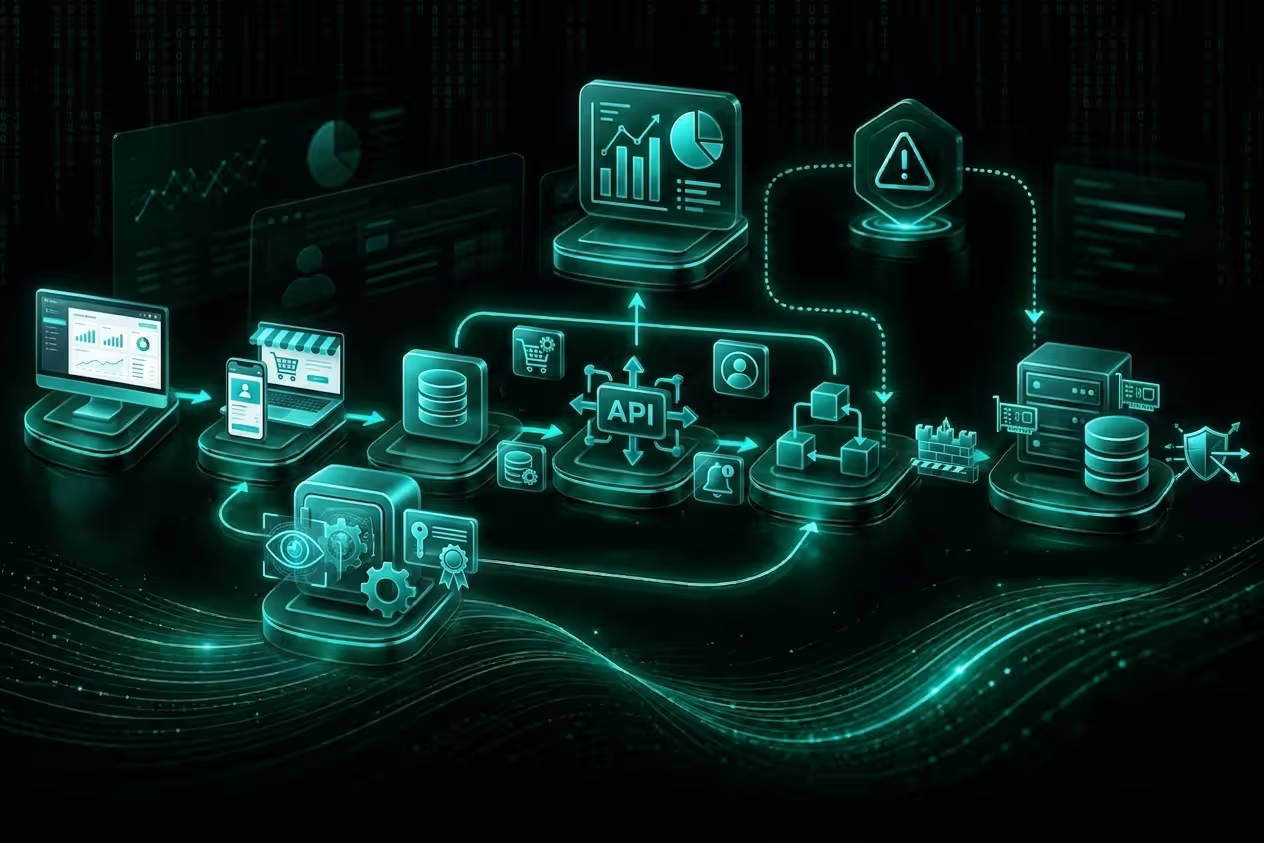
Enterprise Software development services require a deep understanding of complex software systems. Typically, delivering an enterprise system involves not just an understanding of the system but also a vision to envisage future challenges. The challenges could be many, for instance, the system being developed is not secure, is not scalable, and is not developed considering many critical components such as SEO, Performance, Extensibility, Cost, etc.
Being a top Enterprise Software Development Company, Futuresoft has delivered complex enterprise systems over the past 35 years. We have a highly skilled team with the right mix of technical, managerial & architectural capabilities.
ButtonMost of the Enterprise Software Development services are dependent on in-house/3rd party systems to be relevant & useful for their target customers/users. Think about eCommerce, would it be possible to have an eCommerce system without integration with Payment/SMS gateway? Being an Enterprise Software Development Company, we need to talk to other systems for many reasons as each system presents unique challenge, for instance, focus of integration while connecting with payment gateways is security whereas focus of integration while connecting with SAP is licensing cost and with AI/ML services is Performance.
FutureSoft has extensive experience in delivering systems based on various integrations. Few significant ones are:

PayU, Razor Pay, Stripe, PayPal etc.

Twilio and Gupshup for sending order confirmations, notifications, & updates.

For Catalogue updates, Invoices & Inventory Updates.

For Order push & status checks with Ship Rocket & Delhivery.
We have extensive experience in creating seller apps and logistic apps for various domains. We have inhouse experts in Magento & Shopify who can easily establish integration between these systems (Magento & Shopify) and ONDC (Open Network for Digital Commerce).

AI/ML is the most trending strategy for enhancing business opportunities. Businesses can tremendously benefit by integrating AI solutions into their existing core systems. E-commerce systems can be enhanced by implementing AI based recommendations (based on ratings & reviews), providing instant support using chatbots, generating meaningful insights from the orders received/video testimonials, providing decision making using AI to control supply chain, providing Try On features for jewelry items such as rings and necklaces.With AI/ML, businesses have endless possibilities to enhance customer base.
Enterprise software should do more than support day-to-day operations. It should help your business manage complex processes, connect disconnected systems, improve operational efficiency, and adapt to changing business requirements. FutureSoft develops enterprise software solutions around specific business needs, from custom applications and workflow systems to connected web platforms and cloud-native applications.
Build enterprise applications around your organization's unique business processes, operational requirements, and business rules. From internal business tools to specialized enterprise platforms, we develop applications that support complex workflows, role-based access, and evolving operational needs.
Manage complex business processes through centralized workflow applications. Build systems that handle task assignments, approval hierarchies, work queues, exception management, escalations, and operational reporting. These applications help businesses establish consistent processes and improve visibility across departments.
Create centralized digital platforms for employees, customers, partners, and business stakeholders. Develop secure web portals that provide role-based access to information, business applications, documents, and self-service functionalities while connecting with existing enterprise systems.
Extend enterprise capabilities beyond the desktop with mobile applications for employees, customers, field teams, and business partners. Develop native and cross-platform applications with features such as real-time data synchronization, API connectivity, secure authentication, and mobile-specific workflows.
Build application-like web experiences that work across devices without requiring users to install traditional mobile applications. PWAs can support installability, responsive interfaces, offline capabilities, and faster access to frequently used business functions, depending on browser and device support.
Develop enterprise applications designed for modern cloud environments. Use modular architectures, containerization, orchestration, and automated deployment practices to support application scalability, resilience, and efficient resource utilization as business requirements evolve.
Connect enterprise applications with internal platforms, third-party services, ERP systems, payment gateways, logistics providers, and other business applications. Develop APIs and integration layers that enable secure data exchange, system interoperability, and coordinated business processes across your technology ecosystem.
Build enterprise applications with security and quality considerations incorporated throughout the development lifecycle. From functional and performance testing to vulnerability assessment, secure coding, and automated testing, establish the quality controls required for reliable software delivery.
Stay Connected to Global Success