
Custom Enterprise Application Development
Enterprise Application Engineering

Custom Enterprise Application Development

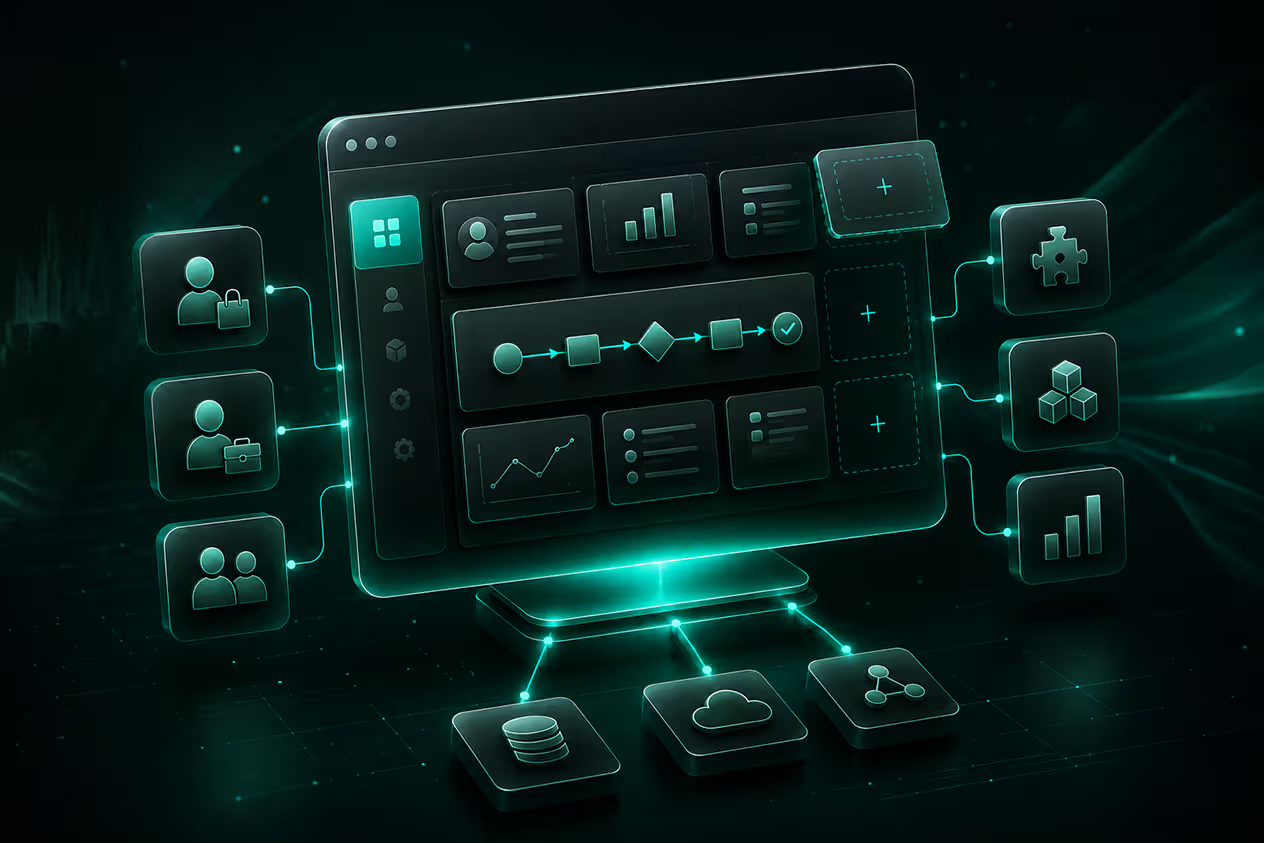
Custom enterprise applications built around the way your business works.

When standard software cannot support a differentiated process, control requirement or operating model, FutureSoft designs and builds applications around the workflow the business actually needs.

35+ years of enterprise software delivery | Architecture-to-production accountability | Reusable workflow and integration patterns

What We Engineer

Application type Typical scope
Operations and workflow applications Work queues, rules, approvals, exceptions, SLA, escalation, dashboards and audit.
Customer and partner portals Secure self-service, transactions, documents, support and collaboration.
Case-management systems Intake, assignment, evidence, decisions, correspondence, review and closure.
Transaction-processing systems Controlled capture, validation, processing, reconciliation and reporting.
Regulatory and compliance applications Maker-checker approvals, evidence, reporting, audit and policy controls.
Employee productivity applications Role-based workflows, task execution, dashboards and enterprise-system access.
SaaS and multi-tenant products Tenant isolation, administration, configuration, billing or subscription logic where required.
Management dashboards and consoles Operational visibility, alerts, exceptions, configuration and administration.

Engineering scope

  • Business and workflow discovery
  • Requirements decomposition and release planning
  • Solution, data, integration and security architecture
  • Responsive interface engineering
  • Backend services and business rules
  • API implementation
  • Identity, roles and permissions
  • API and enterprise-system integration
  • Document and data handling
  • Automated and risk-based quality assurance
  • CI/CD, deployment and production-readiness engineering

Delivery approach

  • Discovery: map users, process, constraints, success measures and system dependencies.
  • Definition: convert operating needs into workflows, user stories, acceptance criteria and a prioritized release backlog.
  • Architecture: define application boundaries, data, integrations, security, deployment and non-functional requirements.
  • Experience implementation: translate approved journeys and designs into responsive, accessible application interfaces.
  • Engineering: build in reviewable increments using coding standards, reusable components and automated checks.
  • Integration: connect dependent systems and validate normal, exception and recovery paths.
  • Validation: perform functional, integration, performance, security and release assurance based on risk.
  • Production transition: automate deployment, plan cutover, monitor stabilization and establish the next-release backlog.

What you receive

  • Process and requirements map
  • Prioritized product backlog and acceptance criteria
  • Target solution architecture
  • Data and integration specifications
  • Working application increments and source code under the agreed commercial model
  • Automated tests and quality evidence
  • Environment and deployment configuration
  • Operational runbooks and handover material
  • Post-launch enhancement roadmap

Commercial outcomes

  • Replace fragmented manual work with controlled digital workflows.
  • Reduce duplicate data entry and avoidable hand-offs.
  • Improve visibility into status, workload, exceptions and bottlenecks.
  • Enforce process controls consistently across roles and locations.
  • Working application increments and source code under the agreed commercial model
  • Create faster experiences for employees, partners and customers.
  • Build a modular foundation that can add modules, channels, integrations and AI capabilities over time.

Engagement models

  • Discovery and architecture sprint
  • MVP or first high-value workflow
  • Complete application delivery
  • Persistent product-engineering pod
  • Application rescue and re-baselining

Benefits of Custom Application Development

Customized Solution

Applications are designed around the workflows, roles, rules and integrations that differentiate the business. Scope is prioritized around the operating outcomes, controls and user needs the solution must support.

Scalability

Architecture is shaped around anticipated transaction volumes, user growth, new modules, integrations and deployment requirements. Scaling choices are validated against the application’s operating context rather than presented as a generic promise.

Integration

Interfaces to ERP, CRM, identity, data and third-party services are identified early. Contracts, mappings, failure handling and monitoring are engineered according to the systems and responsibilities involved.

Security

Security requirements are translated into architecture, identity, permissions, data protection, secure coding, testing and release controls. The precise controls depend on data sensitivity, threat exposure and applicable obligations.

Efficiency

Custom engineering can reduce duplicate entry, manual hand-offs and fragmented work when the application is designed around the target process. Expected improvements should be defined during discovery and measured after adoption.

Why FutureSoft India

When custom engineering is the right choice

Custom software is justified when the process itself creates business value, when existing products require excessive workarounds, or when the organization needs greater control over workflow, data, integration, security or future evolution.

  • A strategic process does not map cleanly to packaged software.
  • Teams depend on spreadsheets, email and manual coordination across functions.
  • Multiple systems must be presented through one coherent application or workflow.
  • Rules, controls, approvals or regulatory requirements are specific to the organization.
  • Commercial platforms create disproportionate licensing or customization complexity.
  • The software needs to become a configurable product, platform or long-lived digital asset.
LET’S BUILD BETTER

Turn a complex business process into a clear application roadmap.

Start with one process, one product concept or one operating problem. We will help define the application boundary, target architecture and first release.

FAQs

Find quick answers to the most common questions about our services, process, and solutions.

FAQ
Can FutureSoft build on our existing technology stack?

Yes, subject to technical assessment. The objective is to use a stack that the client can operate and evolve, rather than forcing a preferred framework where it adds no value.

Do you use low-code platforms?

Where a low-code platform improves speed and maintainability without creating unacceptable lock-in, security or complexity, it can be considered. The choice should follow the process and non-functional requirements.

Can you integrate with our ERP, CRM or other enterprise systems?

Yes. Integration requirements are identified early and engineered using APIs, events, messaging, batch or file patterns appropriate to the systems involved.

Can an existing application be modernized rather than rebuilt?

Yes, but that work belongs to the Application Modernization pillar. The modernization assessment should determine whether to retain, refactor, replatform, rearchitect or replace.

How is scope controlled?

Through release planning, backlog prioritization, acceptance criteria, architecture decisions and agreed change governance.

Get Connected to FutureSoft

Stay Connected to Global Success