
Launching an online store is no longer just about choosing a design and uploading products. Your investment covers platform selection, user experience, software architecture, payment integrations, security, hosting, marketing tools, and long-term support.
Every decision directly impacts your growth potential and operational efficiency. Whether you are a startup or an enterprise brand, understanding the eCommerce website development cost in India helps you allocate budgets intelligently and avoid unexpected expenses.
If you are wondering how much does it cost for an ecommerce website, the answer depends on your business objectives, required features, customization level, and development partner. This guide breaks down every major cost component so you can build an online store with confidence.
Learn how platform selection, customization, integrations, and ongoing optimization influence eCommerce development costs, providing practical insights for smarter budgeting and scalable online growth.
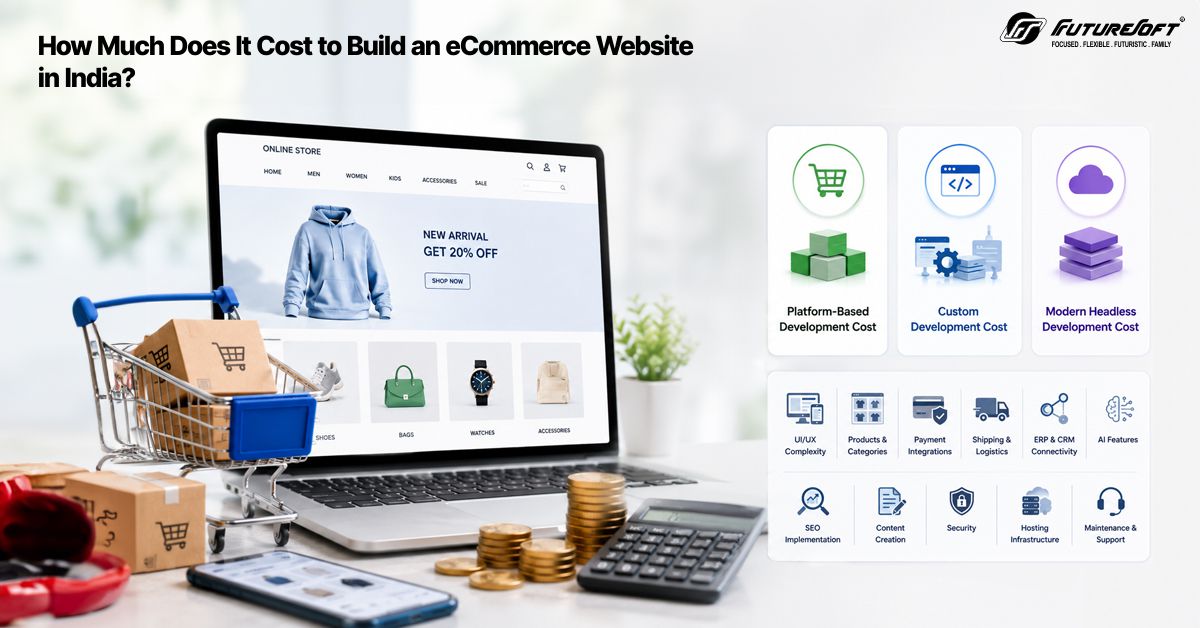
India's digital commerce industry is growing at an unprecedented pace. Millions of consumers now prefer shopping online for convenience, competitive pricing, and faster delivery. As competition rises, businesses need modern, high-performing websites that deliver exceptional shopping experiences while supporting long-term expansion.
Understanding how much does it cost to build an ecommerce site is one of the first steps before launching your digital business. Looking only at the initial investment often leads to poor planning because an online store also requires hosting, integrations, maintenance, marketing, and content creation.
A well-planned investment creates a scalable digital asset that attracts customers, increases conversions, and supports sustainable business growth. Instead of focusing solely on the launch budget, you should evaluate the total cost of ownership and the value generated over time.
eCommerce website development is the complete process of designing, developing, and deploying a digital storefront that allows customers to browse products, make purchases, complete payments, and track orders through an integrated online system.
The process includes user interface design, frontend and backend development, database architecture, product catalog management, payment gateway implementation, security configuration, API integrations, mobile responsiveness, and performance optimization.
Unlike a simple business website, an eCommerce platform functions as a revenue-generating ecosystem that manages inventory, customer accounts, shipping workflows, taxation, marketing automation, and analytics from a centralized dashboard.
When evaluating the eCommerce website development cost in India, you are investing in a business infrastructure that supports sales, customer engagement, and future expansion rather than just purchasing a website.
Professional development services provide much more than attractive storefronts. They combine development expertise, business strategy, and scalable architecture to create platforms capable of supporting continuous growth while improving operational efficiency and customer satisfaction.
Know the top Shopify jewelry stores .
Operating an online store typically requires significantly lower recurring expenses than managing a physical retail outlet. Traditional stores involve commercial rent, electricity bills, furniture investments, security personnel, and large employee teams.
An eCommerce business centralizes most operations within a digital environment, allowing you to automate inventory updates, order processing, customer communication, and payment collection.
These efficiencies reduce administrative costs while allowing your team to focus on revenue-generating activities. This cost advantage makes digital commerce an attractive option for startups and established businesses alike.


Customer demand rarely remains constant. Seasonal festivals, promotional campaigns, influencer collaborations, or viral products can generate sudden traffic spikes that overwhelm poorly built websites.
Professional development creates scalable infrastructure capable of handling thousands of simultaneous users without compromising performance. Additional products, categories, customer accounts, and orders can be added with minimal disruption.
This flexibility allows your online store to grow alongside your business instead of requiring complete redevelopment every few years.
Business requirements evolve continuously. New product categories, pricing models, shipping policies, customer loyalty programs, and promotional campaigns often require modifications to your website.
A professionally developed platform provides the architectural freedom to redesign customer journeys, expand backend workflows, integrate additional software, and introduce new user experiences without rebuilding the entire system.
This adaptability allows your technology investment to support changing business objectives and market opportunities over time.


Modern eCommerce websites integrate directly with advertising and analytics ecosystems that help businesses attract and retain customers more effectively.
Built-in marketing capabilities allow you to connect tracking pixels, remarketing campaigns, email automation, conversion measurement tools, and social advertising platforms. These integrations provide valuable customer insights while supporting personalized promotions and data-driven marketing decisions.
The result is a digital sales engine capable of generating measurable business growth across multiple acquisition channels.
Choosing the right development resource is just as important as selecting the right technology platform. Your sourcing model influences project quality, delivery timelines, communication efficiency, long-term support, and overall investment value.

DIY development relies on website builders, pre-designed themes, and drag-and-drop editors that allow business owners to create basic online stores without advanced programming knowledge.
This approach works well for small catalogs and businesses validating new ideas with limited budgets. However, technical limitations often become visible as product catalogs grow or customer expectations increase.
Learn the features you must have on a watch eCommerce Website .
| Pros | Cons |
|---|---|
| Lowest initial investment | Limited customization |
| Quick launch timeline | Performance limitations |
| Large template libraries | Dependency on platform features |
| Suitable for MVP launches | Difficult to build unique experiences |
Freelancers offer specialized development services on a project basis and are commonly hired for startups or small businesses with limited technical requirements.
Working with an individual developer can reduce costs compared to agencies, but project success depends heavily on one person's availability, experience, and project management skills. Businesses may also need separate designers, SEO specialists, and testers to complete the project.
| Pros | Cons |
|---|---|
| Lower pricing than agencies | Limited resource availability |
| Direct communication | Project delays if unavailable |
| Flexible engagement models | May lack multidisciplinary expertise |
| Suitable for smaller projects | Long-term support may vary |
| Faster decision making | Quality depends on individual capability |


Development agencies provide multidisciplinary teams that include project managers, UI/UX designers, frontend engineers, backend developers, QA specialists, DevOps professionals, SEO consultants, and support engineers.
This collaborative structure produces higher-quality websites with better architecture, stronger security, comprehensive testing, and structured documentation. Agencies also provide ongoing technical support and future enhancements as your business expands.
For organizations planning long-term digital growth, this sourcing model typically delivers the highest business value.
Find out the top food and beverages brands.
| Pros | Cons |
|---|---|
| Complete end-to-end execution | Higher initial investment |
| Dedicated technical specialists | Longer planning process |
| Better quality assurance | More structured workflows |
| Scalable development resources | Premium pricing for enterprise projects |
| Ongoing support and maintenance | Requires detailed project planning |
Selecting the right eCommerce platform is one of the biggest decisions you will make during your digital transformation journey. The platform determines your website's flexibility, performance, scalability, security capabilities, and future expansion possibilities.
It also plays a significant role in the ecommerce website design cost because every ecosystem comes with different licensing, development, and maintenance requirements.
Whether you are a startup launching your first online store or an enterprise managing thousands of products, choosing the right technology foundation directly impacts your long-term success.
Shopify is a fully hosted Software-as-a-Service (SaaS) platform that allows businesses to launch and manage online stores without worrying about server management or complex infrastructure. Everything from hosting and security to software updates is managed by the platform provider, allowing you to focus on sales and customer experience.
Its intuitive dashboard, extensive app marketplace, and professionally designed themes make it an excellent choice for startups, direct-to-consumer brands, and growing businesses. Shopify also supports AI-powered product recommendations, automated marketing applications, smart inventory management, and conversational commerce integrations that improve customer engagement.
Although advanced customization can require specialized development, Shopify remains one of the fastest ways to establish a professional online presence with predictable operational costs.
Know the top headless Magento websites .
| Pros | Cons |
|---|---|
| Quick deployment | Monthly subscription fees |
| Managed hosting included | Platform transaction fees in some plans |
| High security standards | Limited backend customization |
| Large application marketplace | Premium themes increase costs |
| Excellent mobile performance | Complex enterprise workflows require additional apps |
| AI-compatible ecosystem | Vendor dependency |
Magento, now known as Adobe Commerce for its enterprise edition, is one of the most powerful eCommerce frameworks available. Built with an open architecture, it supports massive product catalogs, multiple storefronts, complex pricing structures, and sophisticated business logic.
Large retailers and enterprise organizations choose Magento because it offers complete ownership over the application layer and allows virtually unlimited customization. It also integrates exceptionally well with AI-driven product recommendations, intelligent search capabilities, customer segmentation engines, and enterprise marketing automation platforms.
Magento requires experienced developers and a stronger hosting infrastructure, making it suitable for businesses planning aggressive digital growth rather than simple online storefronts.
For companies with large inventories and complex operational requirements, the higher ecommerce website design cost is often justified by superior flexibility and long-term scalability.
| Pros | Cons |
|---|---|
| Complete customization freedom | Higher implementation investment |
| Enterprise-grade scalability | Requires experienced developers |
| Supports massive product catalogs | Stronger hosting requirements |
| Multi-store functionality | Longer development timelines |
| Advanced API integrations | Maintenance demands technical expertise |
| AI-ready architecture | Greater operational complexity |
WooCommerce is an open-source eCommerce plugin built specifically for WordPress, making it one of the most flexible and widely adopted solutions for content-driven online businesses.
It allows businesses to transform a standard WordPress website into a fully functional online store while maintaining complete control over design, functionality, and hosting environments. Thousands of plugins and extensions make it possible to add subscriptions, memberships, advanced shipping, payment gateways, and marketing automation with relative ease.
WooCommerce also supports AI-powered content generation plugins, intelligent product recommendations, automated SEO optimization, and chatbot integrations, making it highly adaptable for modern digital commerce strategies.
Businesses that already use WordPress often find WooCommerce to be a cost-effective option that balances flexibility with ownership.
| Pros | Cons |
|---|---|
| Open-source platform | Self-managed hosting required |
| Complete ownership | Plugin compatibility management |
| Flexible customization | Security depends on maintenance |
| Large developer community | Performance optimization required |
| Extensive plugin ecosystem | Frequent updates need monitoring |
| AI plugin compatibility | Large stores require stronger infrastructure |
| Feature | Shopify | Magento (Adobe Commerce) | WooCommerce |
|---|---|---|---|
| Hosting | Fully managed | Self-managed or cloud | Self-managed |
| Development Complexity | Low | High | Medium |
| Customization | Moderate | Extensive | High |
| Scalability | Excellent | Enterprise-grade | Excellent with optimization |
| Maintenance | Minimal | Moderate to High | Moderate |
| AI Compatibility | Excellent | Excellent | Excellent |
| Best For | Startups and D2C brands | Large enterprises | SMEs and content-driven businesses |
| Typical Starting Budget | 1 Lakh | 4.5 to 5.5 Lakhs | 2.5 to 3 Lakhs |
Your ideal platform depends on your business objectives rather than popularity alone.
Each platform offers distinct advantages, and the right selection should align with your expected traffic, product catalog size, integration requirements, and future expansion plans.
Learn about the best cosmetics eCommerce website.
Selecting the right platform is only one part of the investment. A successful online store also depends on hosting infrastructure, third-party integrations, content strategy, search visibility, and continuous maintenance.
These supporting components transform a basic website into a scalable digital business capable of generating long-term revenue. Many businesses focus only on development costs and overlook these operational requirements, leading to budget overruns after launch.

Every eCommerce website requires a unique domain name and reliable hosting infrastructure. Your domain represents your digital identity, while hosting stores website files, product databases, customer information, and application logic.
Cloud hosting providers such as AWS, MicroSoft Azure, Google Cloud, and managed hosting companies offer different performance levels depending on traffic expectations. Small businesses may begin with shared or managed hosting, while enterprise stores typically invest in scalable cloud infrastructure with automatic resource allocation and backup systems.
Typical annual costs vary significantly based on bandwidth, storage, security requirements, and expected visitor volumes.
Discover checkout tools to increase conversion of your eCommerce website.

Modern eCommerce websites rely on connected applications that automate operations across sales, payments, logistics, customer engagement, marketing, and finance. These integrations create a unified business ecosystem that improves operational efficiency and customer experience.
Payment gateways allow customers to complete secure online transactions using credit cards, debit cards, UPI, wallets, and net banking.
Popular Indian providers such as Razorpay, Cashfree, PayU, and PhonePe Payment Gateway offer APIs that integrate directly into your checkout process. While integration may involve a one-time development expense, transaction charges are usually applied per successful payment.
A smooth payment experience directly influences conversion rates and customer satisfaction.
Shipping integrations automatically synchronize customer orders with courier partners for shipment creation, label generation, tracking updates, and delivery notifications.
Platforms like Shiprocket, Pickrr, Delhivery, and NimbusPost simplify logistics management while reducing manual work. Automated shipping calculations also provide customers with accurate delivery estimates before checkout, improving transparency and reducing cart abandonment.
CRM systems centralize customer information, purchase history, communication records, and support interactions into one organized platform.
Integrating CRM software enables personalized marketing campaigns, loyalty programs, customer segmentation, and repeat purchase strategies. Businesses can analyze buying behavior and create targeted engagement campaigns that improve customer lifetime value.
Marketing platforms provide valuable insights into customer acquisition, website performance, and campaign effectiveness.
Integrations with Google Analytics 4, Google Tag Manager, Meta Pixel, Google Ads, and email automation platforms help businesses measure traffic sources, conversion funnels, audience behavior, and advertising return on investment.
These insights support informed business decisions rather than assumptions.
Excellent customer support contributes significantly to retention and brand trust.
Modern eCommerce websites commonly integrate live chat software, AI chat assistants, WhatsApp Business APIs, helpdesk platforms, and automated ticket management systems. These applications provide immediate responses while allowing support teams to manage inquiries efficiently across multiple communication channels.
Accounting integrations automatically synchronize invoices, tax calculations, payment records, refunds, and financial reports between your website and accounting software.
This automation reduces manual bookkeeping errors while helping businesses maintain accurate GST records, generate financial statements, and simplify reconciliation processes during audits and tax filings.

Every additional feature increases development complexity and implementation time. The sophistication of your functionality directly influences project scope, development hours, testing requirements, and future maintenance investments.
This level focuses on essential online shopping functionality required for a standard eCommerce website.
Typical features include product listings, category pages, search functionality, shopping cart, customer registration, wishlist support, single payment gateway integration, basic order tracking, and responsive design.
These features satisfy the requirements of many startups and small businesses entering digital commerce.
Businesses seeking stronger customer engagement often invest in more advanced capabilities.
Examples include multi-language support, multi-currency functionality, advanced filtering systems, personalized product suggestions, dynamic review modules, loyalty programs, location-aware pricing, and promotional engines.
These additions create richer shopping experiences while supporting business expansion into multiple markets.
Find out how to reduce shopping cart abandonment on your D2C website.
Enterprise organizations frequently require completely customized digital experiences designed around unique operational workflows.
This level may include bespoke navigation systems, configurable product builders, ERP integrations, custom checkout experiences, advanced inventory synchronization, automated email journeys, subscription models, AI-powered recommendations, and enterprise reporting dashboards.
Projects at this level involve extensive planning, development, testing, and long-term support.

Even the most technically advanced website cannot generate consistent sales without compelling content. High-quality copy builds trust, improves search visibility, educates customers, and increases conversion rates throughout the purchasing journey.
Well-written product descriptions explain benefits instead of simply listing specifications.
Persuasive copy answers customer questions, highlights differentiators, incorporates relevant keywords naturally, and encourages purchase decisions. Professional product content also improves organic search visibility while reducing product return rates caused by unclear expectations.
Category pages introduce shoppers to product collections while helping search engines understand website structure.
Strategic category descriptions improve navigation, strengthen internal linking, provide useful buying guidance, and create additional opportunities to rank for commercial search queries. These pages serve both usability and search optimization objectives.
Know how to increase organic traffic for your eCommerce website.
Educational blogs attract visitors who are researching products before making purchasing decisions.
Long-form articles build topical authority, answer customer questions, generate organic traffic, and position your company as an industry expert. Consistent publishing also creates valuable entry points for potential customers at different stages of the buying journey.
Social media campaigns require concise and engaging content that encourages interaction and website visits.
Product announcements, promotional campaigns, educational posts, customer stories, and seasonal offers help businesses build communities while directing qualified traffic toward product and landing pages.
Consistent messaging strengthens brand recognition across digital channels.

Search optimization has evolved beyond keyword placement. Modern websites must combine technical excellence, content quality, structured data, and AI-friendly formatting to maximize visibility across search engines and intelligent answer systems.
On-page optimization improves the relevance of individual pages through optimized titles, meta descriptions, structured headings, image alt attributes, schema markup, internal links, and strategic keyword placement.
Well-optimized pages communicate clear topical relevance while providing a better browsing experience for visitors.
Off-page optimization builds website credibility through high-quality backlinks, digital PR campaigns, industry citations, guest postings, and brand mentions across authoritative sources.
These external trust signals strengthen domain authority and improve competitive search rankings over time.
Technical SEO focuses on website architecture and performance.
Key activities include optimizing Core Web Vitals, improving mobile responsiveness, reducing page loading times, creating XML sitemaps, fixing crawl issues, implementing canonical tags, and strengthening structured data implementation.
A technically optimized website is easier for search engines to crawl and index efficiently.
Discover the role of AI in eCommerce and how it enhances visual search.
Modern search experiences increasingly rely on AI-generated responses and conversational search interfaces.
Answer Engine Optimization (AEO), AI Optimization (AIO), and Generative Engine Optimization (GEO) organize content into concise, authoritative, and structured formats that large language models and intelligent search engines can easily interpret and reference.
Businesses adopting these practices improve their visibility across traditional search results and AI-powered discovery platforms.

Launching an eCommerce website is only the beginning. Continuous technical management protects security, maintains performance, and keeps every business function operating efficiently as software ecosystems evolve.
Routine maintenance includes database optimization, server monitoring, security patch installations, malware scanning, backup verification, error log reviews, and performance tuning.
Regular maintenance reduces downtime risks while extending the operational lifespan of your website infrastructure.
Technical support teams resolve hosting issues, frontend bugs, checkout failures, integration errors, and unexpected system problems that can affect customer experience and revenue.
Retaining experienced developers allows businesses to address issues quickly without interrupting daily operations.
Themes, plugins, frameworks, payment modules, and third-party applications receive frequent updates that improve security and compatibility.
Controlled upgrade management prevents conflicts, minimizes functionality failures, and keeps your online store aligned with modern technology standards while supporting future feature enhancements.
Find out the Latest Adobe Commerce trends you must know.
By now, you understand that an online store is a combination of technology, design, integrations, content, marketing, and continuous support. The final investment depends on your business objectives, feature complexity, and development approach.
While every project has unique requirements, industry benchmarks provide a practical starting point for planning your budget and selecting the right technology partner.
Platform-based development is the most popular choice for startups and growing businesses because it offers faster deployment and lower implementation costs than fully custom solutions.
A Shopify store typically starts at approximately ₹1 lakh, making it suitable for businesses looking for rapid market entry.
WooCommerce projects generally begin around ₹2.5 to 3 Lakhs, offering greater flexibility and ownership.
Magento (Adobe Commerce) implementations usually start from ₹4.5 to 5.5 Lakhs due to their enterprise architecture, advanced customization capabilities, and higher technical complexity.
The final ecommerce website price increases as additional integrations, premium themes, advanced features, and custom modules are added.
| Platform | Starting Cost | Best Suited For |
|---|---|---|
| Shopify | ₹1 Lakh | Startups, D2C brands, SMEs |
| WooCommerce | ₹2.5 to 3 Lakhs | Content-driven businesses and SMEs |
| Magento (Adobe Commerce) | ₹4.5 to 5.5 Lakhs | Mid-market and enterprise organizations |
Custom development is ideal for businesses that require unique workflows, proprietary features, specialized customer experiences, or enterprise integrations that standard platforms cannot provide efficiently.
Projects generally begin at ₹10 Lakhs and can increase significantly depending on business logic, ERP integrations, AI-powered functionality, multi-vendor capabilities, custom dashboards, advanced security requirements, and large product databases.
The cost of building an eCommerce website through custom development reflects the additional planning, architecture, development, testing, deployment, and long-term support required for enterprise-grade solutions.
| Business Type | Estimated Starting Cost |
|---|---|
| Startup with custom features | ₹10 Lakhs |
| Growing mid-sized business | ₹15 to 20 Lakhs |
| Enterprise digital commerce platform | ₹30 to 40 Lakhs |
| Large multi-store ecosystem | ₹50 Lakhs + |
Headless commerce separates the customer-facing presentation layer from the backend commerce engine through APIs. This architecture delivers exceptional performance, omnichannel experiences, and greater development flexibility.
Businesses adopting headless solutions can create unified experiences across websites, mobile applications, kiosks, marketplaces, and smart devices while maintaining centralized commerce operations.
Due to its architectural complexity, headless development generally starts around ₹1 Lakhs and scales upward based on integrations, front-end frameworks, personalization engines, and enterprise infrastructure.
This modern architecture is increasingly adopted by brands seeking maximum performance and future-ready digital experiences.
| Implementation Level | Estimated Starting Cost |
|---|---|
| Basic headless storefront | ₹15 Lakhs |
| Enterprise omnichannel solution | ₹20 to 25 Lakhs |
| Large-scale custom ecosystem | ₹30 Lakhs+ |
| Business Stage | Recommended Platform | Approximate Investment |
|---|---|---|
| Startup | Shopify | ₹1 Lakh |
| Small Business | WooCommerce | ₹2.5 to 3 Lakhs |
| Growing Business | Magento | ₹4.5 to 5.5 Lakhs |
| Enterprise | Custom Development | ₹10 Lakhs |
| Omnichannel Enterprise | Headless Commerce | ₹15 Lakhs |
Several variables contribute to the final project investment:
Carefully prioritizing these requirements helps businesses allocate budgets efficiently while planning future enhancements.
Learn how to design and execute effective buyer journey.
Building an eCommerce website is a strategic business investment rather than a one-time technology expense. The right platform, sourcing model, feature set, and support structure determine how effectively your digital store can attract customers, process transactions, and grow alongside your business.
Instead of selecting the lowest quote, define your functional requirements, estimate future expansion needs, and compare multiple development approaches before making a decision. A scalable architecture combined with high-quality engineering, optimized content, and continuous technical support creates a stronger foundation for sustainable online growth.
Whether you are launching your first online store or modernizing an enterprise commerce ecosystem, investing in the right technology today can create long-term competitive advantages and stronger customer experiences tomorrow.
The overall project cost depends on platform selection, design complexity, custom functionality, payment integrations, hosting infrastructure, third-party APIs, content creation, SEO implementation, security features, and ongoing maintenance. Businesses requiring enterprise workflows or advanced automation should expect higher development investments than standard online stores.
The average eCommerce website development cost varies according to business requirements. Basic Shopify projects may begin around ₹1 Lakh, WooCommerce implementations typically start near ₹2.5 to 3 Lakhs, Magento projects often begin at ₹4.5 to 5.5 Lakhs, while fully custom enterprise solutions generally start at ₹15 Lakhs and increase based on complexity.
The cost of e-commerce website in India for a startup usually ranges from approximately ₹1 Lakhs to ₹ 5.5 Lakhs depending on the selected platform, design requirements, integrations, hosting infrastructure, and content needs. Businesses using SaaS platforms can often launch faster with a lower initial investment.
Most businesses should reserve an annual maintenance budget covering hosting, security updates, software upgrades, backups, monitoring, bug fixes, technical support, and performance optimization. Larger stores with multiple integrations generally require higher recurring investments than smaller websites.
Custom development becomes valuable when standard platforms limit business growth. Companies requiring unique workflows, enterprise integrations, advanced customer experiences, AI-driven personalization, or omnichannel capabilities often benefit from custom architecture that supports long-term scalability and operational flexibility.

Building a reliable and secure website is not as easy as it seems in India. You need to consider several things in mind to get started with eCommerce. Therefore, it’s better to take help from the best Shopify development company in India.
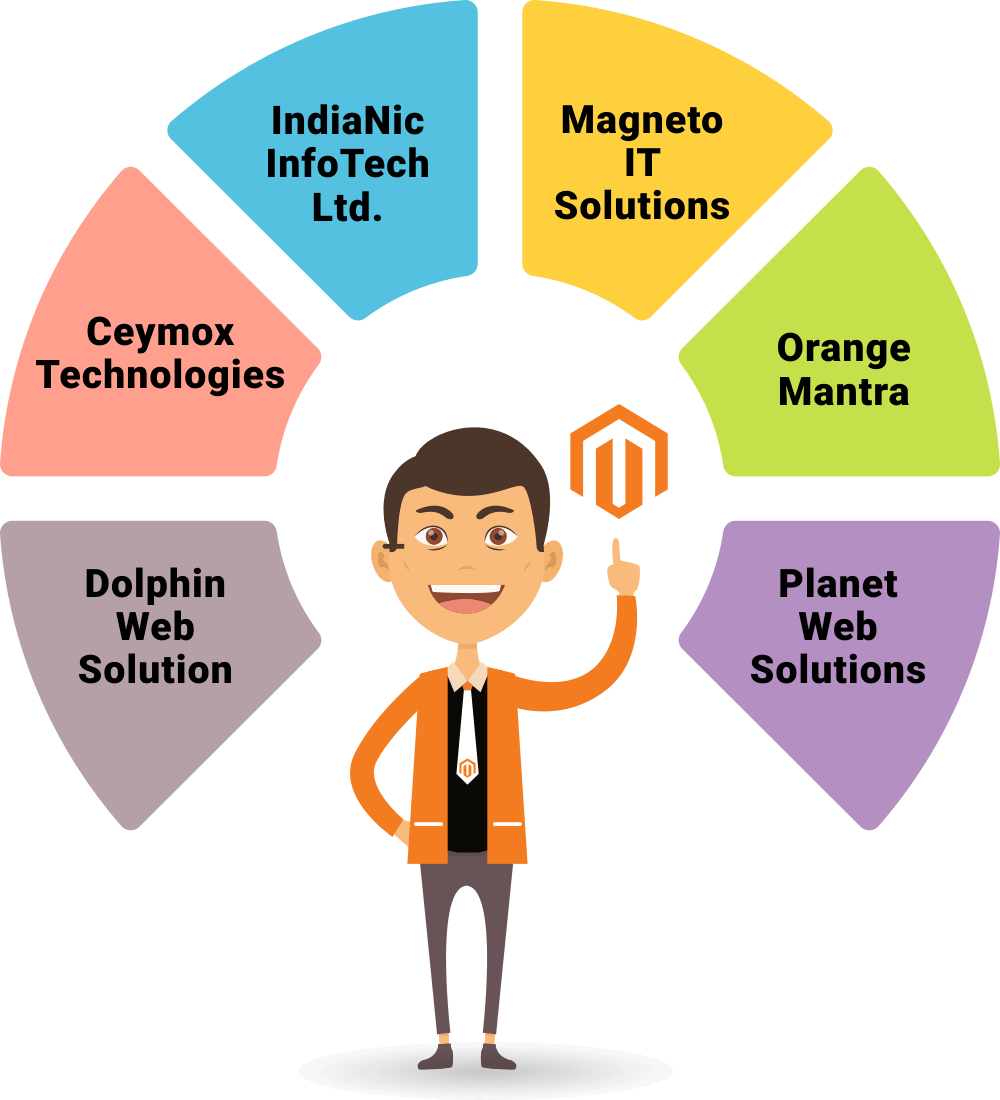
This content makes you aware of the significance of Magento as an eCommerce platform for businesses. It highlights the top Magento Development Companies in India, such as Ceymox Technologies, Magento IT Solutions, Orange Mantra, FutureSoft India and a few others.

For a new or existing business that wants to take its presence online or upgrade its existing eCommerce website, Shopify is one of the prominent options. However, Shopify’s website development cost is the largest endeavor for them.For Shopify website development there are a lot of costs involved apart from buying Shopify subscription plans such as themes, plugins, domains, and hiring professionals.
We would love to be a part of your journey to success. Let's team up today!