
FutureSoft Thought Leadership | AI Modernization • Enterprise Engineering • Commerce • Digital Experience • Growth
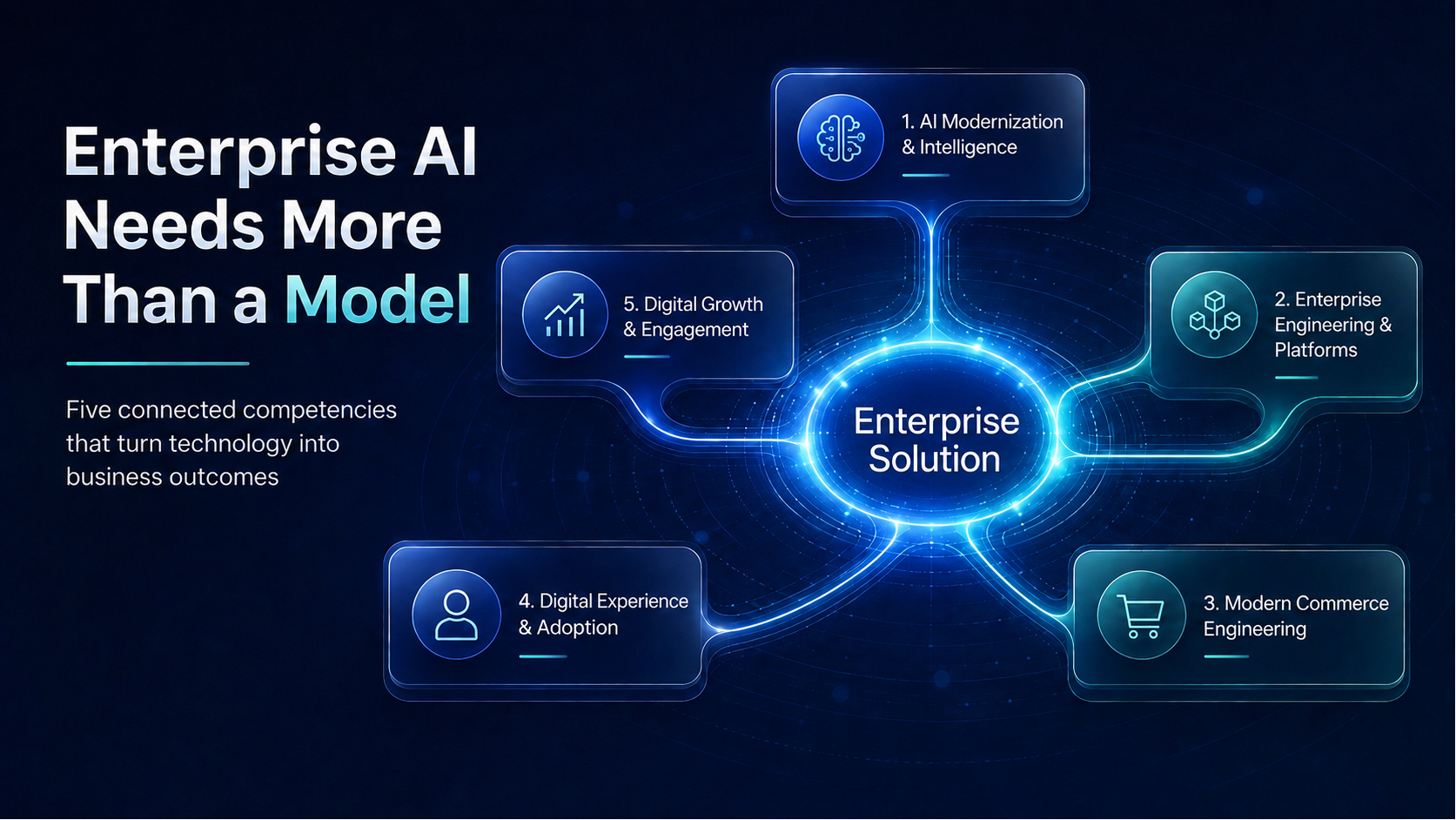
Enterprise AI is becoming easier to access. Turning it into measurable business value is not.
Organizations can increasingly use powerful AI models, cloud platforms and ready-made tools without building everything from scratch. Yet the real challenge begins after the technology is selected.
These are not purely AI questions. They are enterprise transformation questions.
That is why FutureSoft approaches transformation through five specialized but interconnected competencies:
Each can address a specific business requirement independently. But increasingly, the most valuable transformation initiatives cross the boundaries between them.
An AI model can generate, classify, predict, recommend or automate. But it cannot create enterprise value in isolation.
Consider an AI-enabled customer service initiative. The intelligence layer may understand a customer’s question. But delivering the answer could require access to CRM data, an order-management platform, product information, authentication services and business rules.
The customer still needs an intuitive interface through which to interact with the system. The experience needs to perform reliably across devices. Analytics must show whether customers are actually using it. And insights from those interactions can subsequently improve personalization, conversion and retention.
What initially looks like an AI project quickly becomes an AI + platform + experience + growth project.
This pattern is appearing across industries. Enterprise transformation is becoming interconnected because the enterprise itself is interconnected.
AI creates the intelligence layer. But enterprise AI should go beyond isolated proofs of concept, generic copilots or experimentation with large language models. Organizations increasingly need AI embedded into the way work actually happens.
The objective is not simply to deploy AI. It is to make AI useful, governed and operational within the enterprise. And doing that immediately connects AI with the next competency.
AI depends on the enterprise technology around it. Legacy applications, fragmented integrations, disconnected databases and rigid platforms can restrict what even highly capable AI systems can achieve. Enterprise engineering therefore becomes part of AI readiness.
AI can provide intelligence. Enterprise engineering makes that intelligence usable inside real systems and processes.
For commerce businesses, technology eventually has to meet the customer at a buying decision. Modern commerce environments are no longer simply storefronts. They increasingly combine product discovery, personalization, search, recommendations, inventory, pricing, payments, content and post-purchase engagement.
AI can enhance many of these areas, but it must connect cleanly into the commerce stack. The goal is not merely to operate an ecommerce platform. It is to engineer commerce environments that can adapt, integrate and scale with the business.
A technically successful transformation can still fail if people do not use it. That applies to customers, employees, partners and other users. Whether an organization introduces AI, modernizes an enterprise platform or redesigns its commerce journey, the technology ultimately reaches people through an experience.
Technology capability tells us what a system can do. Digital experience determines whether people can and will use it. AI makes that distinction even more important: the more sophisticated the underlying technology becomes, the simpler the user experience often needs to become.
A great digital experience is valuable. A great digital experience that continually attracts, converts and retains the right audience is considerably more valuable. That is where Digital Growth & Engagement completes the picture.
AI increasingly strengthens all of these capabilities. But once again, AI itself is only part of the answer. Growth occurs when intelligence is connected with experience and execution.
The relationship between the five competencies can be understood simply:
But this should not be interpreted as a rigid sequence. A transformation initiative can begin anywhere.
A company may need only application modernization. Another may need commerce engineering. Another may approach FutureSoft for SEO, user experience or an AI initiative. The advantage of connected competencies appears when the challenge expands.
A commerce modernization program may expose an experience problem. An experience initiative may uncover performance or platform limitations. An AI project may require application modernization. A growth program may identify opportunities for personalization that require both AI and engineering.
The competencies are specialized enough to stand independently and connected enough to work together.
It changes the question organizations should ask. Instead of asking “Which AI model should we use?”, the more valuable questions increasingly become:
Those questions naturally extend beyond AI. They connect strategy with engineering, engineering with experience, experience with commerce and commerce with growth.
This is why FutureSoft believes modern transformation requires both depth and connectivity. You may need one specialized capability today. The architecture should still allow tomorrow’s opportunity to connect with it.
The next phase of enterprise transformation will not be determined solely by who has access to the latest technology. Access is becoming increasingly democratized.
Differentiation will come from how effectively organizations can integrate technology into their systems, workflows, customer journeys and operating models.
That requires more than AI. It requires engineering. It requires experience. It requires commerce. It requires growth. And increasingly, it requires these disciplines to work together rather than operate as isolated technology silos.
That thinking sits behind FutureSoft’s five core competencies.
Specialized capabilities. Engineered to work together.
Explore FutureSoft’s competencies or talk to us about the business challenge you are trying to solve.
Explore CompetenciesEnterprise AI modernization is the process of integrating AI into existing applications, data, workflows and technology platforms so that AI can deliver practical business outcomes rather than remain an isolated experiment.
AI often needs access to enterprise applications, APIs, data and workflows. Enterprise engineering provides the architecture and integrations required for AI to operate securely and reliably within real business processes.
Users interact with AI through digital experiences. Clear interfaces, intuitive workflows, accessibility and performance can determine whether employees and customers successfully adopt an AI-enabled solution.
AI can support ecommerce through product discovery, recommendations, personalization, customer assistance, search and automation. Commerce engineering connects these capabilities with product data, platforms and transaction journeys.
FutureSoft’s five core competencies are AI Modernization & Intelligence, Enterprise Engineering & Platforms, Modern Commerce Engineering, Digital Experience & Adoption, and Digital Growth & Engagement.
Yes. Each competency can address a standalone requirement. Multiple competencies can also be brought together when a transformation challenge crosses technology, commerce, experience or growth boundaries.
Stay Connected to Global Success